
ANCIENT EGYPT · DENDERA · LUXOR
A carved sky map from the last centuries of ancient Egypt, and the temple near Luxor where its story began.
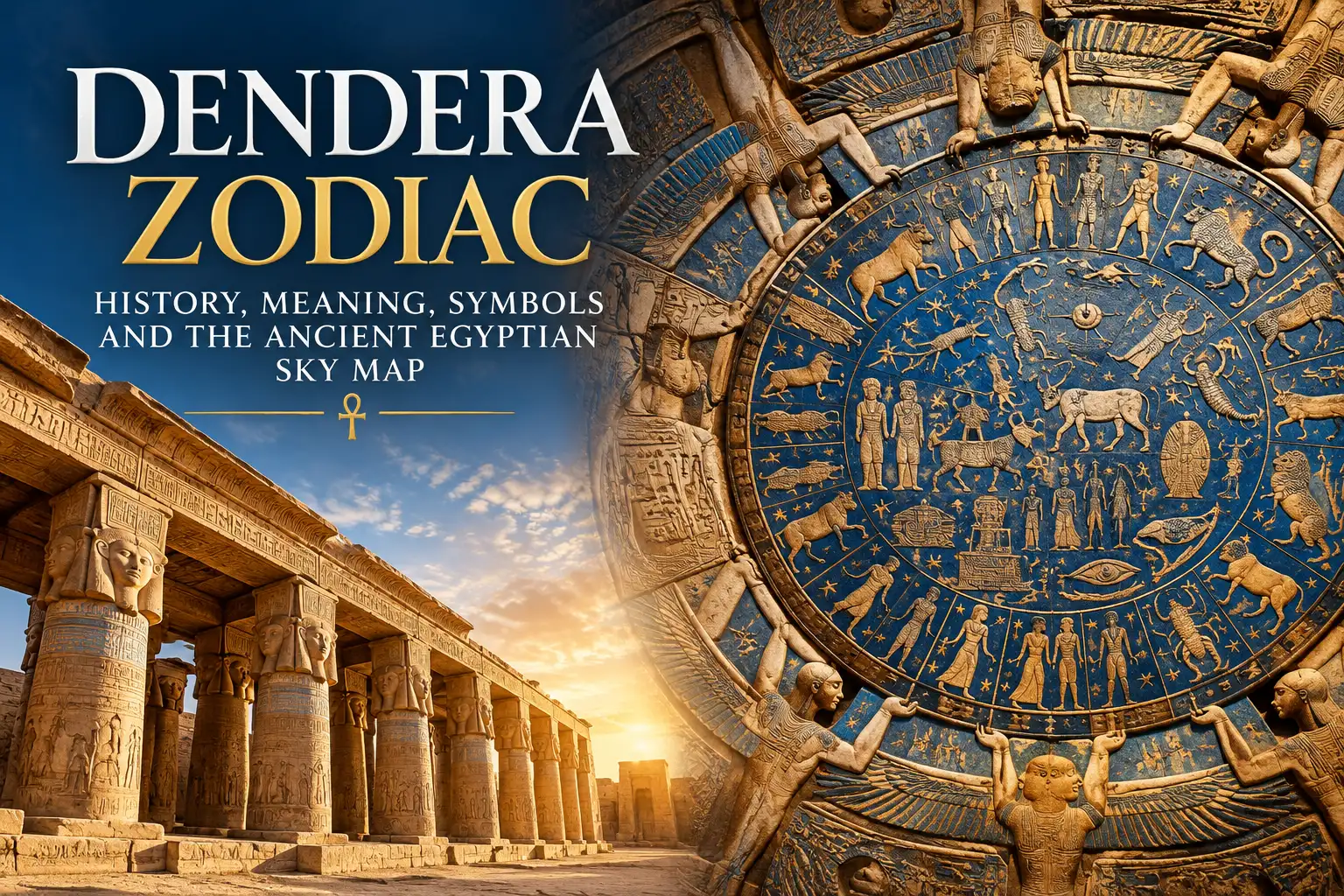
Quick answer: The Dendera Zodiac is a circular sandstone relief carved around 50 BCE for an Osiris chapel in the Temple of Hathor at Dendera, Egypt. The original is now displayed at the Louvre Museum in Paris, while the temple that once held it can still be visited from Luxor.
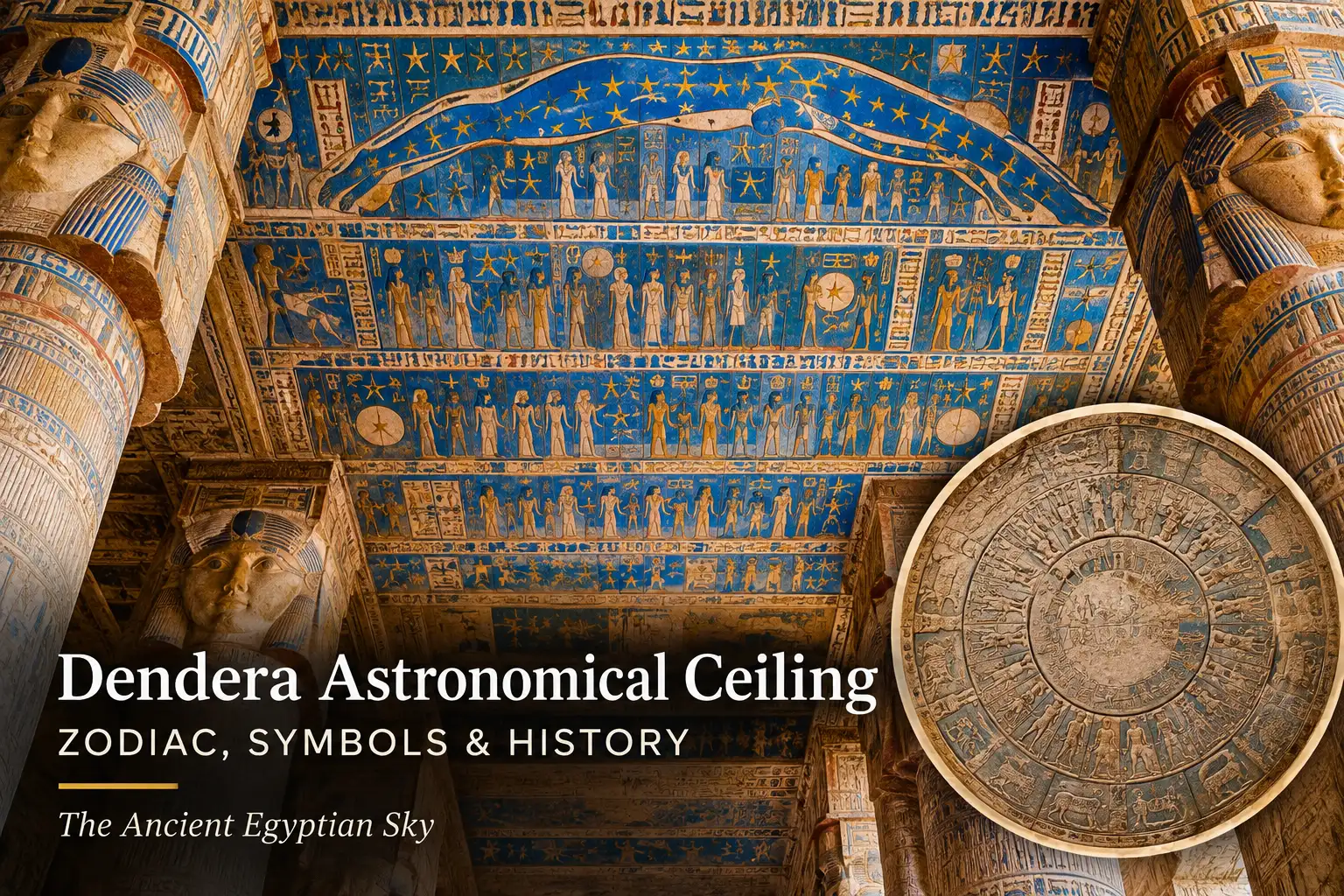
The Dendera Zodiac is one of ancient Egypt’s most fascinating surviving representations of the heavens. Carved into sandstone around 50 BCE, this extraordinary circular relief brings together the twelve zodiacal constellations, planetary figures, Egyptian astronomical traditions, and religious symbolism in a single celestial composition.
Originally located on the ceiling of an Osiris chapel within the Temple of Hathor at Dendera, the zodiac is now displayed in the Louvre Museum in Paris. Its unusual design offers a revealing glimpse into how Egyptian priests understood the relationship between the sky, sacred time, and the divine world.
c. 50 BCE
Carved in the late Ptolemaic period
2.55 × 2.53 m
Size of the sandstone relief
Room 325
Louvre, Sully Wing, Paris
Dendera
Temple of Hathor, near Luxor
Unlike modern zodiac charts, which are usually associated with personality traits and horoscopes, the Dendera Zodiac belongs to a much broader religious and astronomical tradition. Its symbols reflect both ancient Egyptian celestial knowledge and the growing influence of Greek astronomy during the Ptolemaic period.
Understanding this remarkable monument means looking beyond its familiar astrological figures. Its history, artistic details, and original temple setting tell a story about astronomy, religious belief, and cultural exchange in the final centuries of ancient Egyptian civilization.
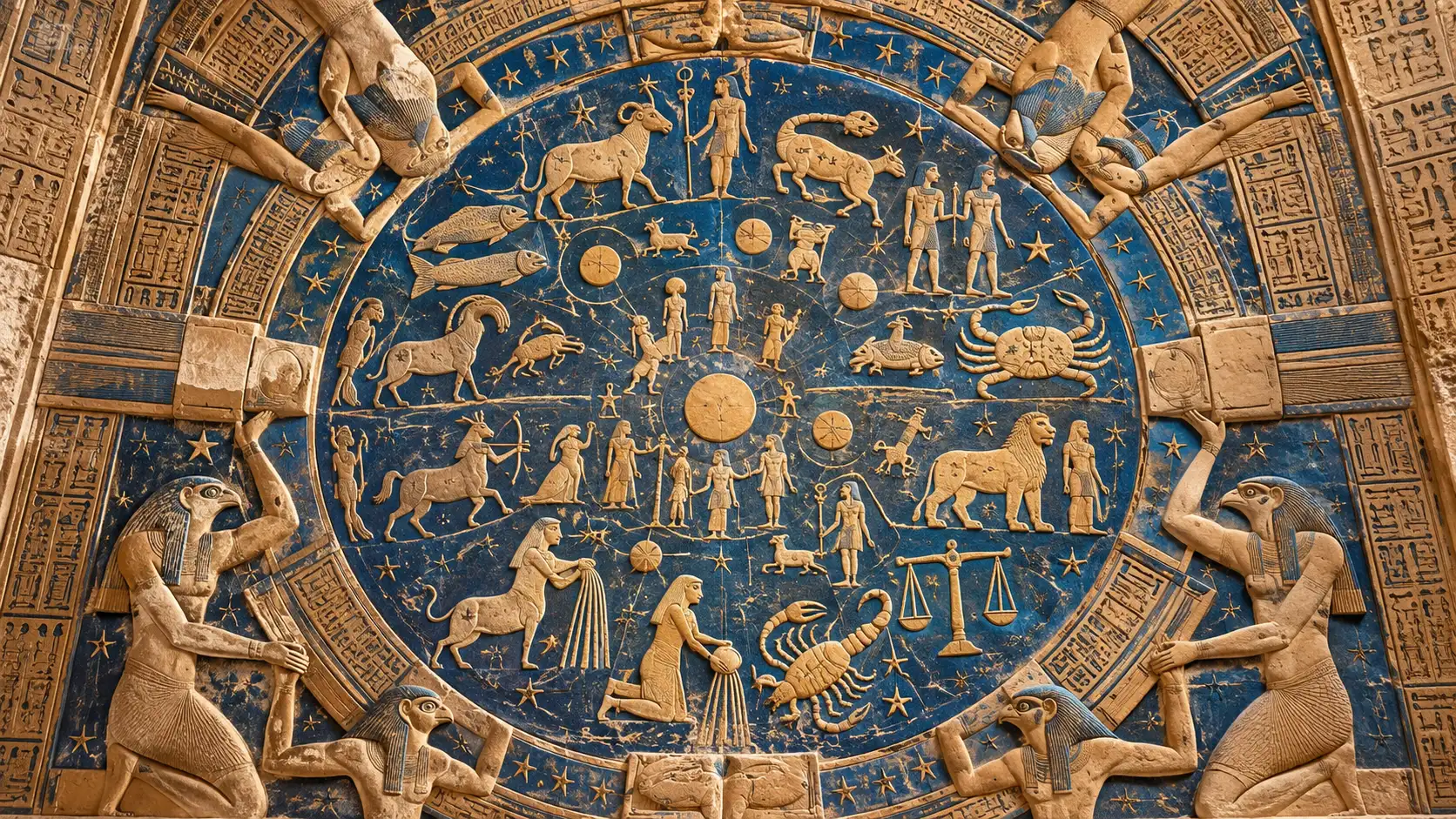
The Dendera Zodiac, originally carved for an Osiris chapel at Dendera and now preserved in the Louvre Museum, Paris.
Louvre Museum collection record
What Is the Dendera Zodiac?
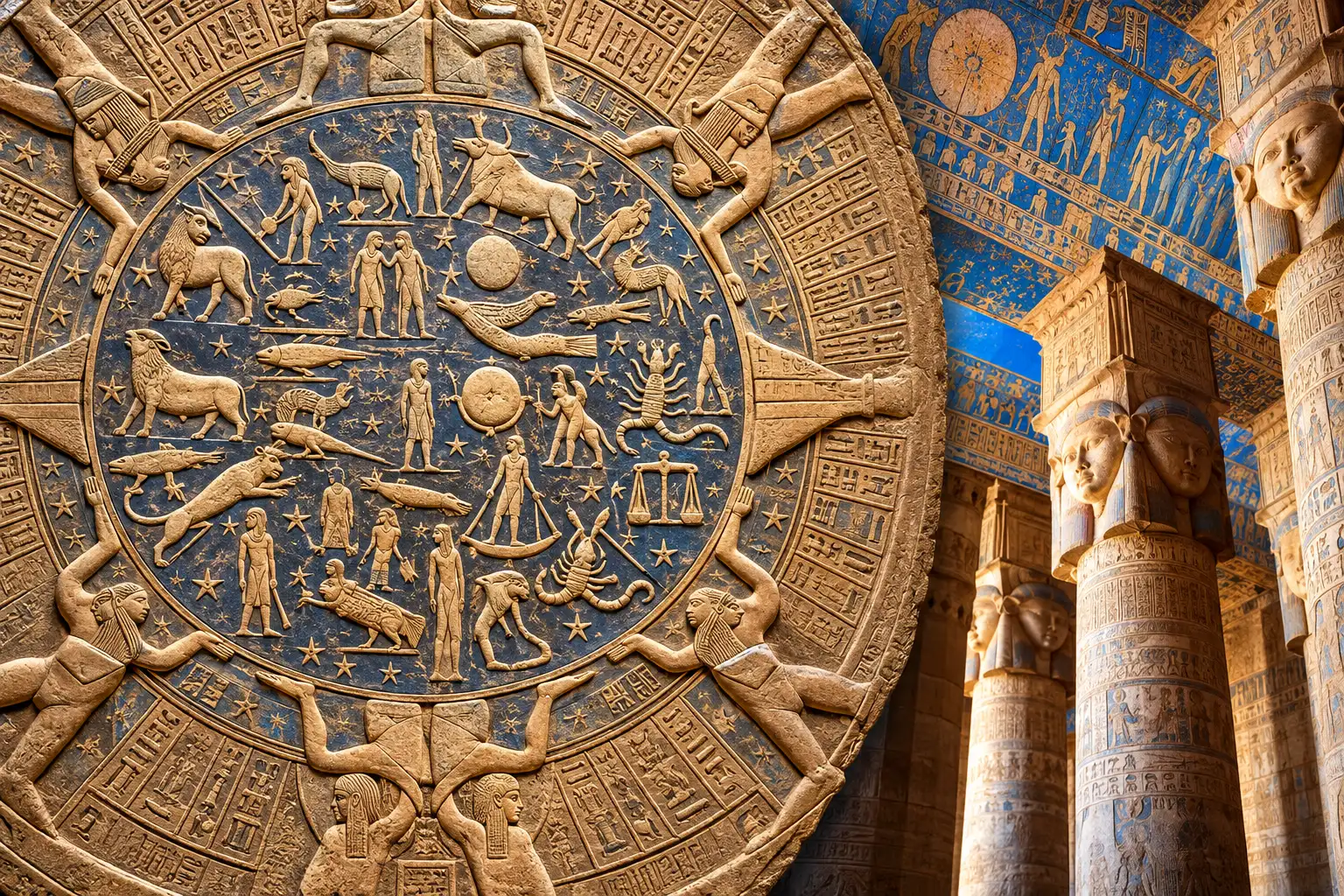
The Dendera Zodiac is a circular sandstone bas-relief representing a symbolic arrangement of the heavens. The relief includes zodiacal constellations, astronomical figures, decans, planetary imagery, and deities associated with the Egyptian understanding of the cosmos.
Its circular composition distinguishes it from many earlier Egyptian astronomical ceilings, which commonly arranged stars and celestial figures in rectangular registers.
The monument measures approximately 2.55 by 2.53 metres (8.4 by 8.3 feet), according to the Louvre’s collection record. Its central circular design is surrounded by divine figures that appear to support the heavenly composition.
Several astronomical and religious systems coexist in the artwork. Some figures are recognizable through the classical zodiac, while others belong to much older Egyptian traditions. Together, they illustrate a period when Egyptian and Hellenistic ideas were being expressed within the same sacred setting.
Dendera Zodiac at a Glance
| Feature | Details |
|---|---|
| Name | Dendera Zodiac |
| Original location | Osiris chapel, Temple of Hathor, Dendera |
| Date | Around 50 BCE |
| Historical period | Late Ptolemaic |
| Material | Sandstone |
| Dimensions | 255 × 253 cm |
| Main subjects | Zodiacal constellations, decans, planets, celestial deities |
| Documented in modern times | January 24, 1799 |
| Removed from Egypt | 1821 |
| Current location | Louvre Museum, Paris |
| Louvre inventory | E 13482 |
Source: Louvre Museum official collection record.
Dendera Zodiac History: From Ancient Egypt to the Louvre
The Dendera Zodiac During the Ptolemaic Period
The Dendera Zodiac dates to the late Ptolemaic period, when Egypt was ruled by a dynasty of Greek origin that began with Ptolemy I following Alexander the Great’s conquest.
Although the ruling dynasty had Greek roots, Egyptian temple worship and artistic traditions continued. Priests maintained established religious practices, while Greek astronomical and zodiacal concepts became increasingly influential.
The zodiac belongs to this cultural environment.
The Louvre dates the relief to approximately 50 BCE, during the reign of Cleopatra VII and the period of her co-ruler Ptolemy XIII. This makes it a monument of Egypt’s final decades under the Ptolemaic dynasty.
The artwork does not indicate that the Egyptians suddenly adopted an entirely new understanding of the sky. Instead, its design shows the integration of zodiacal imagery into an existing Egyptian religious and astronomical framework.
The Discovery of the Dendera Zodiac in 1799
The Dendera Zodiac entered European scholarly discussion during Napoleon Bonaparte’s Egyptian campaign.
According to the Louvre, the relief was documented on January 24, 1799, by members of the French expedition, including General Desaix, Louis Pierre Aimé Chastel, and Dominique Vivant Denon.
Its unusual circular arrangement attracted the attention of European scholars, who debated its age and astronomical interpretation.
These discussions formed part of a wider effort to understand ancient Egyptian monuments before the decipherment of hieroglyphs transformed the study of Egyptian civilization.
Why Was the Dendera Zodiac Removed from Egypt?
The original relief remained within the Temple of Hathor until the early nineteenth century.
In 1820, Sébastien Louis Saulnier arranged for Jean-Baptiste Lelorrain to travel to Egypt to obtain the monument.
The Louvre records that the removal was authorized by Muhammad Ali through a decree dated January 27, 1821. The sandstone relief was detached from its original ceiling in April–May 1821, transported from Alexandria to France, and reached Paris in January 1822.
King Louis XVIII purchased it in April 1822.
The zodiac was subsequently displayed at the Louvre, transferred to the Royal Library, and returned to the Louvre in 1919.
Although the Louvre documents the historical authorization and purchase, those records do not settle contemporary questions about the removal of Egyptian antiquities during the nineteenth century.
Today, the monument’s history is part of the broader conversation about archaeological heritage and the relationship between museums and countries of origin.
Dendera Zodiac Timeline
c. 50 BCE
Carved for an Osiris chapel in the Temple of Hathor
24 Jan 1799
Documented by members of the French expedition
1821
Removed after Muhammad Ali’s decree of 27 January 1821
April 1822
Purchased by King Louis XVIII, now in the Louvre
Dendera Zodiac Meaning: What Does the Ancient Sky Map Represent?
The central meaning of the Dendera Zodiac lies in its representation of the heavens as an ordered and sacred realm.
For ancient Egyptians, celestial movements were closely connected with religious beliefs, seasonal cycles, and the measurement of time. The sky was not treated simply as a collection of distant objects; celestial phenomena also belonged to the divine structure of the universe.
The zodiac combines three important themes.
1. The Order of the Cosmos
Egyptian religion emphasized the maintenance of ma’at, a concept encompassing order, balance, justice, and cosmic harmony.
Within this religious worldview, the regular movement of celestial bodies provided a powerful expression of an ordered universe.
The Dendera Zodiac can be understood within this broader tradition, although scholars continue to examine the precise interpretation of particular figures and their relationships.
2. The Measurement of Sacred Time
Astronomical observation helped Egyptian priests organize calendars, religious celebrations, and aspects of temple ritual.
The zodiac incorporates celestial figures associated with the divisions of time, including the decans, whose history extends much further back than the introduction of the twelve-sign zodiac.
3. The Relationship Between Egyptian and Greek Traditions
One of the monument’s most distinctive features is its combination of Egyptian imagery with zodiacal constellations associated with Hellenistic astronomy.
Rather than separating these systems, the artists brought them into a shared composition.
This makes the Dendera Zodiac an especially important source for studying the interaction between Egyptian religious traditions and the wider Mediterranean world.
Dendera Zodiac Symbols and Their Meanings
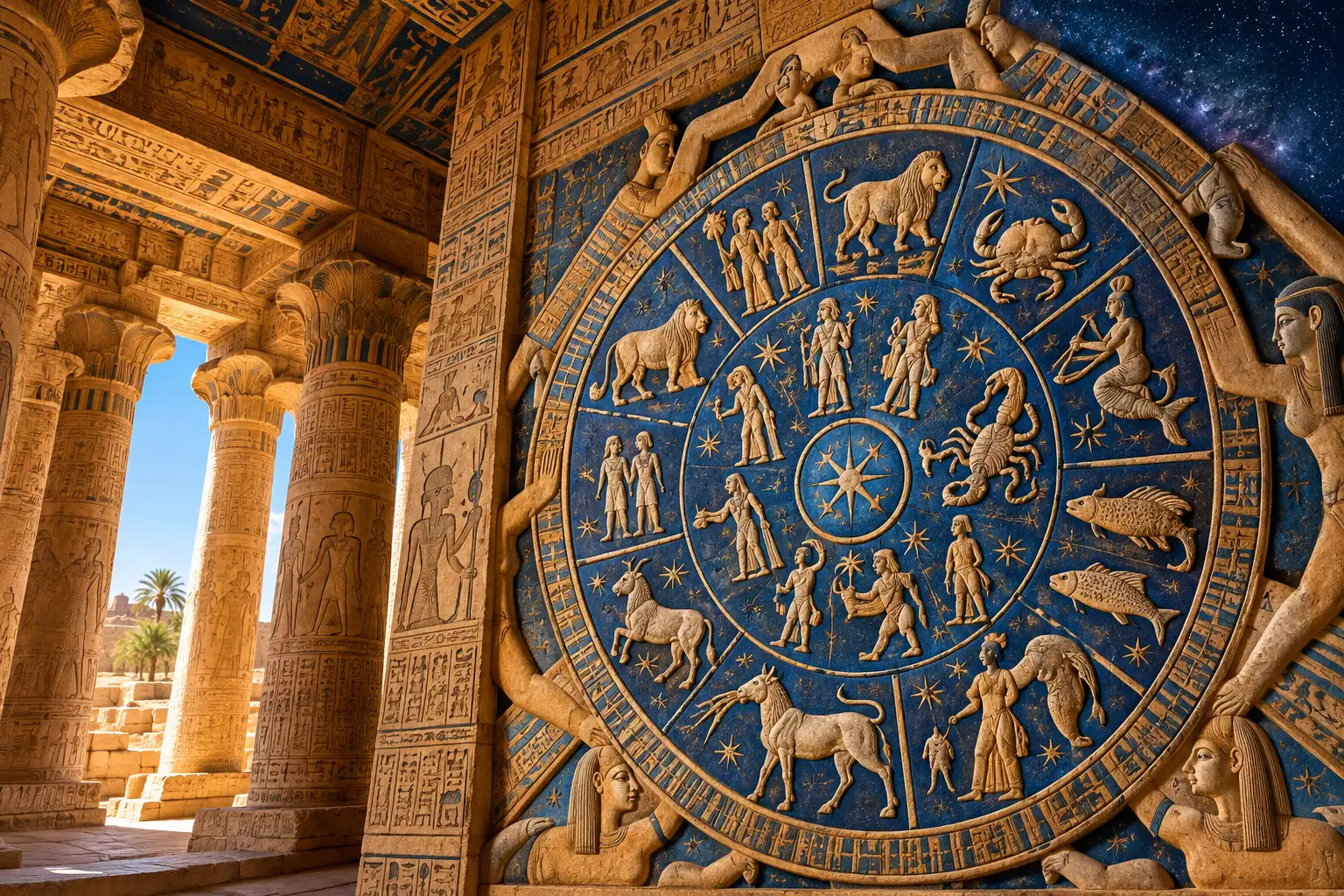
The carvings can initially seem difficult to interpret. Animals, human figures, sacred beings, and unfamiliar astronomical signs appear close together, without the layout of a modern star chart.
However, several groups of symbols help explain the design.
The Twelve Zodiac Signs
The central circular composition incorporates the twelve zodiacal constellations familiar from the classical zodiac.
These include:
Aries, Taurus, Gemini, and Cancer
Leo, Virgo, Libra, and Scorpio
Sagittarius, Capricorn, Aquarius, and Pisces
Some figures are relatively easy to recognize, including the bull associated with Taurus and the scales representing Libra.
Others are integrated into more complex scenes that reflect Egyptian artistic traditions.
Their presence does not mean that the relief functioned like a modern personal horoscope. The figures formed part of a religious celestial image, and the specific purpose of the complete composition remains a subject of scholarly interpretation.
The 36 Decans
Among the most important features of the Dendera Zodiac are the 36 decans.
Decans were groups of stars or celestial markers used in Egyptian timekeeping. They were associated with approximately ten-day divisions of the year and with the progression of nighttime hours.
The traditional Egyptian civil calendar contained twelve months of thirty days, plus five additional days. Thirty-six ten-day periods therefore account for its 360 regular days.
The decans illustrate the continuity between older Egyptian astronomical traditions and the later zodiacal system represented at Dendera.
Planetary Representations
The zodiac also includes representations associated with the five planets visible to the unaided eye:
Mercury, Venus, Mars, Jupiter, and Saturn.
These planets were known to ancient astronomers long before telescopes existed. Their changing positions against the background of stars made them significant subjects of observation.
Researchers have studied the monument’s planetary imagery to investigate the astronomical circumstances represented in the relief.
However, determining whether every celestial detail records one specific observation or has a primarily symbolic role requires careful interpretation.
Divine Figures Supporting the Heavens
The central circular field is surrounded by supporting figures.
The Louvre identifies four standing women and eight kneeling falcon-headed gods within the composition.
Their arrangement reinforces the sacred character of the heavens and visually connects the astronomical scene with Egyptian religious iconography.
Dendera Zodiac Astronomy: How Accurate Is the Ancient Sky Map?
The Dendera Zodiac demonstrates that astronomically recognizable constellations and celestial phenomena were incorporated into Egyptian temple decoration.
Yet its function is different from that of a contemporary astronomical map.
A modern star chart generally aims to show celestial objects according to observable positions or coordinates. The Dendera relief combines recognizable astronomical relationships with religious symbolism and artistic conventions.
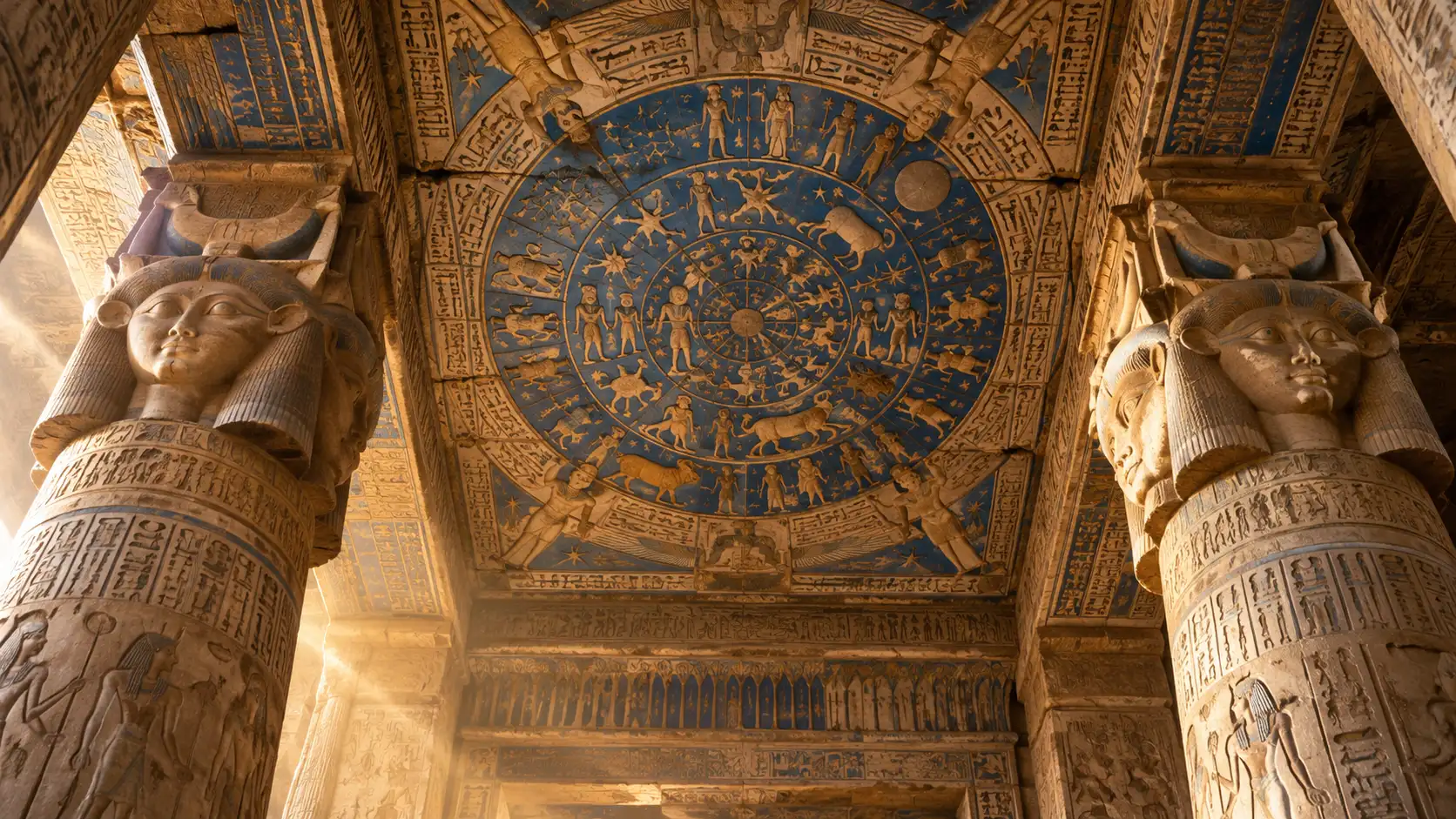
The circular planisphere makes it possible to examine ancient representations of the sky, but it should not be interpreted as a scientifically precise projection of every visible star.
Astronomical research has nevertheless played an important role in studying the relief’s date.
Research published by the French Institute of Oriental Archaeology, including work by Éric Aubourg, has examined the monument’s astronomical imagery and its possible chronological significance.
Does the Dendera Zodiac Show an Eclipse?
Some researchers have interpreted particular circular symbols on the relief as references to eclipses.
These interpretations have contributed to astronomical attempts to date the monument. However, identifying an image as a particular historical eclipse is not the same as establishing that interpretation beyond doubt.
The safest conclusion is that the relief contains astronomical imagery from which researchers have proposed specific celestial events. Not every suggested identification is universally accepted.
Is the Dendera Zodiac Connected to Modern Astrology?
The Dendera Zodiac contains familiar zodiacal figures, but its historical setting is considerably different from modern popular astrology.
It is important to distinguish three subjects:
| Subject | Main focus |
|---|---|
| Ancient Egyptian astronomy | Observation and organization of celestial phenomena |
| Ancient zodiacal astrology | Interpretation of celestial arrangements within historical belief systems |
| Modern popular horoscopes | Interpretations often based on an individual’s zodiac sign |
The Dendera Zodiac and Cleopatra VII
Because the monument is dated to approximately 50 BCE, its creation falls within the reign of Cleopatra VII, Egypt’s last active Ptolemaic ruler.
This historical connection has made the Dendera Zodiac particularly interesting to readers exploring Cleopatra’s Egypt.
The Louvre’s dating associates the relief with the period of Cleopatra VII and Ptolemy XIII.
Where Is the Original Dendera Zodiac Today?
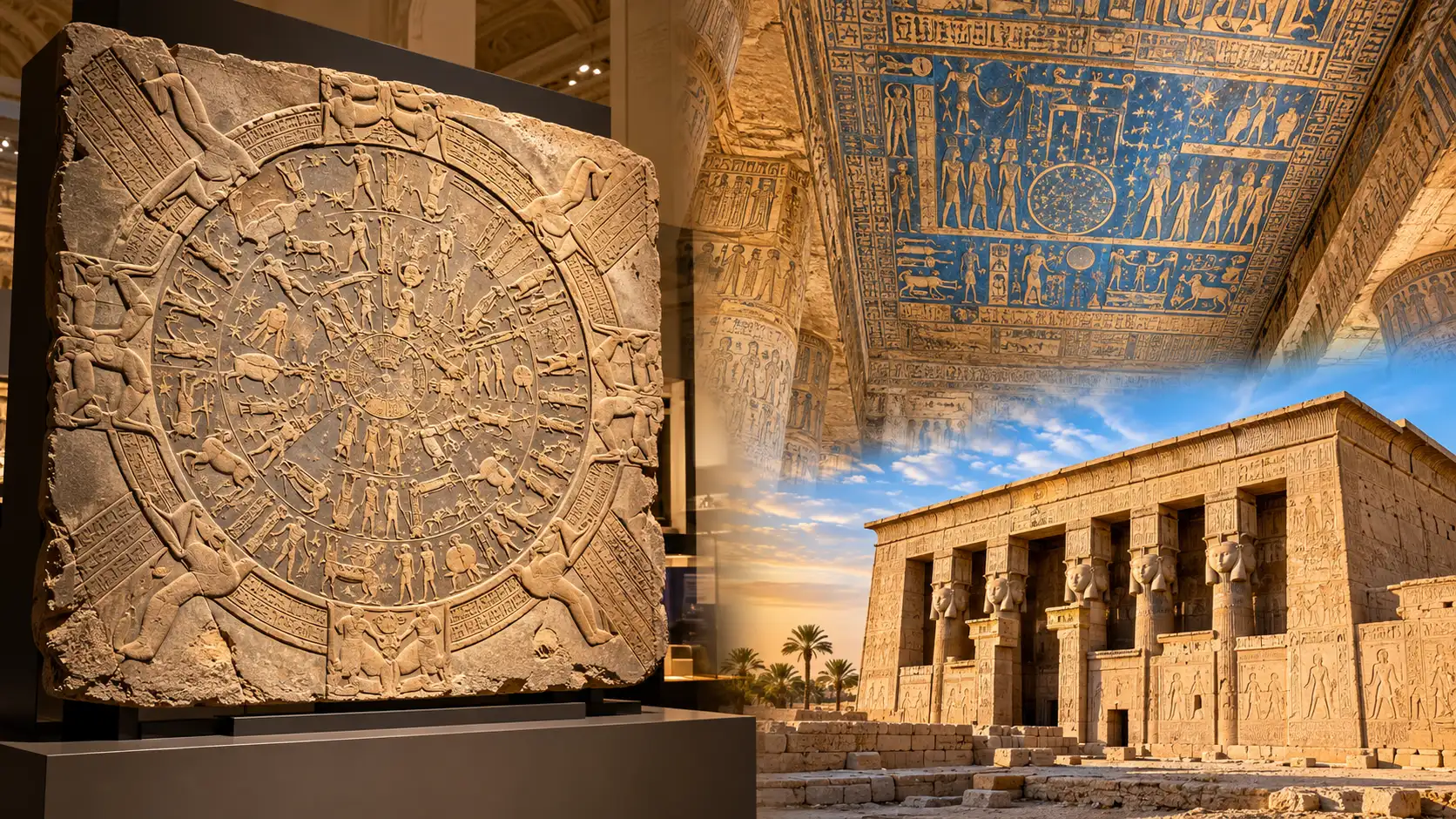
The original Dendera Zodiac is currently displayed at the Louvre Museum in Paris.
The official Louvre collection lists its location as Room 325, Sully Wing, Level 0, within the Egyptian Antiquities Department.
Its inventory number is E 13482. Visitors can consult the official Louvre collection entry for photographs and object documentation. Gallery arrangements may change, so checking the museum before visiting is advisable.
Can You Still See the Dendera Zodiac in Egypt?
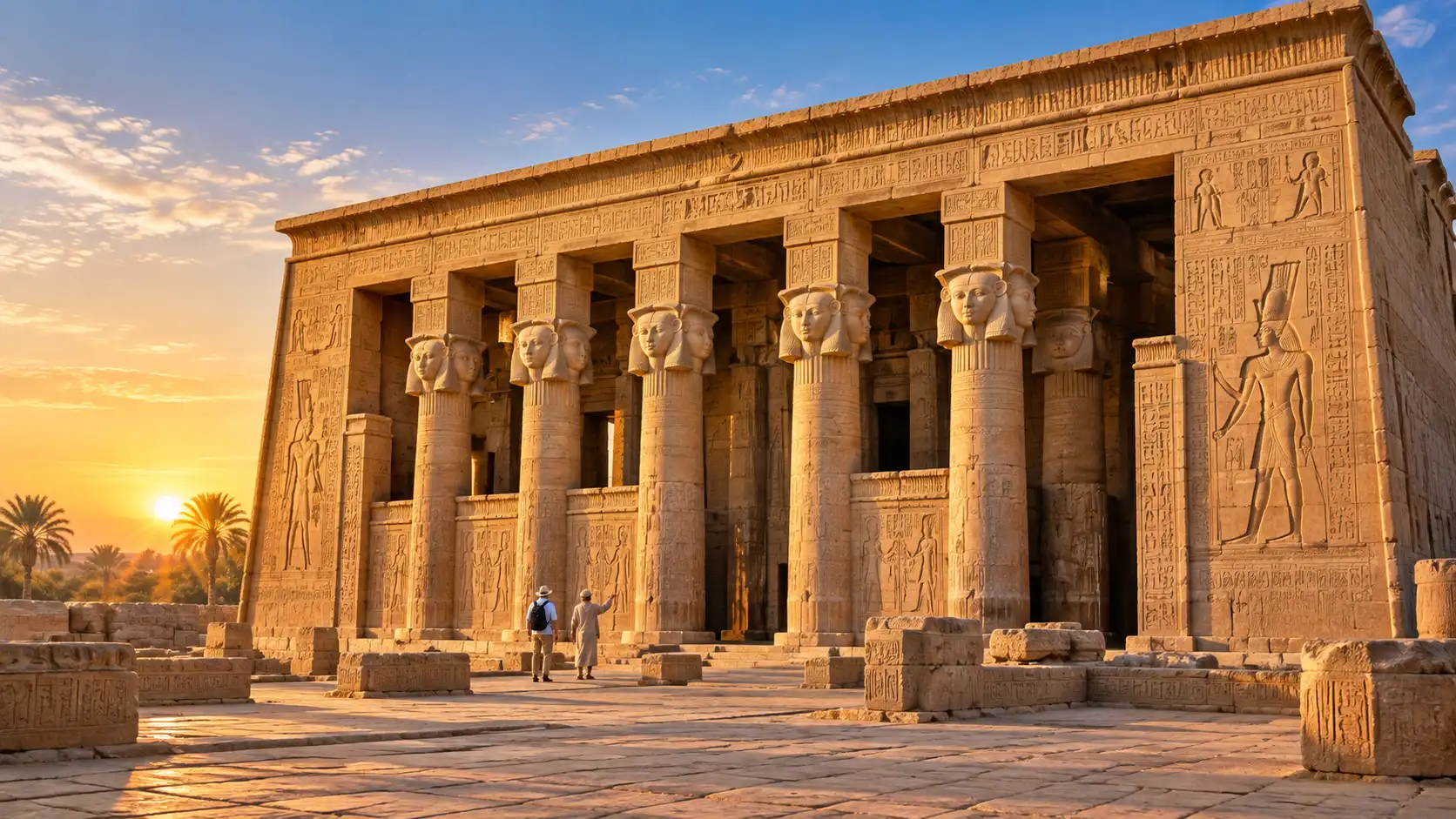
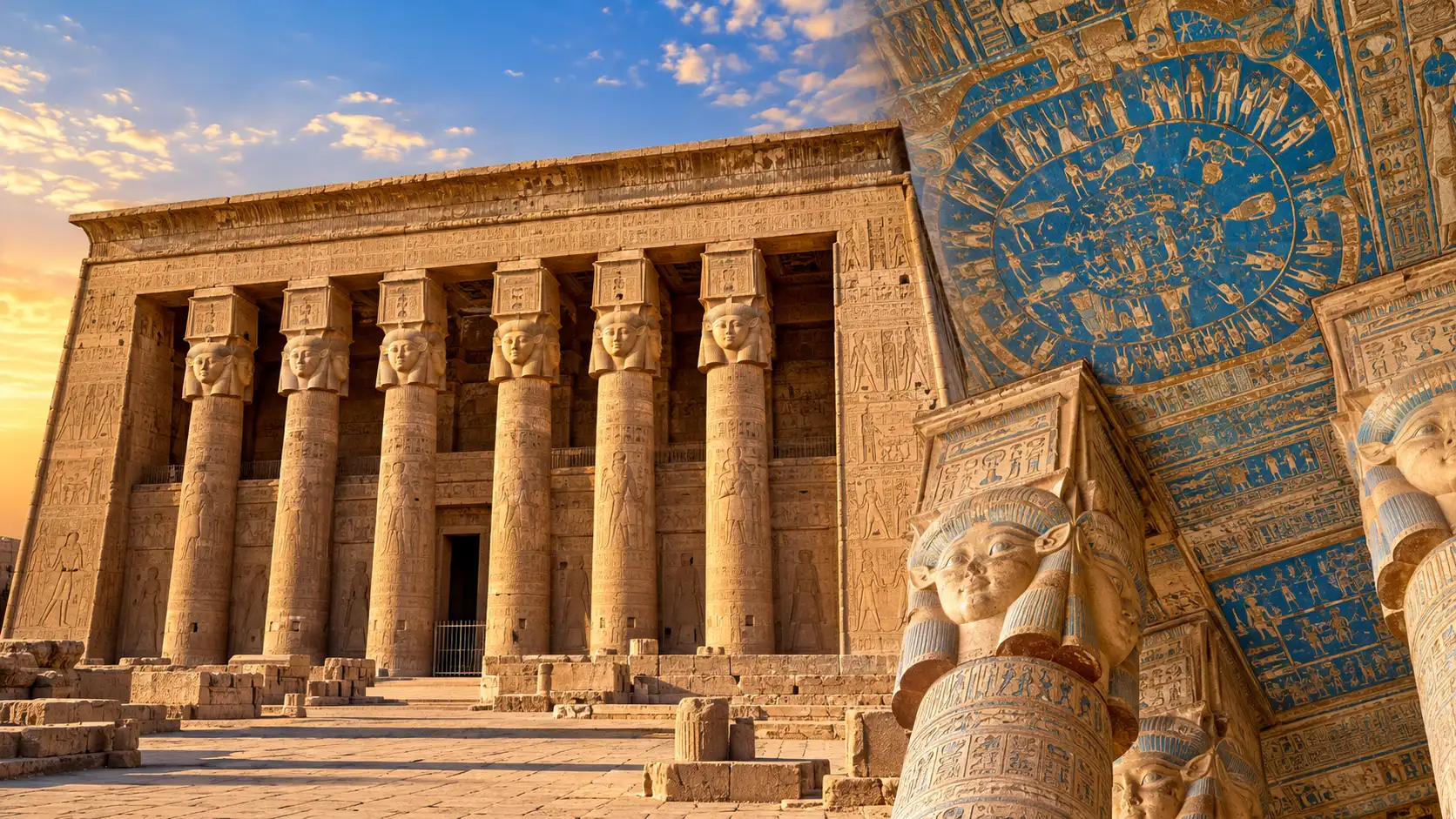
Although the original circular relief is in France, its architectural and religious setting remains at the Temple of Hathor in Dendera.
A replacement reproduction is associated with the original chapel ceiling, allowing visitors to understand where the ancient artwork was positioned.
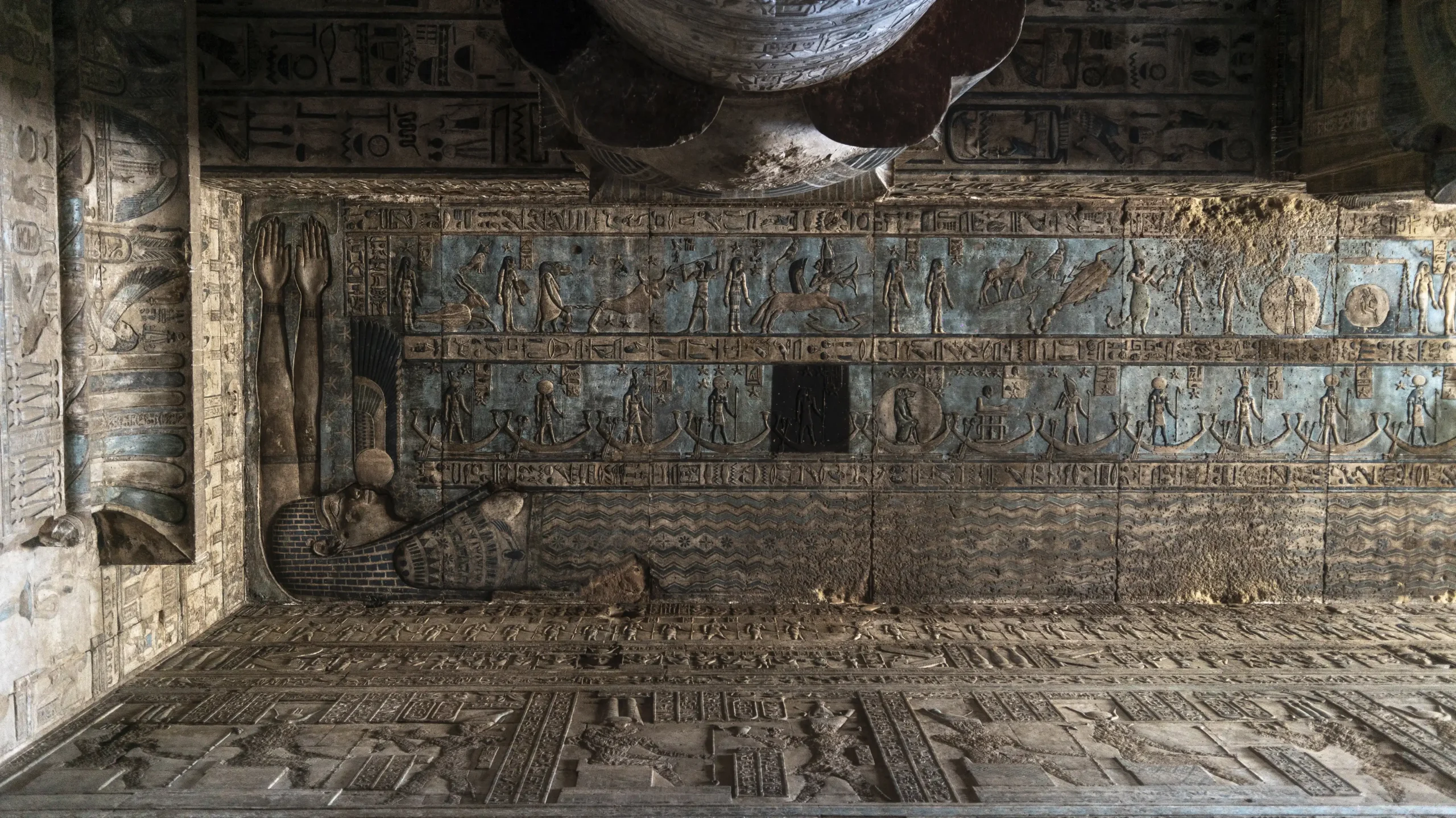
The temple also contains extensive astronomical and religious decorations, including ceiling scenes that preserve important elements of Egyptian celestial imagery.
It is essential to distinguish the original circular zodiac from the other astronomical ceilings at Dendera. Not every decorated ceiling showing stars, deities, or celestial symbols is a copy of the famous relief.
Visiting Dendera Temple to Understand the Zodiac
For travelers interested in ancient Egyptian astronomy, visiting the Temple of Hathor offers a perspective that museum photographs cannot fully provide.
The zodiac was originally part of a religious building, closely connected to temple architecture and ceremonies honoring Egyptian deities.
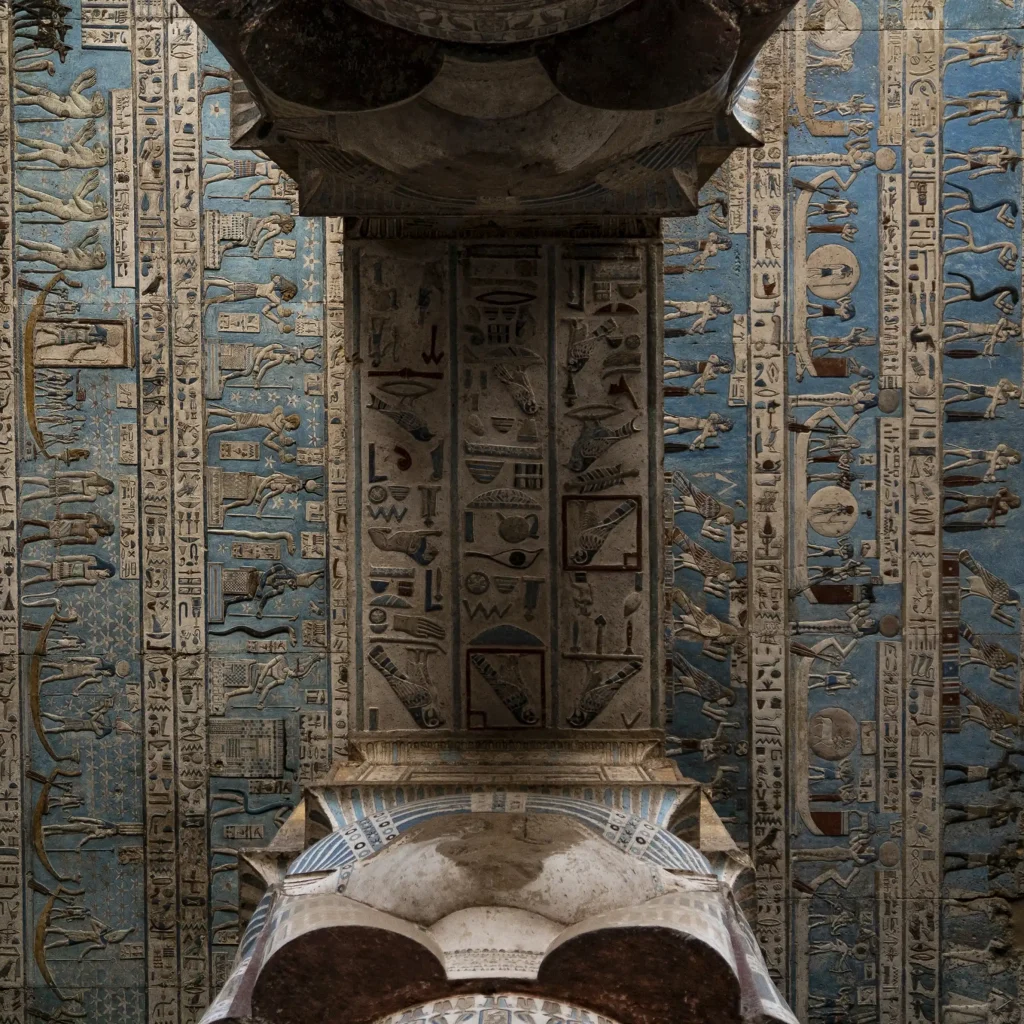
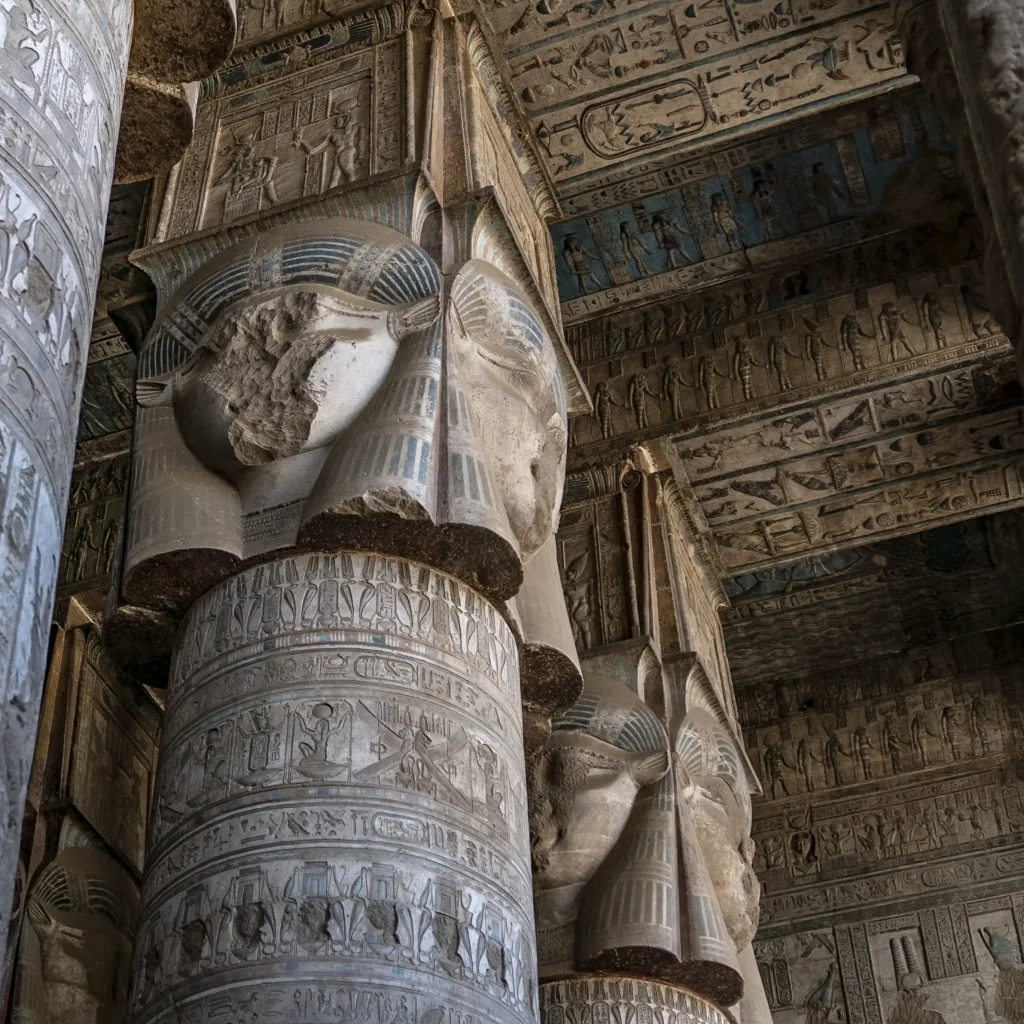
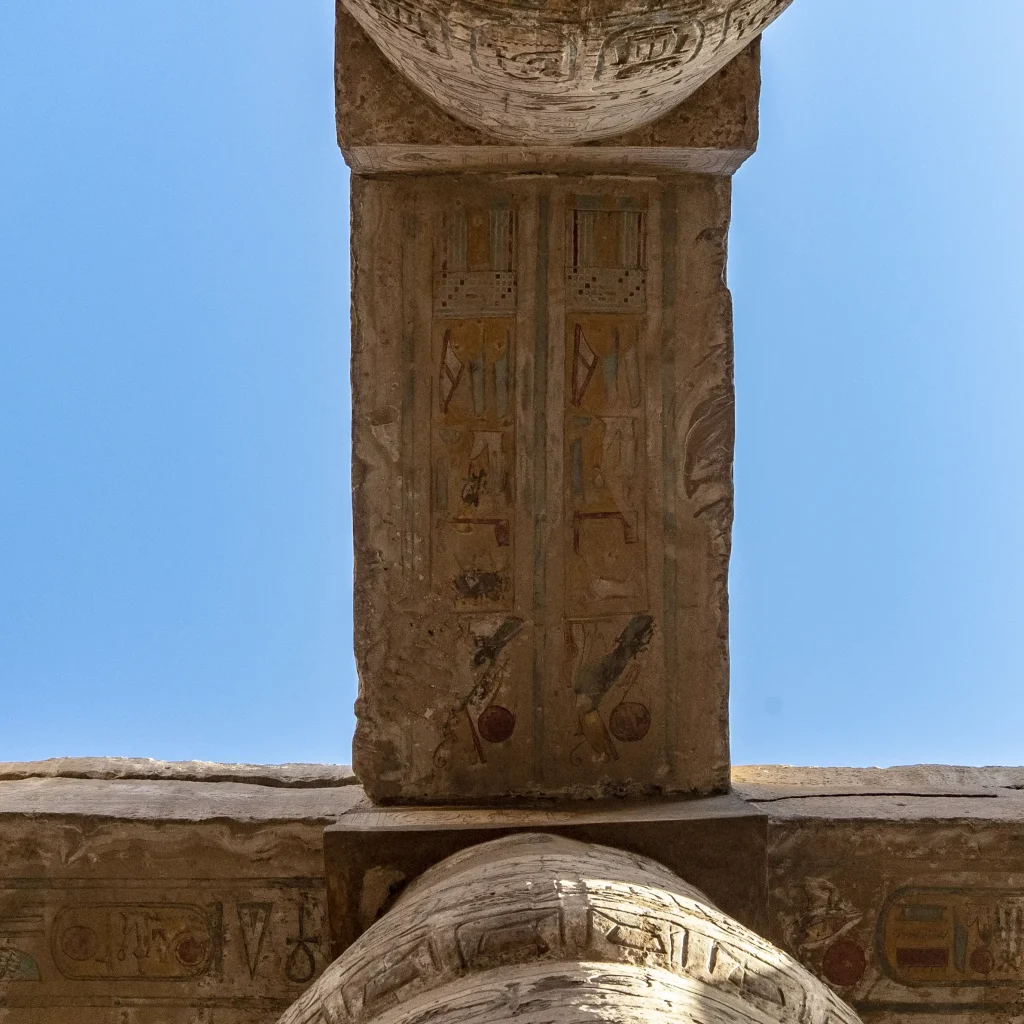
Seeing the wider complex makes it easier to appreciate that its astronomical representations were not isolated works of art. They belonged to a coordinated environment of religious imagery and architectural symbolism.
At Dendera, visitors can examine the temple’s decorated columns, religious reliefs, and richly detailed astronomical ceilings.
The contrast between the surviving temple decorations and the zodiac displayed in Paris also illustrates how the physical context of an ancient object can contribute to its interpretation.
Dendera Temple Tours from Luxor
For travelers staying in Luxor, Egypt Luxury Trips offers two relevant private excursions.
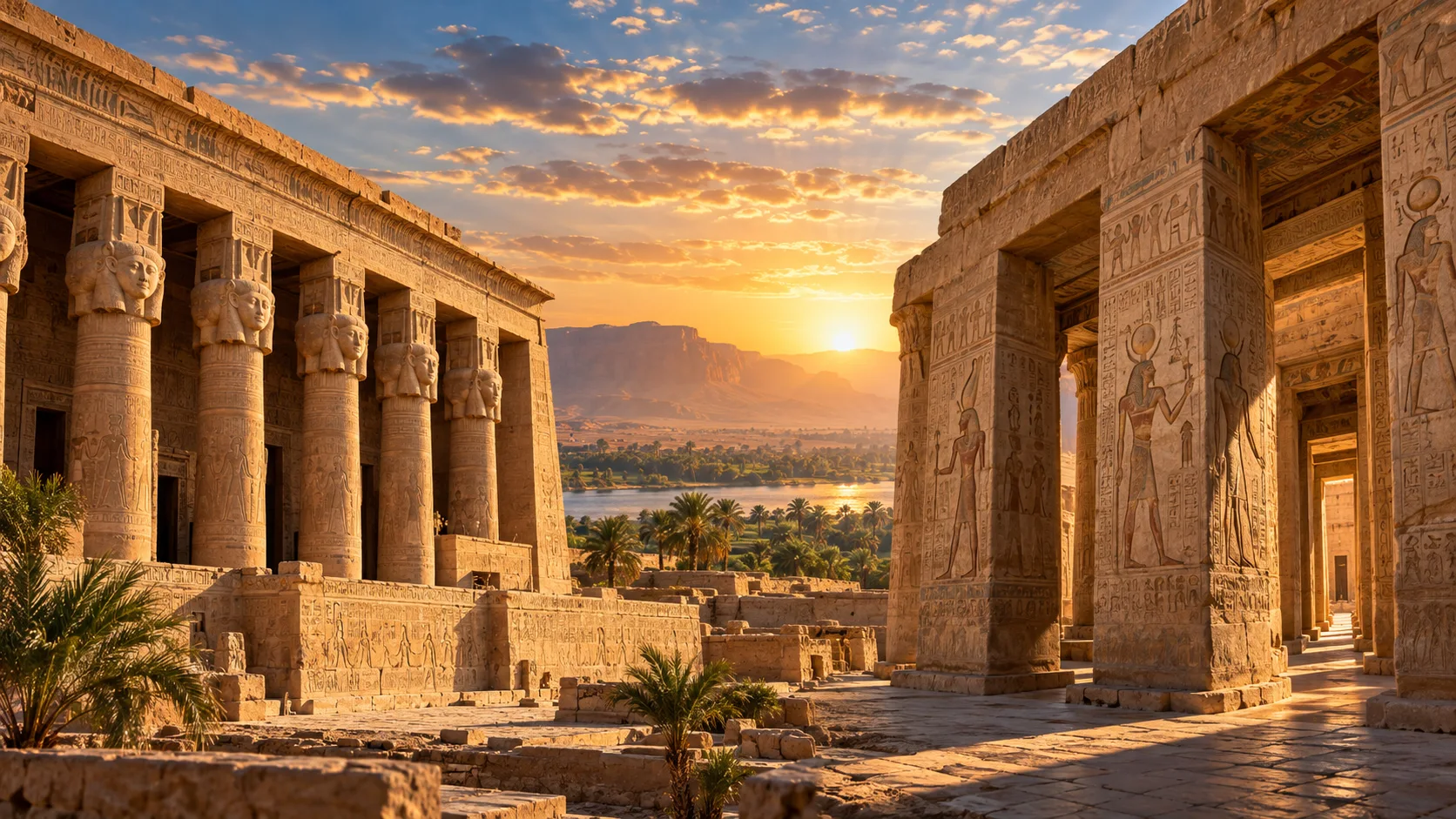
Dendera Temple Half Day Tour from Luxor
A private excursion focused on Dendera Temple, with an Egyptologist guide, air-conditioned transportation, temple admission, and return transfer, as described on the tour page.
Approximately 5 hours
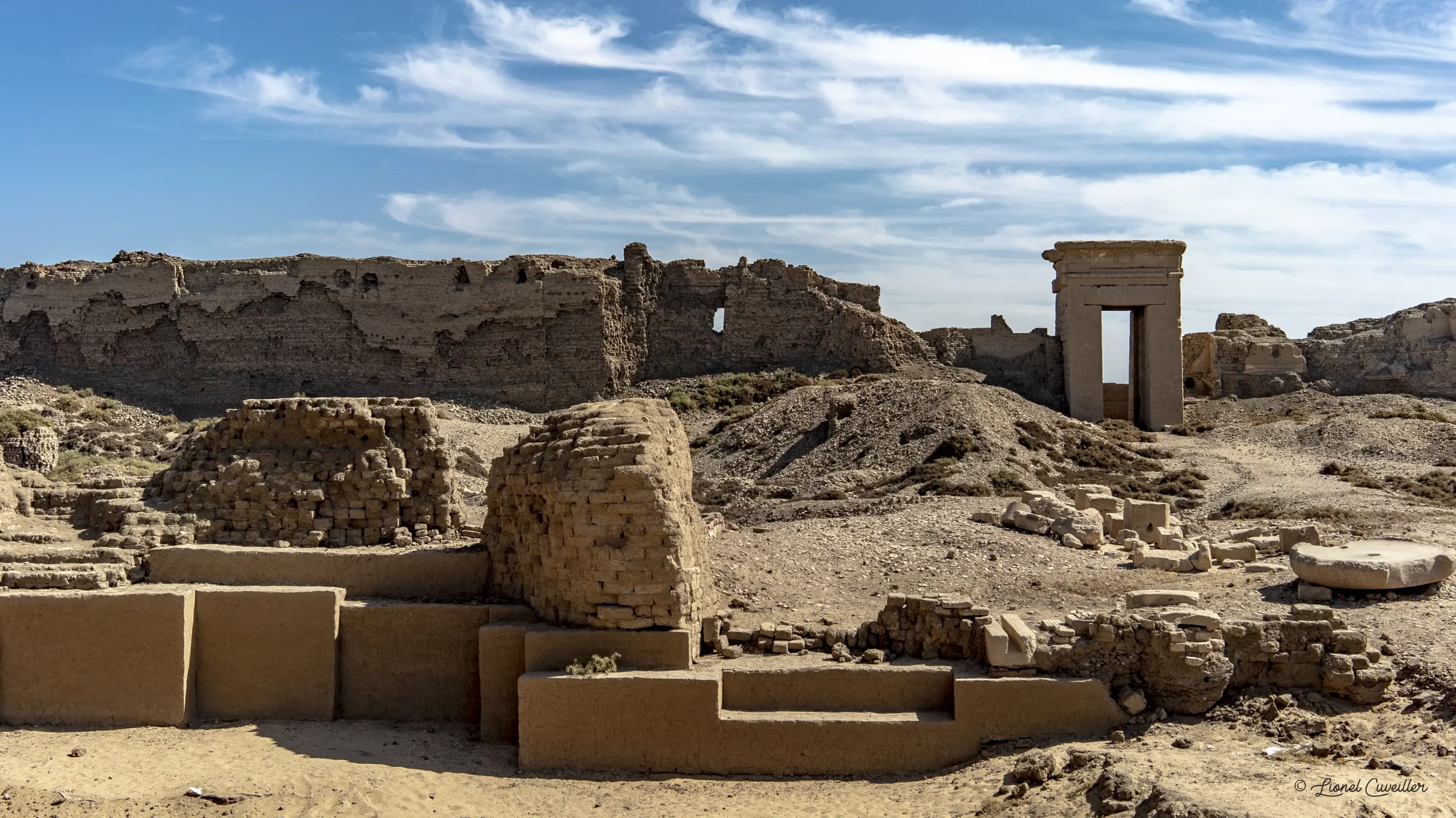
Dendera and Abydos Day Tour from Luxor
A longer private excursion combining Dendera’s astronomical and religious decorations with the Temple of Seti I at Abydos, known for its reliefs and royal king list.
Approximately 9–10 hours
These tours offer opportunities to understand the temples’ surviving architecture and decorations, rather than seeing the Dendera Zodiac merely as an isolated museum object.
Why Is the Dendera Zodiac Important?
The monument occupies an important place in the history of ancient Egyptian astronomy for several reasons.
First, its combination of Egyptian celestial figures and the twelve zodiacal constellations provides evidence of cultural exchange during the Ptolemaic period.
Second, it preserves elements of Egyptian timekeeping, particularly the decans, alongside later astronomical traditions.
Third, its circular composition offers a distinctive example of how celestial information could be organized within religious art.
Finally, its modern history reveals how Egyptian monuments became objects of scientific investigation, collecting, and debate in Europe.
Rather than providing a single answer to how ancient Egyptians understood the universe, the Dendera Zodiac preserves several overlapping ways of representing celestial order.
Keep Exploring Dendera
Extending your stay in Luxor? Pair Dendera with the Full-Day Luxor Tour of the East and West Banks, the Karnak and Luxor Temples Tour, or a 4 Night Nile Cruise from Luxor to Aswan.
Frequently Asked Questions About the Dendera Zodiac
What is the Dendera Zodiac?
The Dendera Zodiac is an ancient Egyptian sandstone relief depicting zodiacal constellations, decans, planetary imagery, and religious figures in a circular celestial composition. It was originally installed in an Osiris chapel within the Temple of Hathor.
How old is the Dendera Zodiac?
The Louvre dates the relief to approximately 50 BCE, making it more than 2,000 years old. It belongs to the late Ptolemaic period.
Where was the Dendera Zodiac discovered?
It was documented in 1799 inside a rooftop Osiris chapel at the Temple of Hathor in Dendera, Upper Egypt.
Where is the original Dendera Zodiac?
The original is housed in the Louvre Museum in Paris, France, within the Egyptian Antiquities Department.
Who discovered the Dendera Zodiac?
The Louvre identifies General Desaix, Louis Pierre Aimé Chastel, and Dominique Vivant Denon in connection with its documentation on January 24, 1799. The relief had already been part of the ancient temple for centuries.
Why was the Dendera Zodiac removed from Egypt?
It was removed in 1821 as part of an acquisition arranged by Sébastien Louis Saulnier. The Louvre documents an authorization issued under Muhammad Ali before its extraction and transportation to France.
Is the Dendera Zodiac a star map or an astrological chart?
It contains elements of both astronomical representation and zodiacal symbolism. It is best understood as a religious celestial composition rather than a modern scientific star chart or personal horoscope.
Which zodiac signs appear on the Dendera Zodiac?
All twelve classical zodiacal constellations are represented, including Aries, Taurus, Gemini, Cancer, Leo, Virgo, Libra, Scorpio, Sagittarius, Capricorn, Aquarius, and Pisces.
What are the 36 decans?
The decans are celestial groups traditionally associated with Egyptian ten-day calendar periods and nighttime timekeeping. Their appearance connects the relief with older Egyptian astronomical traditions.
Does the Dendera Zodiac show planets?
Yes. The composition contains planetary representations associated with the five planets visible to the unaided eye: Mercury, Venus, Mars, Jupiter, and Saturn.
Is there a replica of the Dendera Zodiac in Egypt?
A reproduction is associated with its original location in the Temple of Hathor. The original carved sandstone relief remains in the Louvre.
Why is the Dendera Zodiac significant?
It is an important archaeological source for studying the interaction of Egyptian religious astronomy, traditional celestial timekeeping, and Hellenistic zodiacal imagery.
Final Thoughts: Understanding the Dendera Zodiac
The Dendera Zodiac is more than a collection of ancient astrological signs. It is a carefully composed representation of the heavens, created within the religious and intellectual world of late Ptolemaic Egypt.
Its constellations, decans, planets, and divine figures demonstrate how Egyptian traditions and Mediterranean astronomical ideas could coexist within one sacred artwork.
Although the original relief is preserved in Paris, its birthplace at Dendera remains essential to understanding the monument’s purpose and cultural significance.
If you are planning to visit Luxor and want to experience this historical setting, you can explore the Dendera Temple Half Day Tour offered by Egypt Luxury Trips.
Complete the enquiry form below to request more information, confirm the available details, and discuss your visit with the Egypt Luxury Trips team.
Historical references: The factual details in this article are principally supported by the Louvre Museum’s collection database, the Linda Hall Library’s historical exhibition, and scholarship published by the French Institute of Oriental Archaeology.
Traveler Reviews on Tripadvisor
See what guests say about travelling with Egypt Luxury Trips.


Plan Your Dendera Visit
Let’s design your Egypt. Tell us your dates and group size, and our team will shape a private Dendera and Luxor experience around you.