
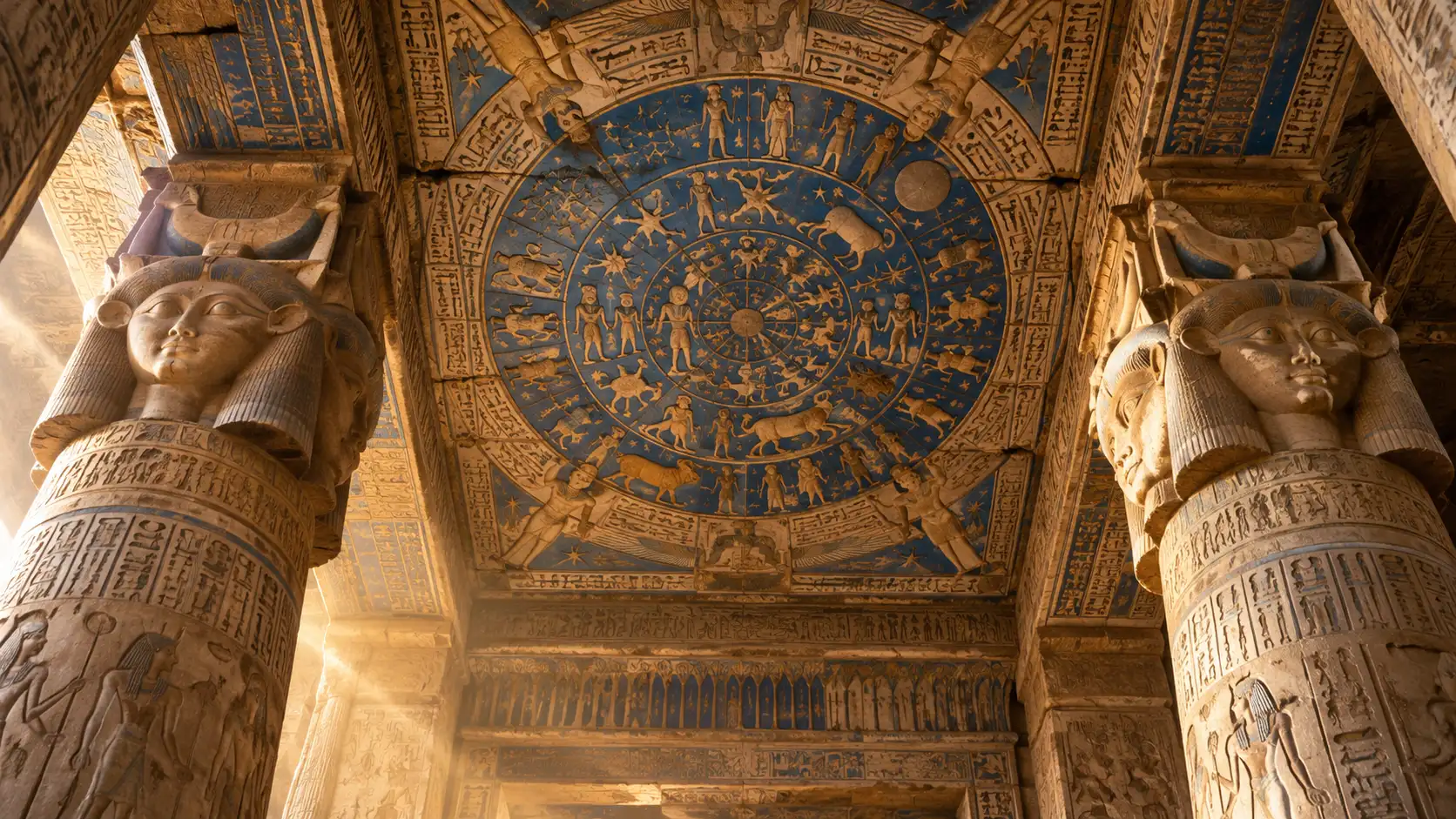
The Dendera Calendar, commonly associated with the famous Dendera Zodiac, is one of the most fascinating surviving examples of ancient Egyptian astronomy. Carved into the ceiling of a chapel at the Temple of Hathor at Dendera, this remarkable circular relief brings together constellations, zodiac signs, planetary symbols, and religious imagery in a single representation of the heavens.
What makes the Dendera Zodiac particularly interesting is the meeting of two astronomical traditions. Its imagery combines Egyptian religious ideas about the sky with the twelve-sign zodiac that developed through Babylonian and Greek influences.
The original relief dates to approximately 50 BCE, during the late Ptolemaic period, and is now displayed at the Louvre Museum in Paris. The temple where it was discovered remains one of Upper Egypt’s most impressive archaeological sites.
Quick answer: is the Dendera Calendar really a calendar?
Not in the everyday sense. The Dendera Calendar is the popular name for the Dendera Zodiac, a circular sandstone relief carved around 50 BCE. It is best described as a celestial diagram, or planisphere, showing zodiac signs, planets, decans, and Egyptian deities. It is not the same thing as the ancient Egyptian civil calendar of 365 days.
But can its symbols tell us how ancient Egyptians measured time? And what do its unusual figures reveal about the way Egyptian priests understood the universe? To answer these questions, we need to look beyond the familiar zodiac signs and understand the relationship between ancient Egyptian astronomy, religion, and the passage of time.
What Is the Dendera Calendar?
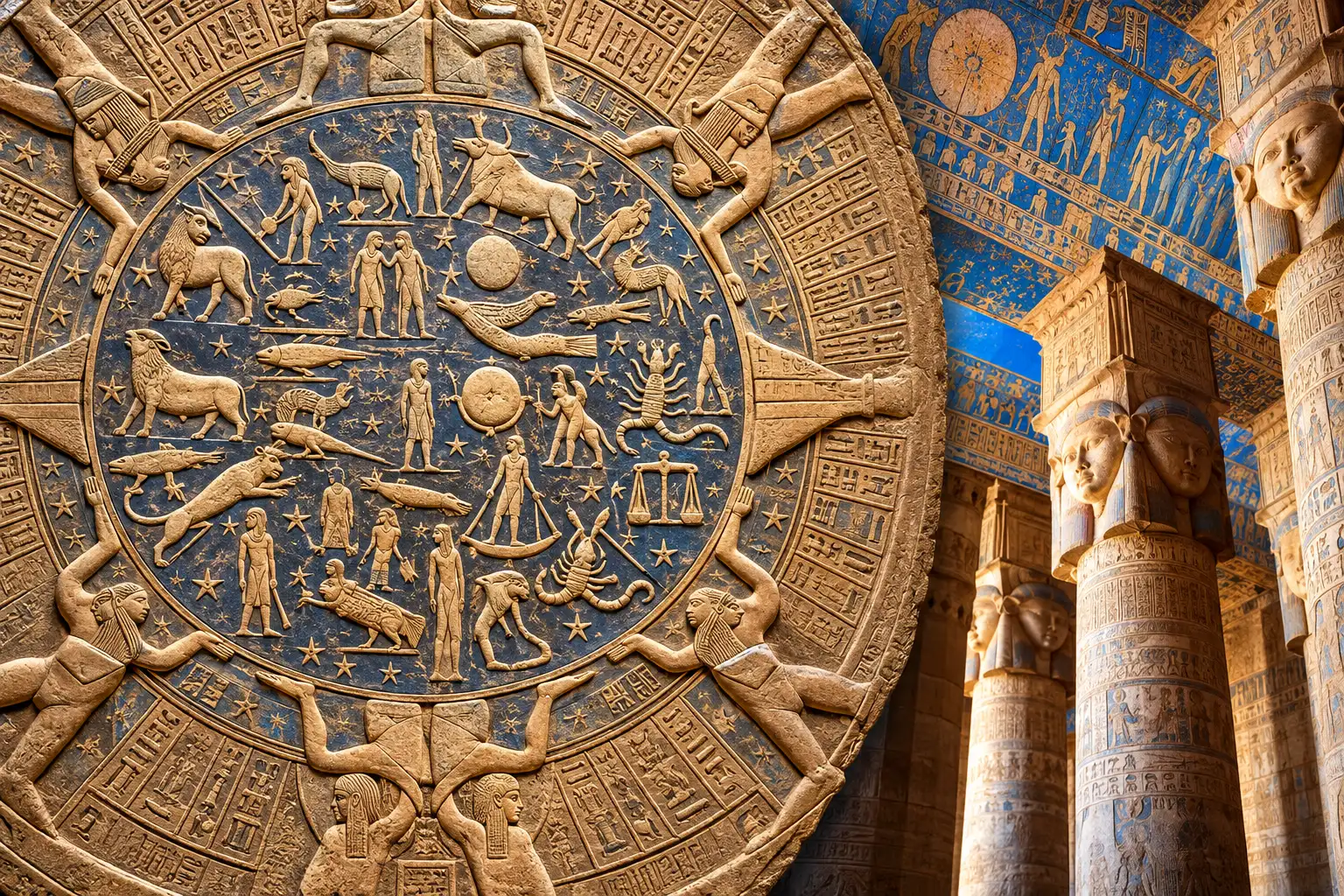
The name Dendera Calendar usually refers to the Dendera Zodiac, a circular sandstone relief originally carved into the ceiling of an Osiris chapel within the Temple of Hathor at Dendera.
Although it is frequently called a calendar, the object is more accurately described as a celestial diagram, or planisphere. Its carved figures represent constellations, planets, astronomical divisions, and religious concepts connected with the movement of the heavens.
Unlike a conventional calendar, which lists days and months in a sequence, the Dendera Zodiac arranges celestial symbols around a circular composition.
Dendera Zodiac: Key Facts
| Feature | Details |
|---|---|
| Common name | Dendera Calendar or Dendera Zodiac |
| Original location | Osiris chapel, Temple of Hathor, Dendera |
| Historical period | Late Ptolemaic Egypt |
| Approximate date | 50 BCE |
| Material | Sandstone |
| Dimensions | Approximately 255 × 253 cm |
| Main imagery | Zodiac constellations, planets, decans, Egyptian deities |
| Original today | Louvre Museum, Paris |
| Museum collection | Egyptian Antiquities, inventory E 13482 |
These details are documented in the Louvre’s collection record.
The History of the Dendera Zodiac
c. 50 BCE
Carved during the final decades of the Ptolemaic dynasty
1802
Dominique-Vivant Denon publishes a drawing that introduces the zodiac to Europe
1821
The relief is removed from the temple and enters the French royal collections
When Was the Dendera Calendar Created?
The Dendera Zodiac was carved around 50 BCE, during the reign of Cleopatra VII and the final decades of the Ptolemaic dynasty.
This makes the relief more than 2,000 years old, but it is important to distinguish its age from that of Egyptian astronomy itself. By the time the zodiac was produced, Egyptians had already been observing celestial movements and using sophisticated systems of timekeeping for thousands of years.
The circular zodiac belongs to a relatively late chapter of this tradition, when Egyptian religious astronomy interacted with the zodiacal system used across the eastern Mediterranean. The Louvre dates the surviving relief to 50 BCE. Scholars have also studied its astronomical imagery, including possible representations of eclipses, to understand its historical setting.
Why Was It Created at Dendera?
Dendera was an important religious center dedicated primarily to Hathor, a goddess associated with music, celebration, motherhood, and divine protection. The temple complex also contained chapels connected with Osiris, the god associated with death, rebirth, and the afterlife.
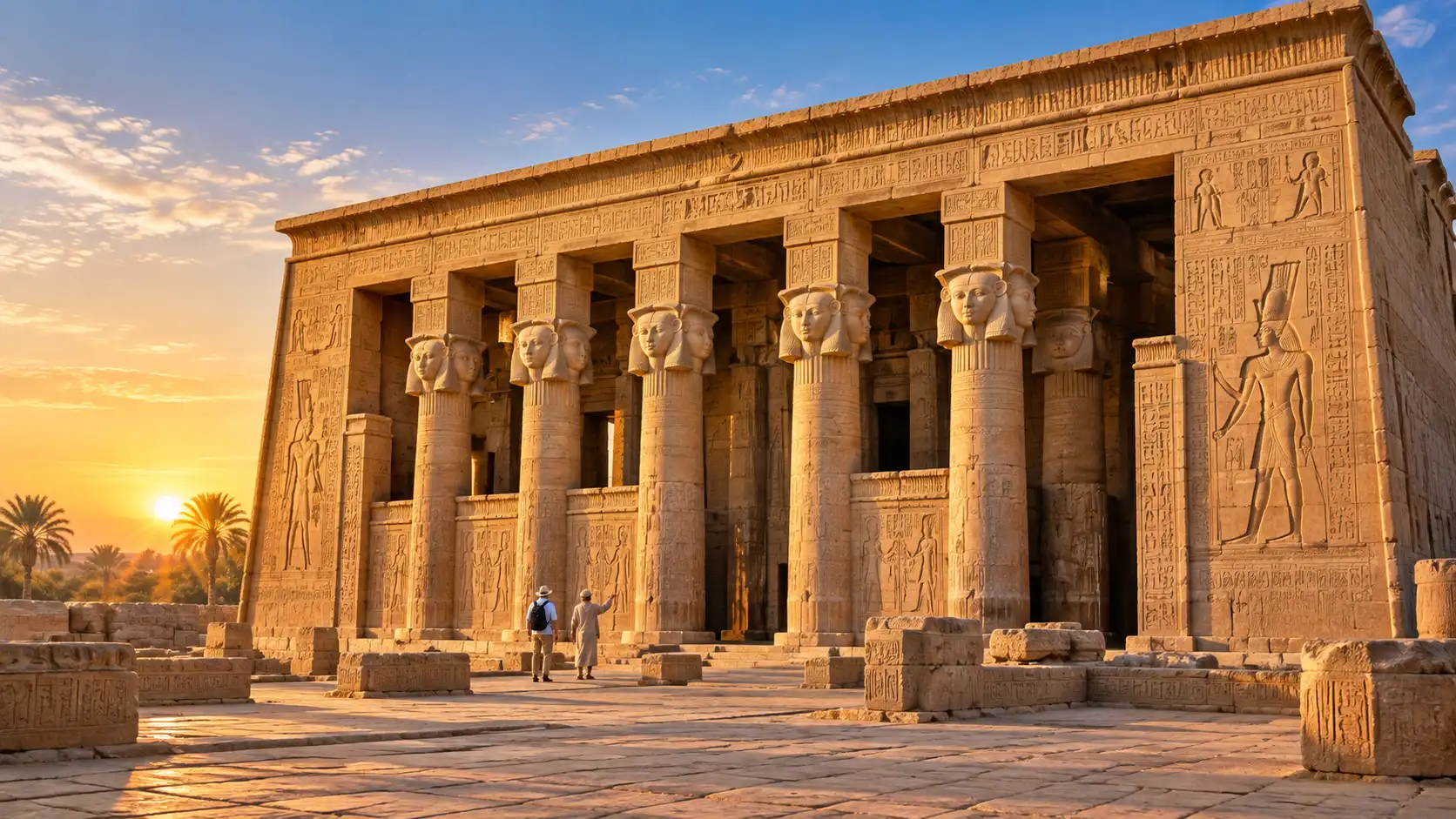
Within this religious environment, astronomical decorations were more than artistic representations of stars. The sky formed part of the Egyptians’ understanding of divine order, ritual timing, regeneration, and the relationship between earthly and heavenly life.
The zodiac was therefore part of a sacred architectural setting, not simply an educational chart for observing constellations.
How Was the Zodiac Discovered?
The relief attracted international scholarly attention during the French expedition to Egypt at the end of the eighteenth century. In 1802, Dominique-Vivant Denon published a drawing that helped introduce the zodiac to European audiences. Its mysterious symbols led to debates about the age of Egyptian civilization and the history of astronomy.
The original was removed from the temple in 1821 and subsequently entered the French royal collections. It was later incorporated into the Louvre’s Egyptian antiquities collection. Today, it is among the best-known examples of astronomical imagery from ancient Egypt.
Understanding the Dendera Zodiac Symbols
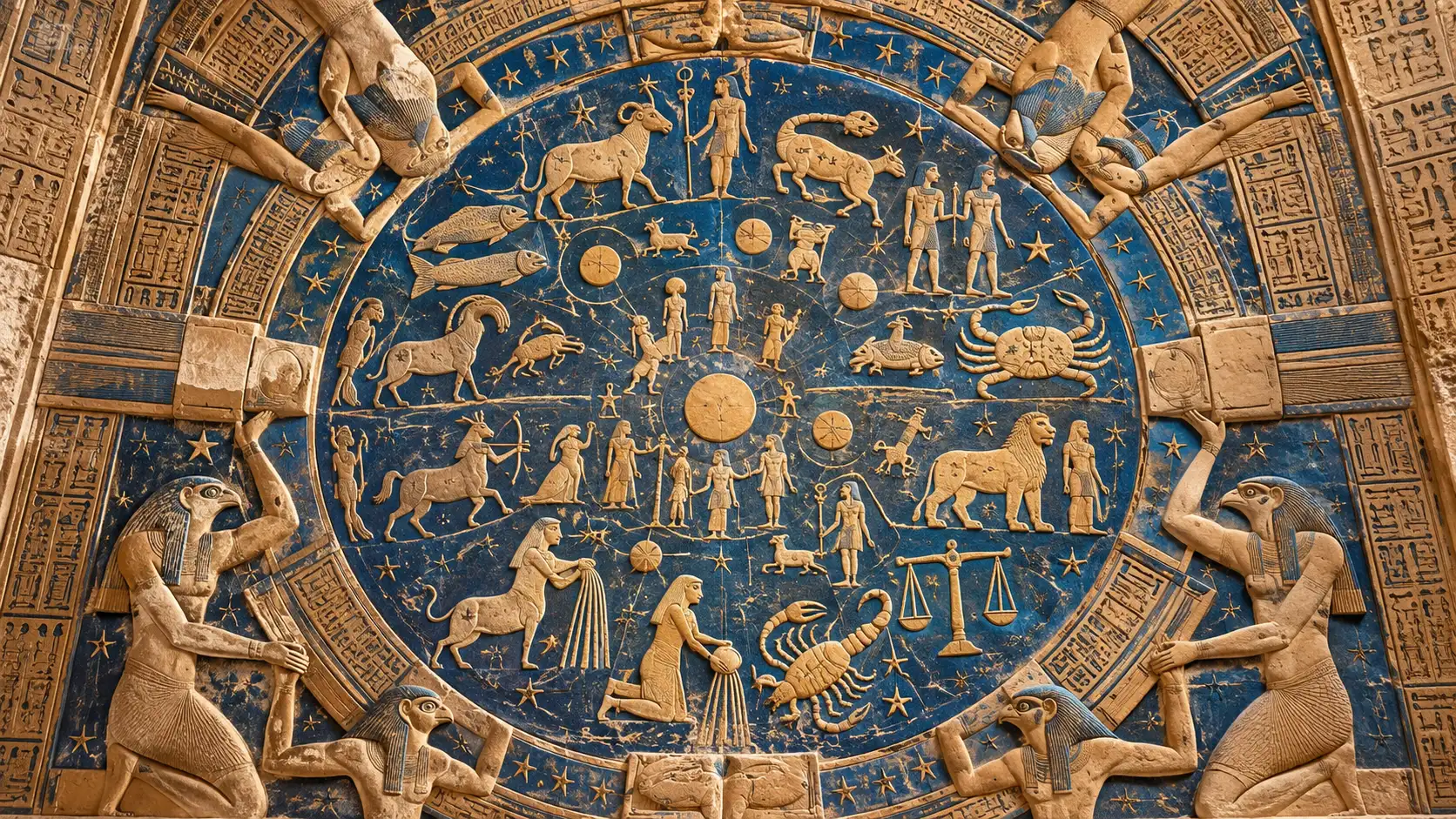
At first glance, the relief can seem almost impossible to interpret. Human figures stand beside unfamiliar animals. Stars and circular symbols appear between divine figures. Some recognizable zodiac signs are represented in forms that differ from their modern equivalents. The composition becomes easier to understand when divided into several elements.
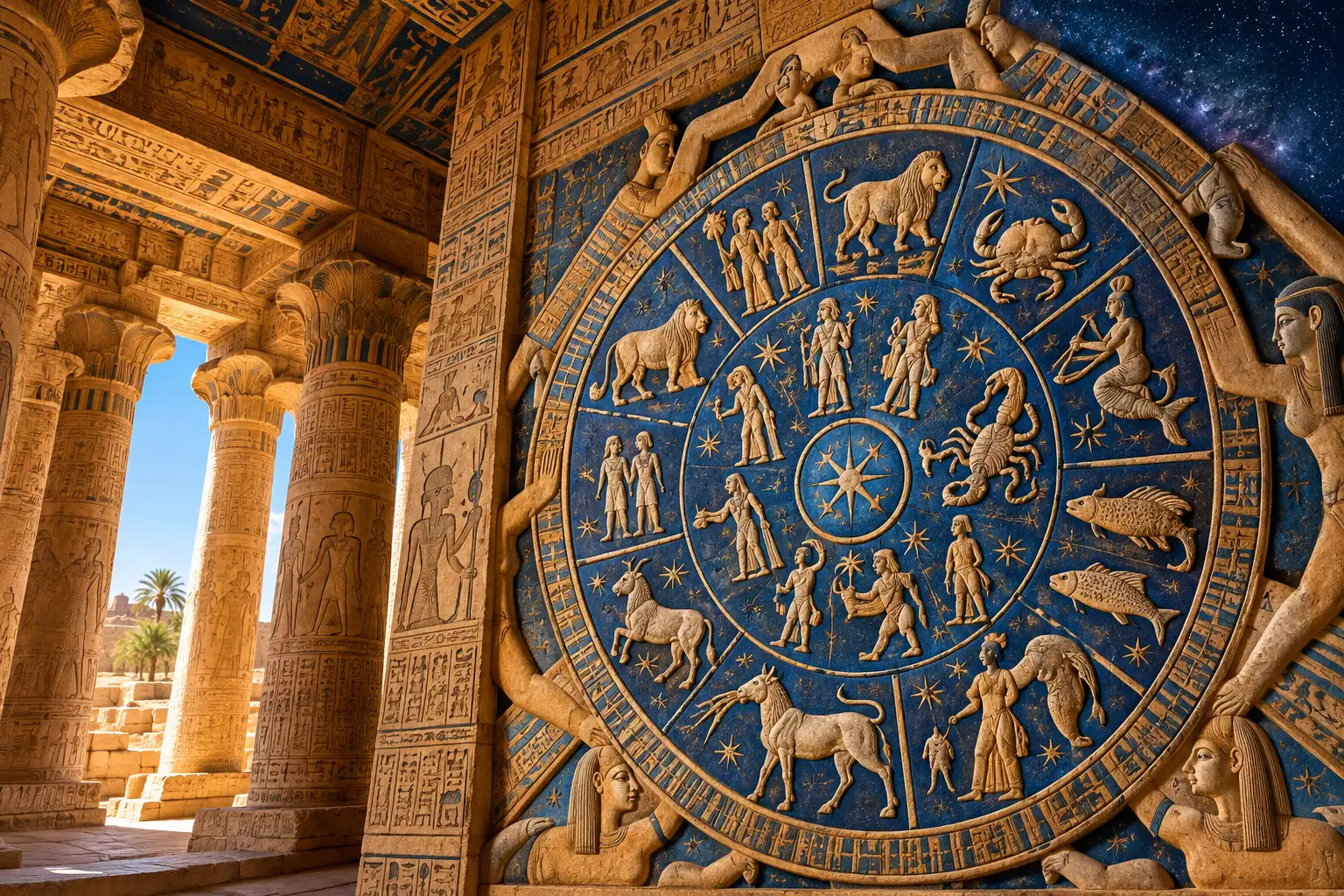
The Twelve Zodiac Signs
The Dendera Zodiac includes the twelve constellations of the classical zodiac. These correspond to the familiar names:
- Aries — the Ram
- Taurus — the Bull
- Gemini — the Twins
- Cancer — the Crab
- Leo — the Lion
- Virgo — the Maiden
- Libra — the Scales
- Scorpio — the Scorpion
- Sagittarius — the Archer
- Capricorn — the Sea-Goat
- Aquarius — the Water Bearer
- Pisces — the Fish
Their presence reflects the influence of Mediterranean astronomical traditions in Ptolemaic Egypt. However, the carvings should not be interpreted as a modern horoscope. They appear alongside Egyptian constellations, deities, and other astronomical divisions, producing a visual system that is much richer than the twelve signs alone.
Egyptian Constellations and Divine Figures
The zodiac also includes imagery belonging to older Egyptian celestial traditions. These figures helped connect the star-filled sky with Egyptian religious mythology.
Rather than treating astronomy and religion as entirely separate subjects, temple artists presented celestial movements within a divine framework. This blending of astronomical and sacred imagery is one of the reasons the relief remains so distinctive.
The Decans: Ancient Egyptian Star Groups
Among the most important astronomical elements are the decans. Decans were groups of stars used in Egyptian timekeeping. Their successive appearances helped people mark periods during the night and became associated with divisions of the year.
The system is significantly older than the Dendera Zodiac itself. The relief preserves decanal imagery together with the twelve-sign zodiac, showing how established Egyptian celestial traditions continued alongside newer astronomical influences. The Louvre identifies decans among the relief’s major decorative elements.
Planetary Symbols
The Dendera Zodiac also represents the five planets visible to the unaided eye that were recognized in ancient astronomy:
Mercury
Venus
Mars
Jupiter
Saturn
These planets were important because, unlike the relatively fixed patterns of the stars, their positions changed against the celestial background. Ancient observers followed these movements, and planetary imagery acquired astronomical as well as astrological significance. The presence of the planets adds another layer to the relief’s depiction of the heavens.
Is the Dendera Zodiac a Calendar or a Star Map?
The distinction matters because the terms are often used interchangeably online.
The Dendera Zodiac is best understood as a symbolic map of the heavens incorporating astronomical and calendrical ideas. It is not the same thing as the ancient Egyptian civil calendar.
Here is how the two differ.
| Dendera Zodiac | Ancient Egyptian Civil Calendar |
|---|---|
| A circular astronomical relief | A system for counting days and years |
| Created around 50 BCE | Developed much earlier in Egyptian history |
| Includes zodiac signs, planets, and decans | Organized into 12 months and 3 seasons |
| Connected with temple religious imagery | Used for administrative and civil dating |
| Combines several astronomical traditions | Based on a 365-day year |
Understanding this difference helps explain why the zodiac contains so many astronomical figures instead of an ordinary sequence of dates.
How Did the Ancient Egyptian Calendar Work?
Long before the Dendera Zodiac was created, the Egyptians had established a civil calendar with 365 days. The calendar contained twelve months of thirty days each, followed by five additional days at the end of the year. Its basic calculation was straightforward:
12 months × 30 days + 5 additional days = 365 days
The year was also divided into three agricultural seasons, each containing four months.
The Three Ancient Egyptian Seasons
| Egyptian name | Meaning | Seasonal association |
|---|---|---|
| Akhet | Inundation | The Nile flood |
| Peret | Emergence or Growing | Cultivation and agricultural growth |
| Shemu | Harvest | Harvesting and the dry season |
These seasons reflected the central importance of the Nile in Egyptian life. Agriculture depended on the river, and predictable patterns of flooding and cultivation helped shape the organization of the year. Although the calendar was associated with these seasonal cycles, its fixed 365-day structure gradually shifted relative to the solar year because the traditional civil calendar lacked a leap day.
The Five Additional Days
The five days added after the twelve regular months were known as epagomenal days. They completed the 365-day year and also held religious significance. In Egyptian mythology, they were associated with the births of five important deities:
Osiris
Isis
Seth
Nephthys
Horus
These days illustrate an important feature of Egyptian timekeeping: calendars did not simply organize practical activities. They also formed part of religious life.
Sirius, the Nile Flood, and Egyptian Astronomy
One of the brightest stars in the night sky, Sirius, held particular importance in Egyptian astronomy. Known to the Egyptians as Sopdet, or Sothis in Greek, it was associated with the approach of the new year and the Nile’s annual inundation.
The star’s heliacal rising occurs when it first becomes visible shortly before sunrise after a period of being hidden in the Sun’s glare.
This astronomical event provided a recognizable celestial marker. There is evidence that the Egyptian New Year was originally associated with the heliacal rising of Sirius, although the precise historical relationship between different Egyptian calendars and the observation of the star is complex.
To see the river that shaped this calendar for yourself, a 4-night Nile cruise from Luxor to Aswan follows the Nile through the same landscape of temples and farmland that Egyptian astronomers once watched.
What Is the Sothic Cycle?
Because the Egyptian civil calendar contained exactly 365 days without a leap-year correction, it gradually moved out of alignment with the solar year. In the idealized traditional calculation, a full recurrence takes approximately 1,460 Julian years. This is commonly called the Sothic cycle.
It has played an important role in scholarly discussions of Egyptian chronology, although the interpretation of individual historical observations requires care. The important point is that Egyptians developed several ways of tracking time, and the movement of stars remained closely connected with those traditions.
Dendera Zodiac Astronomy and Astrology
The Dendera relief belongs to a period when astronomy, religious symbolism, and astrology were closely connected. Astronomy involved observing celestial bodies and their movements, while astrology interpreted those movements as meaningful within broader systems of belief.
The distinction familiar to modern readers was not necessarily drawn in the same way in the ancient Mediterranean world. The presence of planets and zodiac signs indicates the importance of celestial observation, but the relief cannot be reduced to a modern astrological birth chart.
Does the Dendera Zodiac Show Eclipses?
One of the more interesting scholarly interpretations concerns two symbols identified as representations of a solar and a lunar eclipse. Researchers have studied these images alongside the positions of the planets and other astronomical features.
Some astronomical interpretations associate the eclipse symbols with events in 52 and 51 BCE, providing evidence relevant to the relief’s dating. The Louvre discusses both eclipse representations, while scholarly work has examined how specific celestial arrangements might relate to its creation.
These interpretations are useful, but they should not be presented as evidence that the relief predicts future eclipses or contains a hidden astronomical prophecy.
Where Is the Original Dendera Zodiac Today?
The original Dendera Zodiac is displayed in the Louvre Museum in Paris. According to the museum’s collection catalogue, the relief belongs to the Department of Egyptian Antiquities and is displayed in Room 325 of the Sully Wing, Level 0. The museum’s own catalogue is the appropriate place to check if the display location changes.
The original stone relief was removed from its temple setting during the nineteenth century. At Dendera, visitors can see the location associated with the original and a replacement representing its design, along with the temple’s other remarkable astronomical decorations.
Can You Still See Astronomical Ceilings at Dendera Temple?
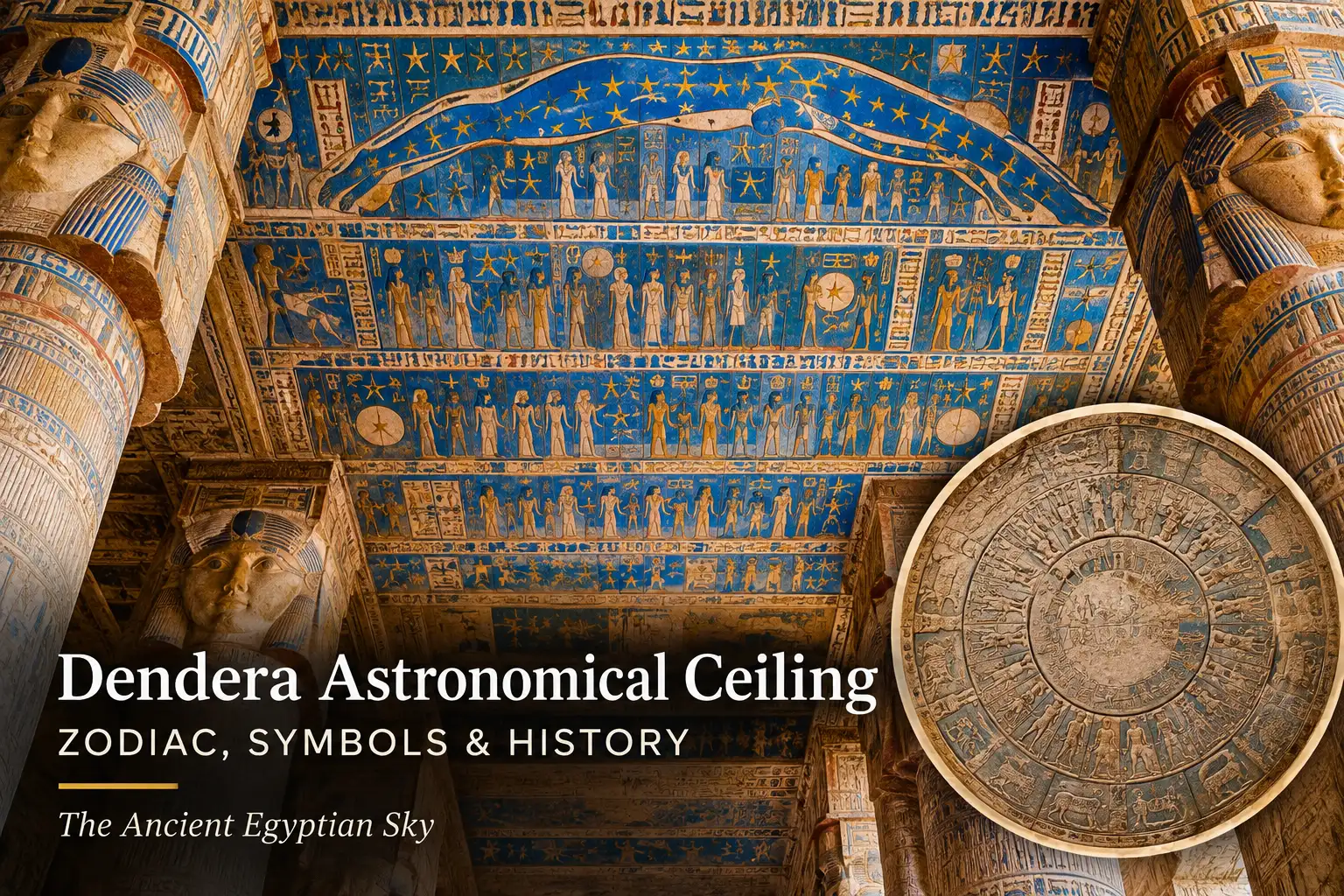
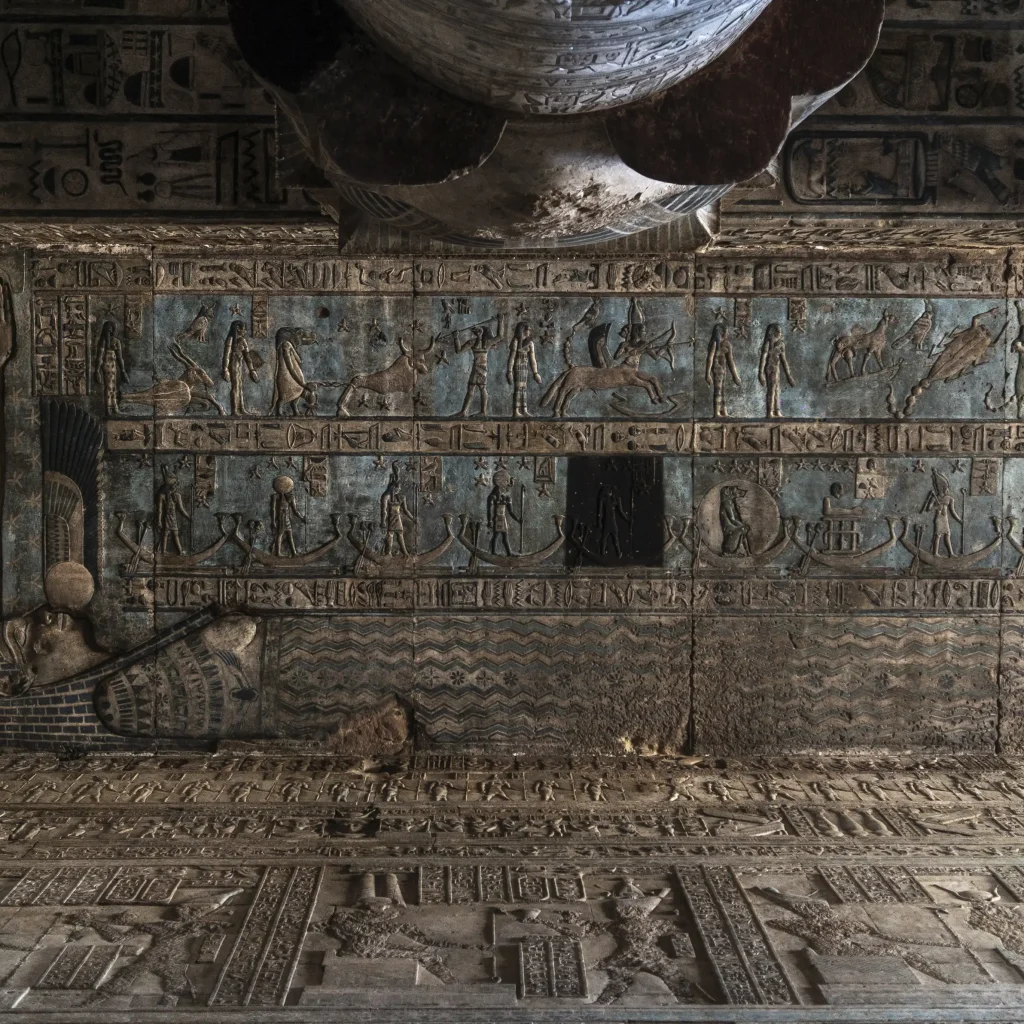
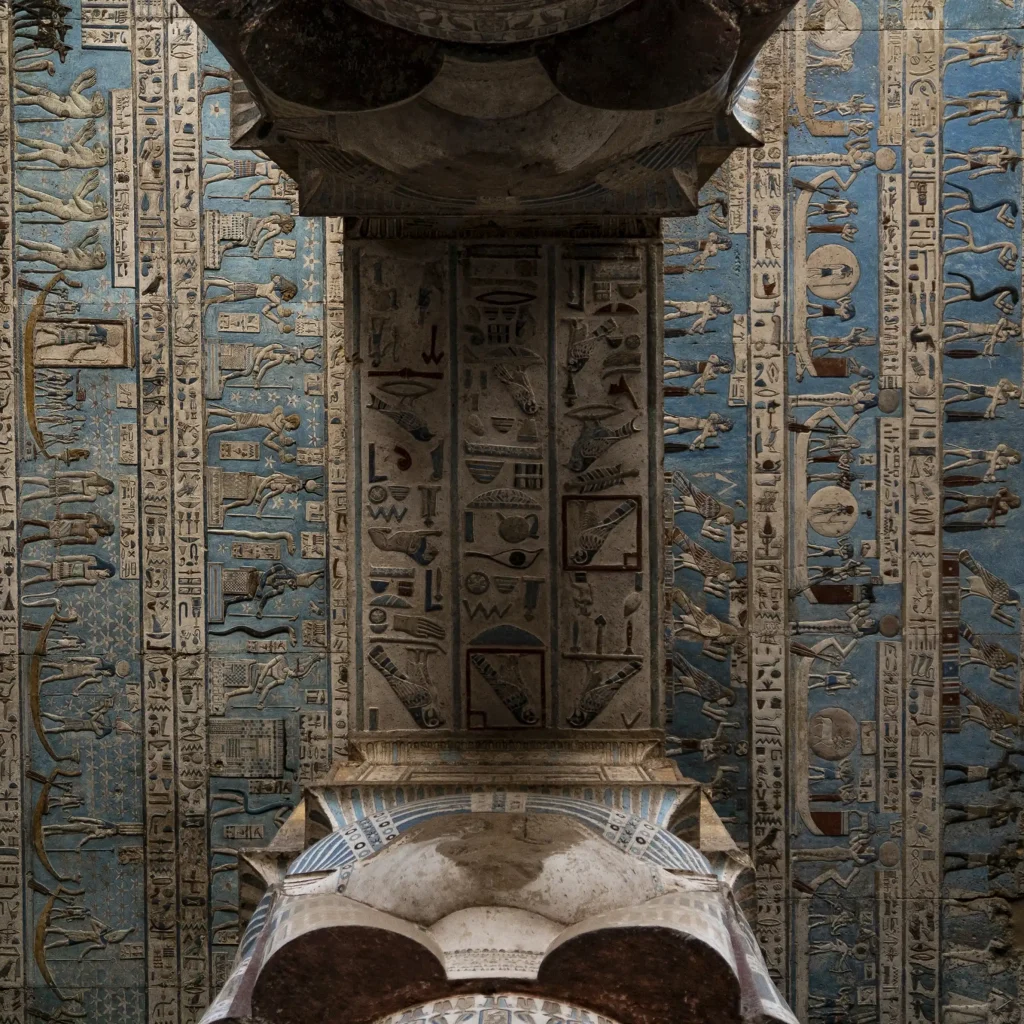
Yes. Although the original circular zodiac is in Paris, the Temple of Hathor still contains extensive astronomical ceiling decorations. These include representations of celestial deities, stars, solar imagery, and sacred scenes connected with Egyptian beliefs about the cosmos.
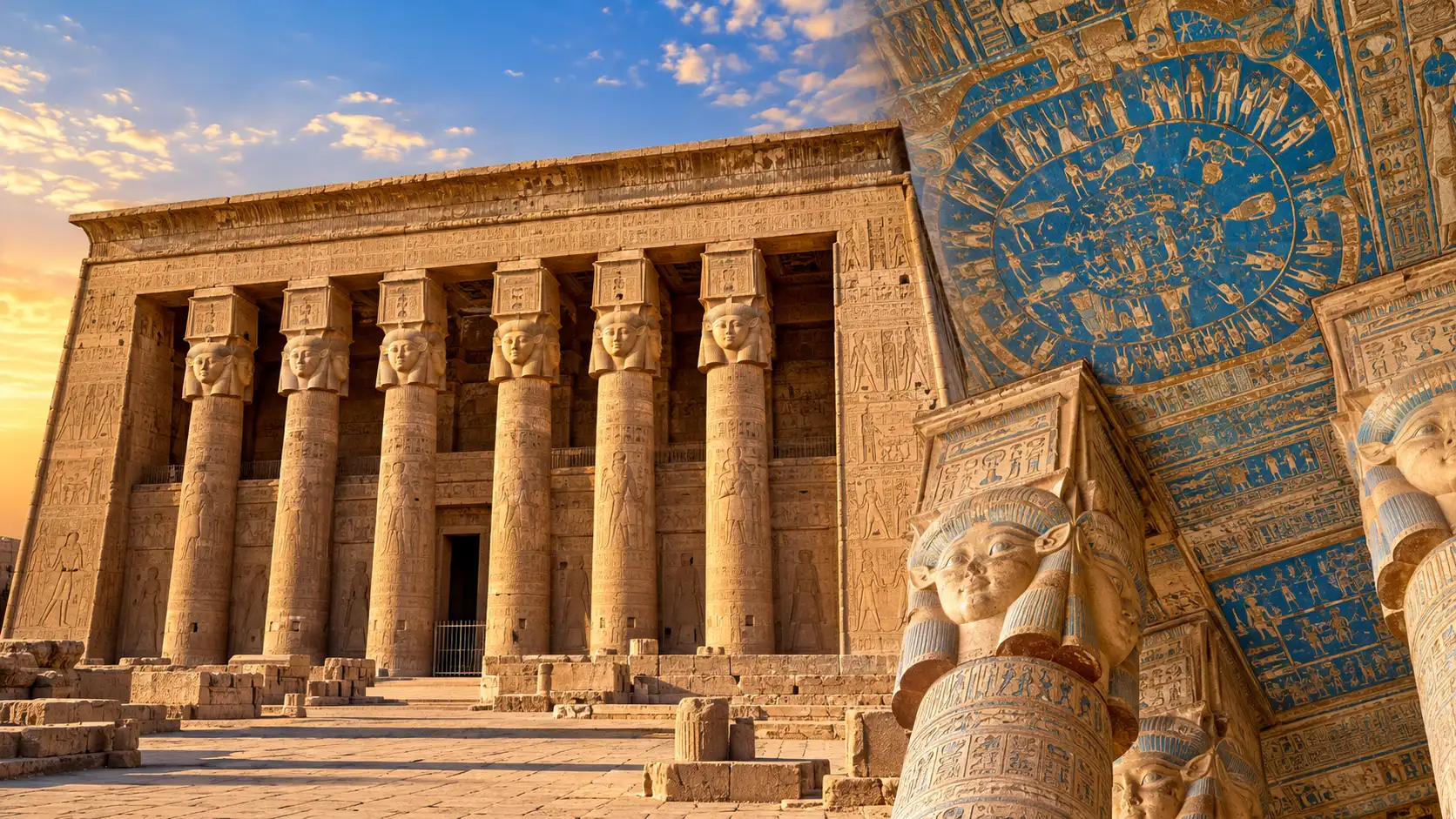
The temple’s richly decorated columns and preserved reliefs make it possible to appreciate the artistic and religious setting in which the famous zodiac was created. This is important for anyone interested in Egyptian astronomy: the circular zodiac is only one part of a much larger tradition of temple decoration.
Visiting Dendera Temple from Luxor
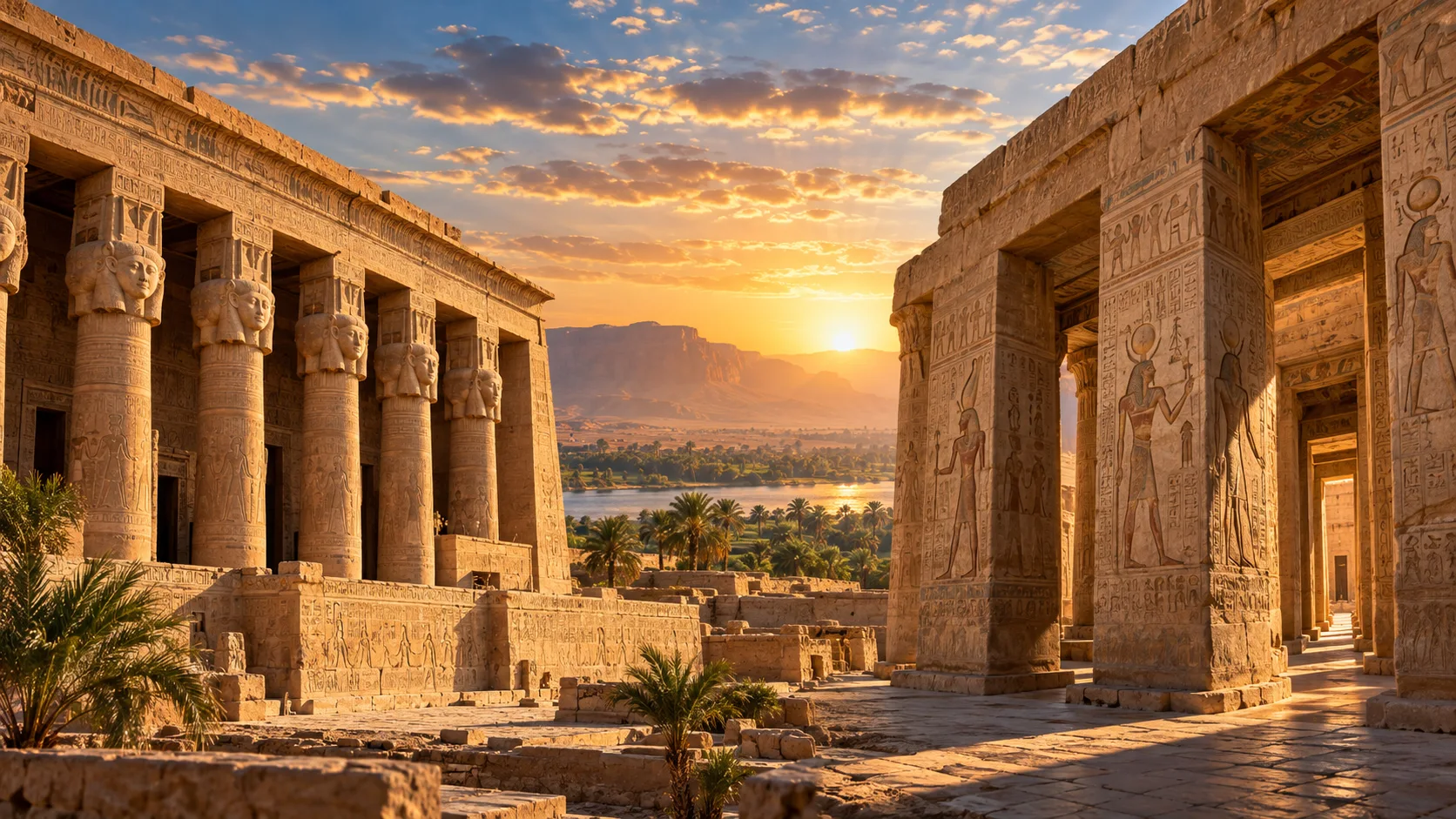
The Temple of Hathor is located at Dendera, near the city of Qena in Upper Egypt, north of Luxor. It is particularly interesting for visitors who have already seen the major temples of Luxor and Karnak and want to understand other aspects of Egyptian religious architecture. Dendera is known for its Hathor-headed columns, detailed reliefs, decorated ceilings, and chapels associated with different religious traditions.
What Should You Look For at Dendera?
When visiting the temple, pay attention to the relationship between its architecture and religious imagery.
The decorated ceiling
Rather than looking only for recognizable zodiac signs, examine how celestial figures are integrated with other religious scenes.
The Hathor-headed capitals
Their repeated forms contribute to the temple’s distinctive architectural identity.
The zodiac chapel
Ask your guide to explain the original chapel location and how the circular relief differs from the other astronomical representations that survive at the site.
Exploring Dendera with Egypt Luxury Trips
For visitors staying in Luxor, Egypt Luxury Trips offers a private Dendera Temple tour from Luxor. The published tour includes transport, guiding by an Egyptologist, and temple admission. It offers an opportunity to understand the temple’s astronomical decorations within their historical and religious context.
Travelers interested in comparing two important religious sites can also consider the Dendera and Abydos day tour from Luxor, which combines Dendera with the Temple of Seti I at Abydos. For a closer look at that journey, read our guide to Dendera and Abydos Temples from Luxor.
These visits are particularly rewarding when the monuments are understood as religious buildings rather than simply collections of impressive ancient artwork.
See the Dendera Ceilings with a Private Egyptologist
Your custom itinerary is one conversation away. Let us design your Dendera visit, from a half-day temple tour to a full Dendera and Abydos journey.
More Luxor Experiences to Pair with Dendera
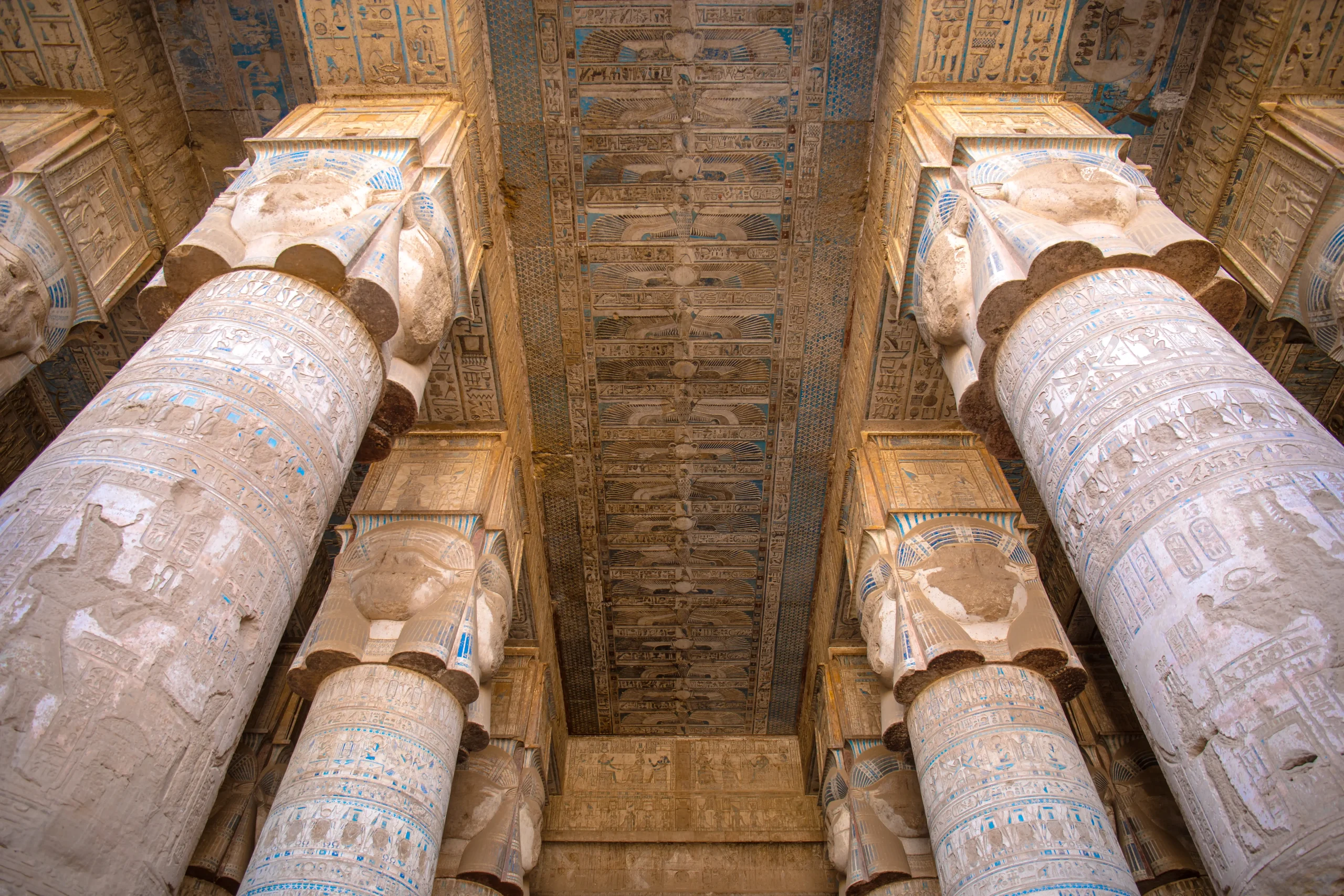
Dendera Temple Half Day Tour
Explore the Temple of Hathor and its astronomical ceilings on a private half-day journey from Luxor.
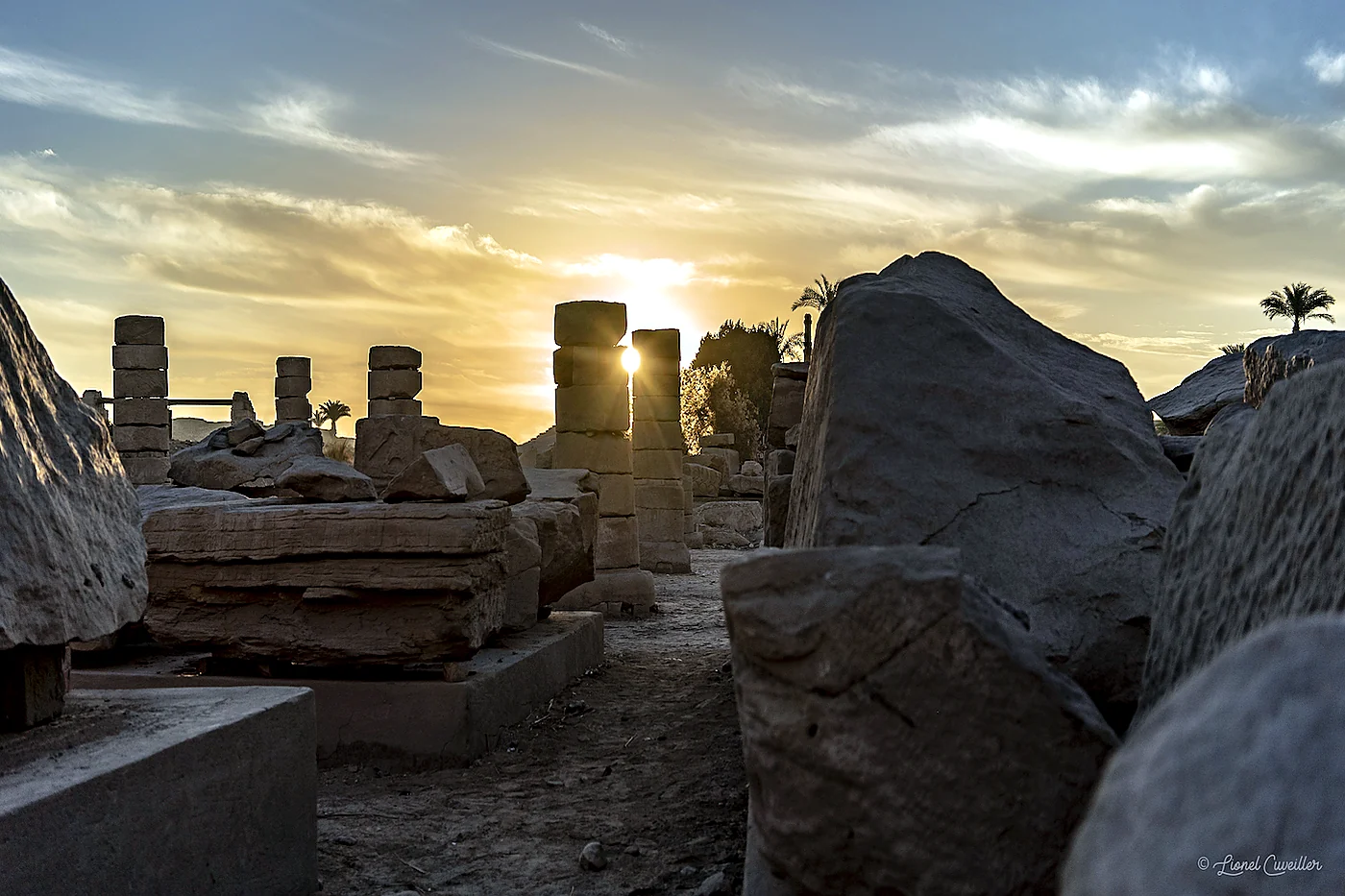
Karnak and Luxor Temples Tour
Walk through Karnak and Luxor Temple, the great religious centers of ancient Thebes.
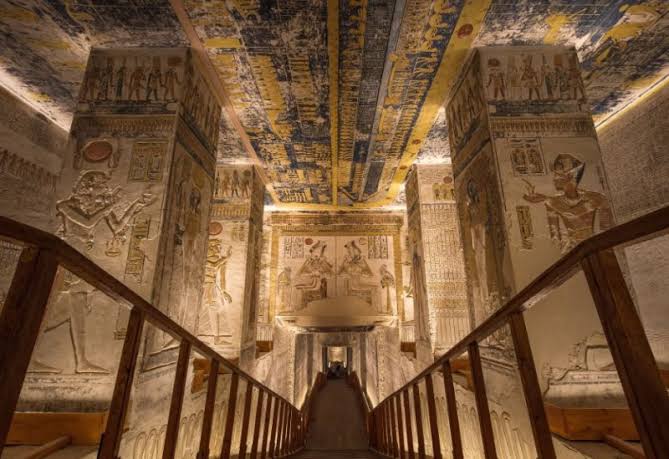
Valley of the Kings and Hatshepsut Temple
Visit royal tombs and the terraced mortuary temple of Hatshepsut on Luxor West Bank.
Frequently Asked Questions About the Dendera Calendar
What is the Dendera Calendar?
The Dendera Calendar is a popular name for the Dendera Zodiac, an ancient Egyptian circular astronomical relief depicting zodiac constellations, planetary symbols, decans, and religious figures. It was carved around 50 BCE in the Temple of Hathor at Dendera.
How old is the Dendera Zodiac?
The Dendera Zodiac dates to approximately 50 BCE, during the reign of Cleopatra VII in the late Ptolemaic period. This dating is supported by the Louvre’s archaeological catalogue.
Is the Dendera Zodiac the oldest zodiac in the world?
No. The Dendera Zodiac is an important surviving example of a circular zodiacal representation, but the twelve-sign zodiac tradition developed earlier in Mesopotamia. The Dendera relief reflects a later combination of Egyptian and Mediterranean astronomical traditions.
What do the twelve signs on the Dendera Zodiac mean?
They represent the twelve constellations associated with the zodiac. Their presence shows the influence of Babylonian and Greek astronomy on Egyptian religious imagery during the Ptolemaic period. They appear together with traditional Egyptian celestial symbols.
Is the original Dendera Zodiac still in Egypt?
No. The original is displayed at the Louvre Museum in Paris. Dendera Temple preserves the original historical setting and other significant astronomical decorations.
Did Cleopatra create the Dendera Zodiac?
There is no established evidence that Cleopatra personally designed or commissioned the relief. It dates to the period of her reign, but that chronological connection does not demonstrate her direct involvement.
Does the Dendera Zodiac predict the future?
There is no reliable archaeological evidence that the zodiac was designed to predict modern events or reveal a hidden future chronology. It contains astronomical and religious imagery, including symbols interpreted as eclipses, but claims of modern prophecy are not supported by established scholarship.
What is the connection between the Dendera Zodiac and the 365-day Egyptian calendar?
Both belong to Egyptian traditions of astronomy and timekeeping, but they are not identical systems. The civil calendar organized the year into twelve months of thirty days plus five additional days. The Dendera Zodiac is a representation of celestial imagery that includes zodiac signs and traditional Egyptian star groups.
Can you visit Dendera Temple on a day trip from Luxor?
Yes. Dendera can be visited on a day trip from Luxor. Visitors can explore the Temple of Hathor, its decorated halls, and its astronomical artwork. Egypt Luxury Trips offers a private Dendera Temple tour from Luxor for travelers interested in the site.
Final Thoughts: Why the Dendera Calendar Still Matters
The Dendera Calendar tells a story that extends far beyond the twelve zodiac signs. It reveals how Egyptian religious traditions adapted and interacted with the astronomical knowledge circulating through the ancient Mediterranean world. Its carvings bring together observations of the heavens, traditional star groups, deities, and ideas about cosmic order.
Perhaps its greatest significance lies in this combination. Created during the final decades of Ptolemaic Egypt, the zodiac preserves both the endurance of Egyptian religious imagery and the changes taking place in the intellectual world around it.
Today, the original relief can be studied at the Louvre, while Dendera Temple offers something equally valuable: the architectural and religious surroundings in which this astronomical artwork once belonged. For travelers curious about that connection, visiting the Temple of Hathor at Dendera is an opportunity to encounter ancient Egyptian astronomy where its symbols originally formed part of sacred space.
What Our Travelers Say on Tripadvisor
Discover why travelers choose Egypt Luxury Trips and see what our guests have to say about their experiences exploring Egypt with us.


Plan Your Dendera Visit with Egypt Luxury Trips
Let’s design your Egypt. Share your dates and interests, and we will reply with a custom itinerary for Dendera, Abydos, Luxor, and beyond.