
Few monuments in Egypt make an entrance quite like Abu Simbel.
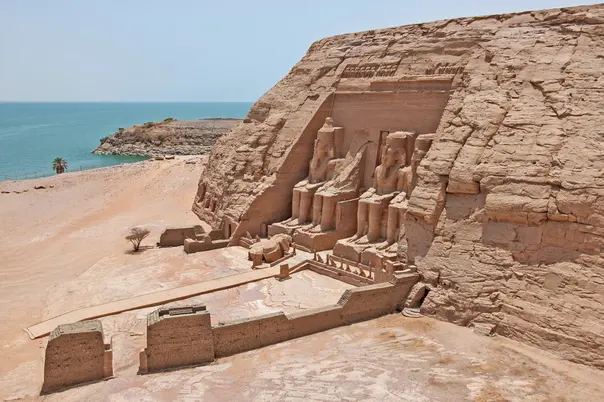
Standing above the waters of Lake Nasser in southern Egypt, four colossal statues of Ramesses II dominate the façade of the Great Temple, while nearby, a second rock-cut sanctuary celebrates both the goddess Hathor and Queen Nefertari.
Yet the size of the statues is only the beginning of the story.
Among the most fascinating Abu Simbel temples facts are how the temples were carved directly into sandstone, how sunlight penetrates deep inside the Great Temple on particular days of the year, and how the entire complex was dismantled and reconstructed on higher ground during one of the most ambitious archaeological rescue projects of the twentieth century.
If you are considering adding Abu Simbel to your Egypt itinerary, understanding its history before you arrive can completely change the way you experience it.
Here is what you should know.
Abu Simbel Facts at a Glance
| Fact | Abu Simbel |
|---|---|
| Location | Southern Egypt, in the historic Nubian region |
| Setting | Western side of Lake Nasser |
| Builder | Pharaoh Ramesses II |
| Dynasty | Nineteenth Dynasty |
| Construction | 13th century BCE |
| Commonly cited construction period | Approximately 1264–1244 BCE |
| Number of principal temples | Two |
| Larger temple | Great Temple of Ramesses II |
| Smaller temple | Temple associated with Hathor and Queen Nefertari |
| Great Temple façade | Four colossal seated statues of Ramesses II |
| Temple type | Rock-cut temples |
| Modern relocation | Mainly 1964–1968 |
| UNESCO World Heritage status | Part of the Nubian Monuments listing since 1979 |
| Famous solar phenomenon | Traditionally observed around February 22 and October 22 |
Where Are the Abu Simbel Temples?
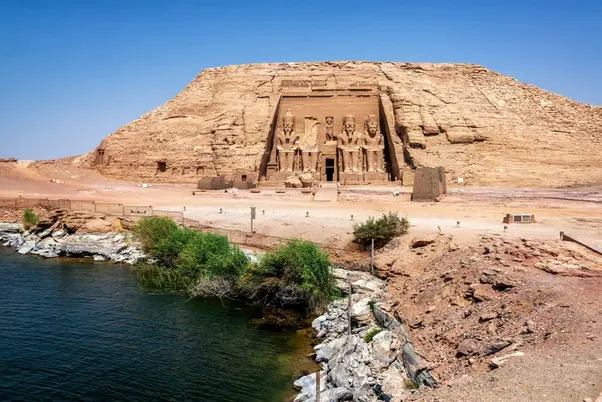
The Abu Simbel location places the complex deep in southern Egypt’s historic Nubian region, relatively close to the Sudanese border and today overlooking Lake Nasser.
For most international travelers, Aswan is the practical gateway to Abu Simbel.
The temples are approximately 230 kilometres southwest of Aswan by direct distance, although the actual road journey covers a greater distance.
This remote location is part of Abu Simbel’s character. Unlike monuments situated inside modern cities, the temples stand within a dramatic southern landscape where desert, monumental architecture and the vast waters of Lake Nasser meet.
If you are building an itinerary around Upper Egypt, you can explore our Aswan destination guide before deciding where Abu Simbel fits into your journey.
Who Built Abu Simbel?
The Abu Simbel Temples were commissioned by Pharaoh Ramesses II, one of the best-known rulers of Egypt’s Nineteenth Dynasty.
Both temples were carved into sandstone during the 13th century BCE. Their construction is commonly dated approximately from 1264 to 1244 BCE, although ancient construction dates can vary depending on the chronology used.
Ramesses II did not commission Abu Simbel simply as an impressive building project.
The complex combined religion, royal authority and monumental imagery. Its position in Nubia also made the temples a powerful visual statement of the Egyptian king’s presence in Egypt’s southern territories.
That message becomes obvious before you even enter.
Four enormous representations of Ramesses II sit across the façade of the Great Temple. The king is not tucked quietly into a decorative scene. He dominates the mountain.
Ancient Egyptian architecture could be subtle.
Abu Simbel chose another strategy.
The Two Temples of Abu Simbel
One useful Abu Simbel fact is that Abu Simbel is not a single temple.
The archaeological complex contains two principal rock-cut temples, each with a different emphasis.
The Great Temple of Ramesses II
The larger monument is commonly called the Great Temple of Abu Simbel or the Temple of Ramesses II.
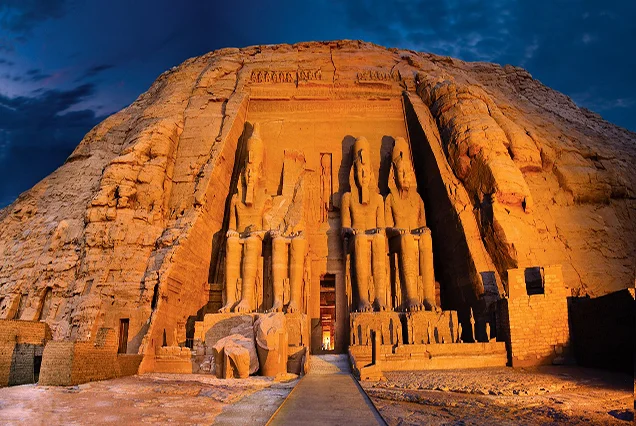
Its façade is dominated by four colossal seated statues representing Ramesses II.
One of these colossal figures was damaged and partially collapsed, but the fallen elements were preserved rather than reconstructed to pretend the damage never happened.
The temple’s significance goes far beyond its façade.
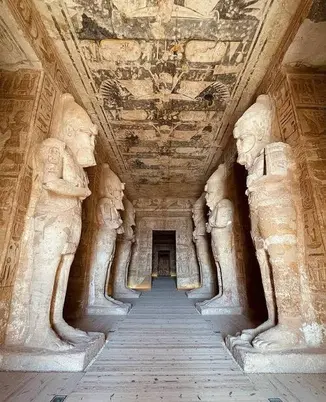
Inside are halls, chambers, carved reliefs and a sanctuary associated with Amun-Ra, Ra-Horakhty, Ptah and the deified Ramesses II.
The architecture guides visitors progressively deeper into the mountain, moving from the overwhelming scale of the exterior toward increasingly sacred interior spaces.
The Small Temple of Abu Simbel
Nearby stands the Small Temple of Abu Simbel, often referred to as the Temple of Nefertari.
It is associated principally with the goddess Hathor and Queen Nefertari, the Great Royal Wife of Ramesses II.
One of its most remarkable features is the prominence given to Nefertari.
Her figures on the façade appear on an unusually monumental scale and are comparable in size to representations of the king.
For travelers interested in ancient Egyptian queens, religion and royal representation, this temple deserves just as much attention as its larger neighbour.
Why Is Abu Simbel Famous?
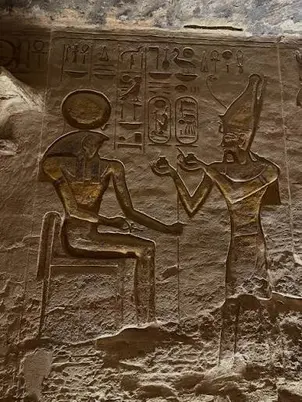
Abu Simbel became one of Egypt’s most recognizable archaeological sites because several remarkable stories meet in one place.
There is the sheer scale of the architecture.
There are the four colossal images of Ramesses II.
There are detailed religious and military reliefs.
There is the unusual representation of Queen Nefertari.
There is the famous solar alignment.
And then there is the modern rescue operation that physically moved the temples away from rising water.
Few archaeological sites allow you to examine both ancient engineering and twentieth-century conservation on such an extraordinary scale.
Abu Simbel Architecture
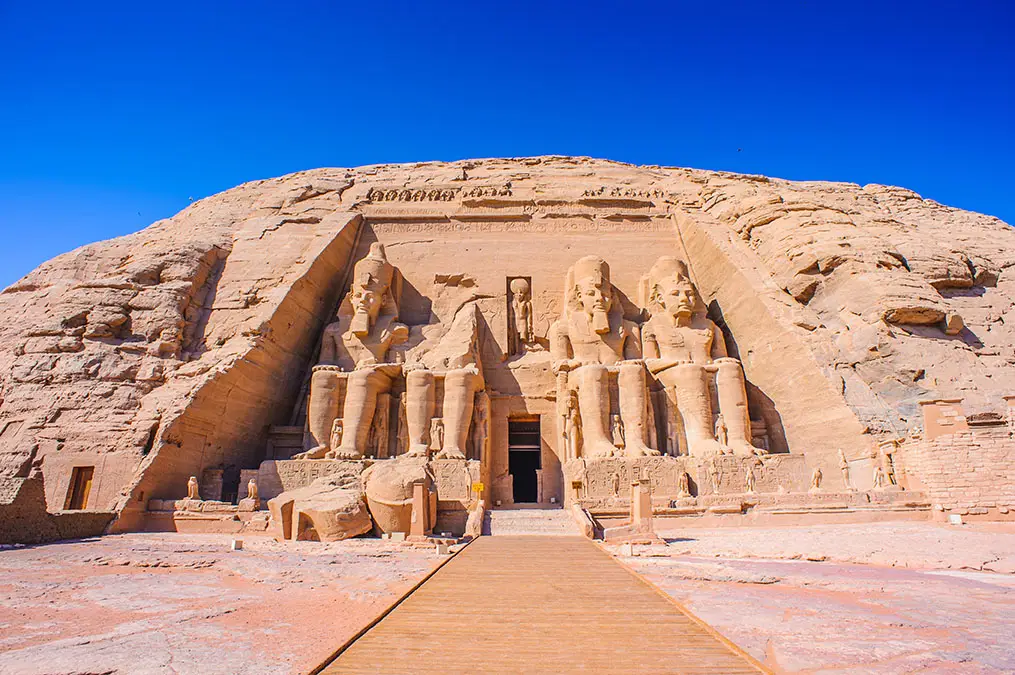
Both monuments are rock-cut temples.
Instead of constructing the temples mainly from freestanding blocks, ancient builders carved major sections directly into the sandstone cliffs.
The Great Temple includes a monumental façade followed by a sequence of interior spaces including halls, side chambers, a vestibule and a sanctuary.
This creates a deliberate progression.
Outside, everything is monumental and public.
Move deeper inside and the spaces become increasingly restricted and religious.
The entrance itself sits between the gigantic seated figures of Ramesses II, meaning that visitors effectively enter the monument beneath the visual presence of the king.
Architecture here was doing more than providing shelter for religious rituals. It was communicating authority.
The Colossal Statues of Ramesses II
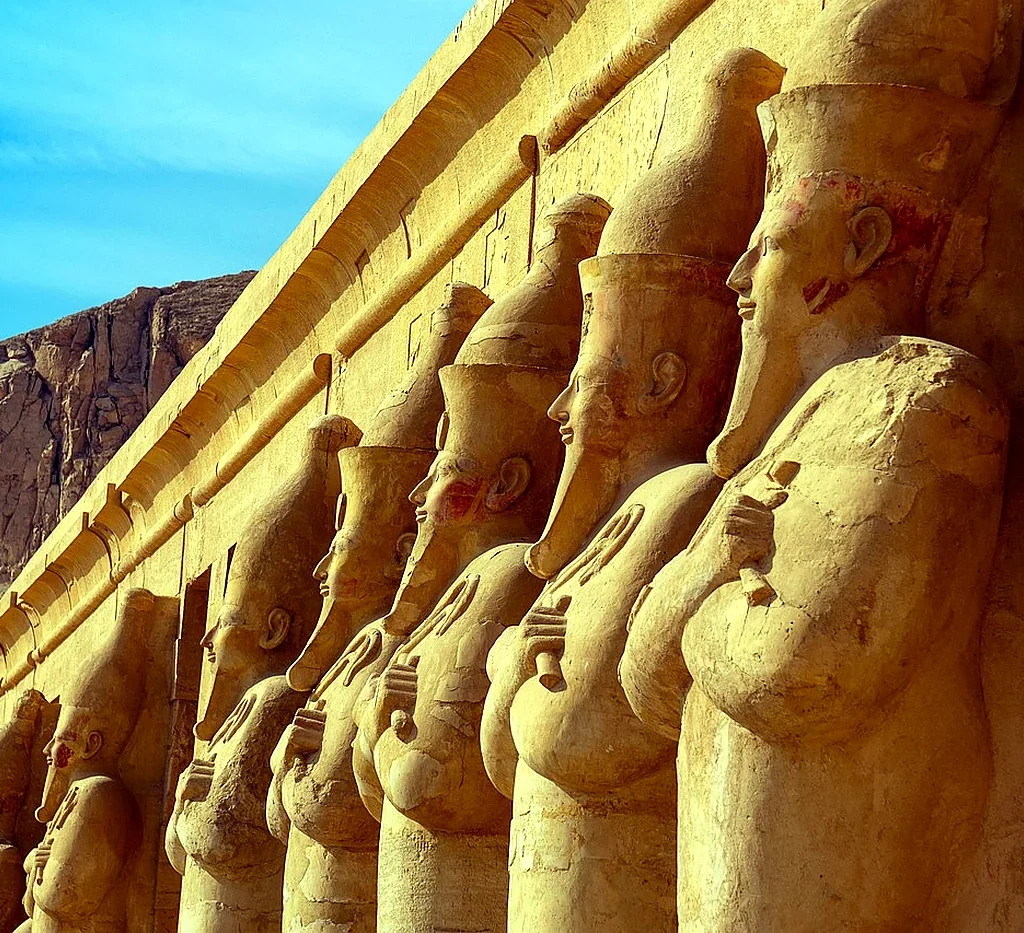
The Abu Simbel statues are probably the complex’s most instantly recognizable feature.
Four colossal seated statues of Ramesses II dominate the Great Temple façade.
They present the king on a scale intended to overwhelm.
One of the colossal statues suffered major damage and collapsed, probably following an earthquake. Parts of the damaged figure can still be seen.
Rather than diminishing the monument, the broken colossus adds another chapter to the site’s history. Abu Simbel was not frozen in time after construction. Natural events, sand, rediscovery and modern engineering all changed the way the site has been experienced.
Inside the Great Temple of Abu Simbel
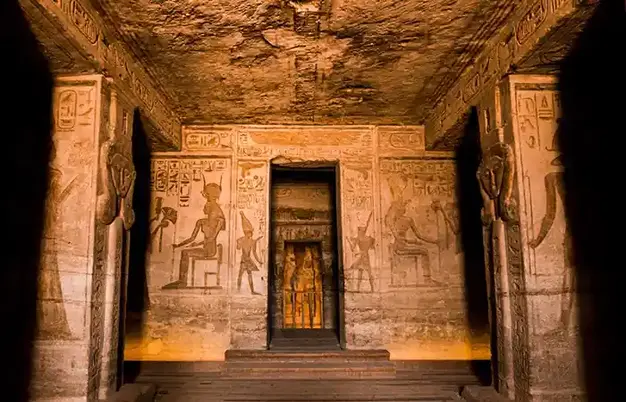
The interior provides an entirely different atmosphere from the monumental exterior.
Visitors move through a series of carved spaces decorated with inscriptions and reliefs.
The images combine religious subjects with royal and military themes.
Among the most notable scenes are reliefs connected with Ramesses II’s campaign at the Battle of Kadesh. Military imagery includes the king, chariots, soldiers and defeated enemies.
Such representations were not simply ancient documentary records in the modern sense.
They were part of a royal visual language designed to present the pharaoh as victorious, divinely supported and capable of maintaining order.
Other inscriptions and Abu Simbel hieroglyphics reinforce the religious identity of the temple and the special status of Ramesses II.
Abu Simbel and the Battle of Kadesh
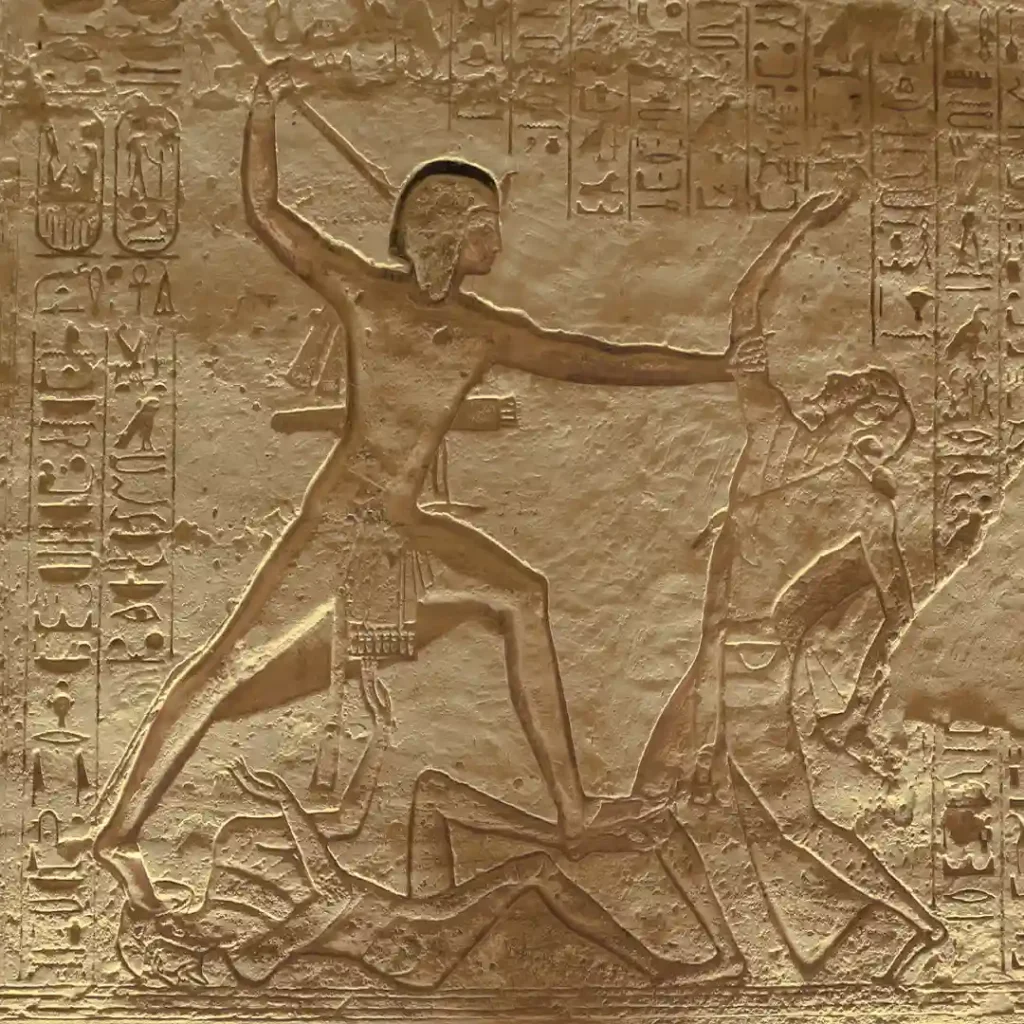
The Battle of Kadesh occupies an important place within the decoration of the Great Temple.
Reliefs represent Ramesses II’s military campaign and his claimed triumph.
For modern visitors, these scenes provide a useful reminder that ancient Egyptian temples were not only places devoted to gods.
They could also function as monumental statements about kingship.
Religion, politics and royal image-making were deeply connected.
At Abu Simbel, the pharaoh appears simultaneously as ruler, warrior and sacred figure.
The Meaning and Significance of Abu Simbel

So what was Abu Simbel actually saying?
There is no need to reduce the entire complex to one purpose.
Its architecture and decoration communicate several overlapping ideas.
The temples honored major Egyptian deities.
They celebrated Ramesses II.
They associated the king with the divine world.
They gave Queen Nefertari an exceptional monumental presence.
And their location in historic Nubia projected Egyptian royal authority close to the kingdom’s southern frontier.
This combination explains much of the Abu Simbel temple meaning.
The complex was both religious monument and royal statement.
The Abu Simbel Solar Alignment
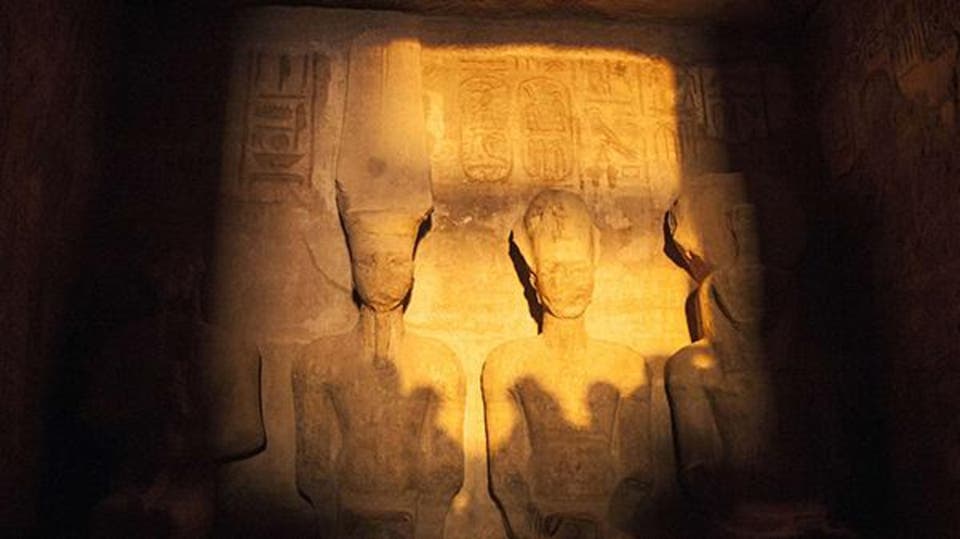
One of the most widely discussed interesting facts about Abu Simbel concerns sunlight.
On two significant periods each year, traditionally observed around February 22 and October 22, sunlight enters the Great Temple and travels through its interior toward the sanctuary.
The light reaches figures associated with Amun-Ra, Ra-Horakhty and deified Ramesses II.
The figure of Ptah remains comparatively dark.
This event is commonly associated with the Abu Simbel Sun Festival.
For travelers, the phenomenon demonstrates how architecture, religious symbolism and the movement of the sun were brought together within the temple’s design.
The festival dates attract particular attention, so visitors interested specifically in witnessing the event should remember that these periods may also draw larger numbers of people.
Why Was Abu Simbel Moved?
The modern story of Abu Simbel is almost as extraordinary as its ancient one.
Construction of the Aswan High Dam transformed the landscape of southern Egypt.
As water levels rose and what became Lake Nasser expanded, major Nubian archaeological sites faced the threat of being submerged.
Abu Simbel was among them.
Leaving the temples where they stood would have placed the monuments at serious risk from the rising water.
A major international conservation effort therefore began to save them.
How Was Abu Simbel Relocated?
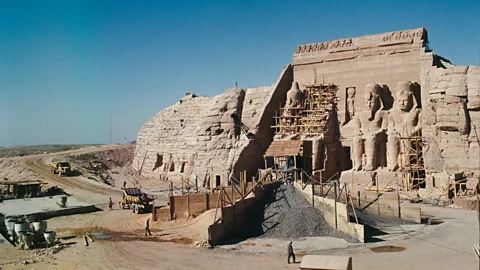
The rescue operation took place mainly between 1964 and 1968.
The temples were dismantled into sections and reconstructed on higher ground.
The objective was not merely to save isolated statues. The architectural relationship between the temples and their setting had to be recreated as faithfully as possible.
Today, visitors see Abu Simbel in its relocated position above Lake Nasser rather than exactly where Ramesses II’s builders originally carved it.
That makes Abu Simbel unusual.
You are simultaneously looking at an ancient Egyptian monument and one of the modern world’s most famous heritage-preservation projects.
Abu Simbel and UNESCO
Abu Simbel forms part of the Nubian Monuments from Abu Simbel to Philae, which entered UNESCO’s World Heritage List in 1979.
The international effort to rescue Nubian monuments became an important example of cross-border cooperation in cultural-heritage conservation.
Abu Simbel therefore represents more than ancient Egyptian history.
Its survival also tells a modern story about what countries and institutions can accomplish when archaeological heritage is threatened on a massive scale.
The Rediscovery of Abu Simbel
Long after the temples ceased functioning in their original ancient context, sand covered substantial portions of the site.
Swiss explorer Johann Ludwig Burckhardt reported Abu Simbel in 1813.
Further work by explorers including Giovanni Belzoni contributed to clearing, entering and documenting the monuments.
This period introduced Abu Simbel to a much wider modern audience.
The story should not be imagined as someone simply stumbling across two perfectly exposed façades in the desert. Sand had obscured significant parts of the complex, and clearing the site was part of the process that brought the temples back into modern archaeological awareness.
Visiting Abu Simbel from Aswan
For many travelers, Abu Simbel is incorporated into an Aswan stay.
Two commonly used approaches are traveling by road or by domestic flight.
Because schedules, operating conditions and availability can change, we recommend confirming the current arrangements when planning your journey rather than relying on old online timetables.
Egypt Luxury Trips currently features both options:
Comparing the two allows you to consider which format better fits your wider Egypt itinerary.
Abu Simbel by Road or Flight?
Neither option needs to be treated as universally better.
The right choice depends on the structure of your trip and the current travel arrangements available for your dates.
Abu Simbel by Road
A road excursion allows travelers to reach the temples overland from Aswan.
If you are interested in this format, see our Abu Simbel Private Tour by Road for the currently provided tour information.
Abu Simbel by Flight
Domestic air travel is another commonly used way of reaching Abu Simbel from Aswan.
You can review our Abu Simbel Temples by Flight when comparing your options.
Because flight schedules and other logistical details may change, current arrangements should always be checked for your intended travel date.
Abu Simbel Tickets and Opening Hours
Travelers frequently search for the latest Abu Simbel entrance fee, Abu Simbel tickets and Abu Simbel opening hours.
These are precisely the kinds of details that should not be treated as permanent facts.
Admission prices, operating hours and visitor rules can change.
For that reason, check the current information from the relevant Egyptian authorities or confirm the latest arrangements while organizing your visit rather than relying on an old article, screenshot or travel forum.
It is better to verify a changing number than publish yesterday’s number as today’s fact.
Best Time to Visit Abu Simbel
Climate is an important consideration when planning southern Egypt.
Cooler months are generally more comfortable for sightseeing, particularly when your itinerary includes outdoor archaeological sites.
Another consideration is the solar phenomenon traditionally associated with approximately February 22 and October 22.
Those dates attract travelers specifically interested in observing the alignment, but greater interest can also mean a busier experience.
Your ideal timing therefore depends on your priorities: comfortable sightseeing, the solar event, or how Abu Simbel fits into the rest of your Egypt itinerary.
Combining Abu Simbel with Aswan and the Nile
Abu Simbel works naturally within a wider southern Egypt itinerary because Aswan provides access to several historical and cultural experiences.
You may want to explore:
- Aswan
- Philae Temple, High Dam and Unfinished Obelisk
- Nubian Village by Motorboat
- Nile Cruise options
- 3 Nights Nile Cruise from Aswan to Luxor
This makes it possible to see Abu Simbel not as an isolated excursion but as part of a broader exploration of southern Egypt and the Nile Valley.
Frequently Asked Questions About Abu Simbel
What is Abu Simbel?
Abu Simbel is an ancient Egyptian archaeological complex containing two major rock-cut temples commissioned during the reign of Pharaoh Ramesses II.
Where are the Abu Simbel Temples located?
They are located in southern Egypt’s historic Nubian region, near the Sudanese border and on the western side of Lake Nasser.
Who built Abu Simbel?
The temples were commissioned by Ramesses II during Egypt’s Nineteenth Dynasty.
When were the Abu Simbel Temples built?
They were carved during the 13th century BCE. A commonly cited approximate construction period is 1264–1244 BCE, although precise dates can vary between chronologies.
How many temples are at Abu Simbel?
There are two principal temples: the Great Temple of Ramesses II and the smaller temple associated with Hathor and Queen Nefertari.
What is the Great Temple of Abu Simbel dedicated to?
The Great Temple honors Ramesses II and is associated with major divine figures including Amun-Ra, Ra-Horakhty and Ptah, as well as the deified king.
What is the Small Temple dedicated to?
The Small Temple is principally associated with the goddess Hathor and Queen Nefertari.
How many colossal statues are on the Great Temple façade?
There are four enormous seated statues of Ramesses II. One suffered severe damage and partially collapsed.
Why is Abu Simbel famous?
Abu Simbel is particularly known for its colossal statues, rock-cut architecture, religious and military reliefs, solar alignment and extraordinary twentieth-century relocation.
Why was Abu Simbel moved?
The temples were threatened by rising water resulting from the construction of the Aswan High Dam and the formation of Lake Nasser.
When was Abu Simbel relocated?
The main relocation project took place between 1964 and 1968.
Is Abu Simbel a UNESCO World Heritage Site?
Yes. Abu Simbel forms part of the Nubian Monuments from Abu Simbel to Philae, included on UNESCO’s World Heritage List in 1979.
What is the Abu Simbel Sun Festival?
It is associated with the solar phenomenon during which sunlight penetrates into the Great Temple and reaches the inner sanctuary around two periods each year, traditionally observed around February 22 and October 22.
Which sanctuary figures are illuminated by the sun?
The sunlight is associated with the figures of Amun-Ra, Ra-Horakhty and the deified Ramesses II, while Ptah remains comparatively dark.
Who rediscovered Abu Simbel?
Swiss explorer Johann Ludwig Burckhardt reported the temples in 1813. Later explorers, including Giovanni Belzoni, were involved in clearing and documenting the site.
How long did Abu Simbel take to build?
Construction is generally estimated to have taken around 20 years.
What does Abu Simbel commemorate?
The complex combines worship of Egyptian deities with the celebration and divine representation of Ramesses II and the expression of royal authority in Nubia.
Can you visit Abu Simbel from Aswan?
Yes. Abu Simbel is commonly visited from Aswan using organized road travel or domestic flights, depending on current schedules and arrangements.
How far is Abu Simbel from Aswan?
The site is approximately 230 kilometres southwest of Aswan by direct distance. The actual road distance is longer.
What is the best time to visit Abu Simbel?
Cooler periods are generally more comfortable for sightseeing. Travelers interested in the solar phenomenon may consider the dates around February 22 and October 22, although these periods can attract additional visitors.
Why Abu Simbel Deserves a Place in Your Egypt Itinerary
Abu Simbel manages to tell several stories at once.
It tells the story of Ramesses II and the scale of New Kingdom kingship.
It tells the story of Queen Nefertari and a temple where her representation is unusually prominent.
It tells the story of Egyptian religion and the careful relationship between architecture, imagery and sunlight.
And, thousands of years later, it tells another remarkable story: how an international conservation campaign dismantled and reconstructed an ancient monument to prevent it from disappearing beneath rising water.
That combination is what makes the Abu Simbel Temples far more than a famous photo stop.
If you are planning to visit Abu Simbel as part of your journey through Aswan and southern Egypt, explore our Abu Simbel tour by road or Abu Simbel tour by flight.
You can then fill out the enquiry form to request the available information, check the current arrangements and discuss how Abu Simbel can fit into your Egypt itinerary with the Egypt Luxury Trips team.
Plan your journey with us
Plan your journey with us and discover unforgettable Egypt experiences