
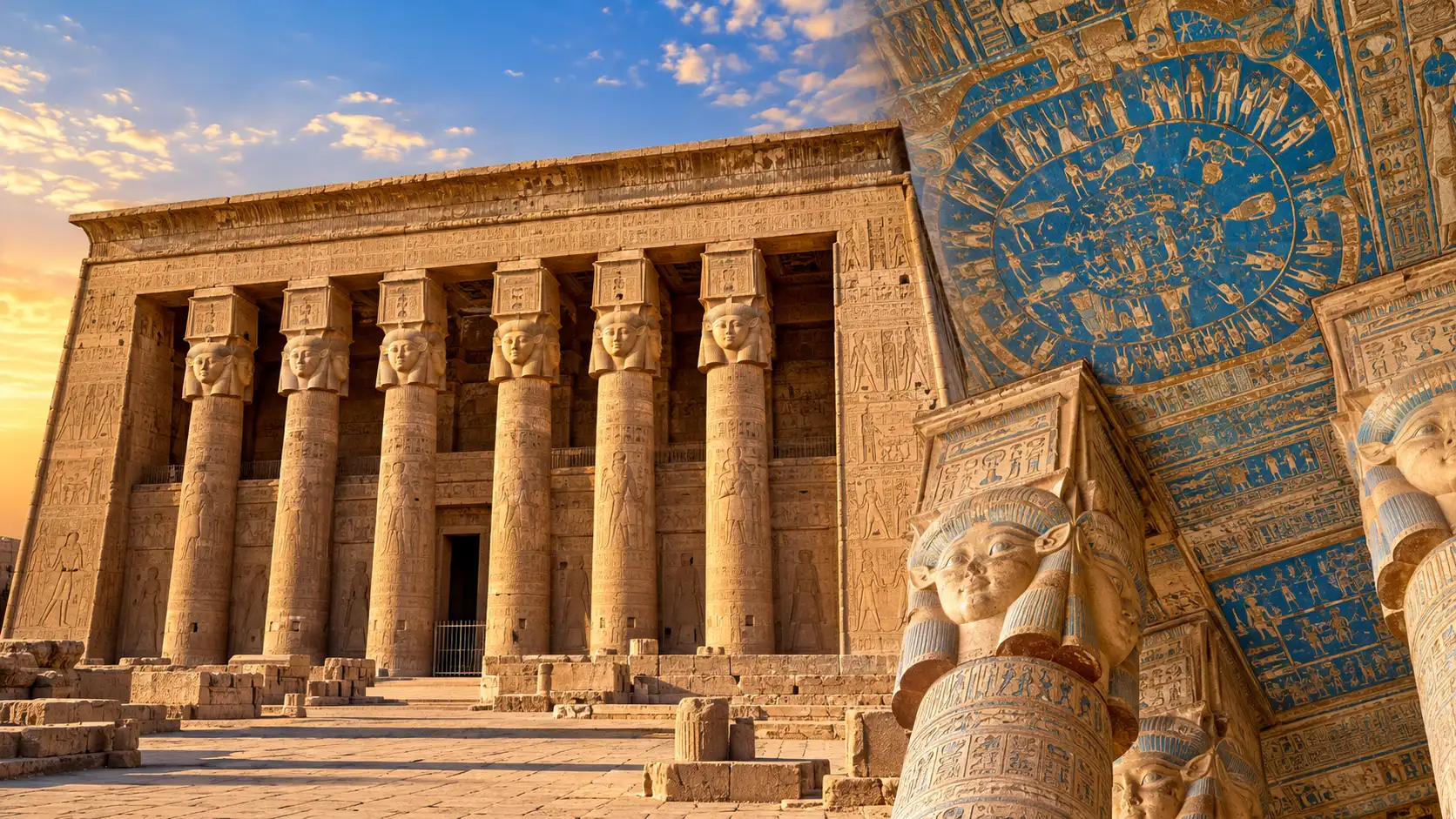
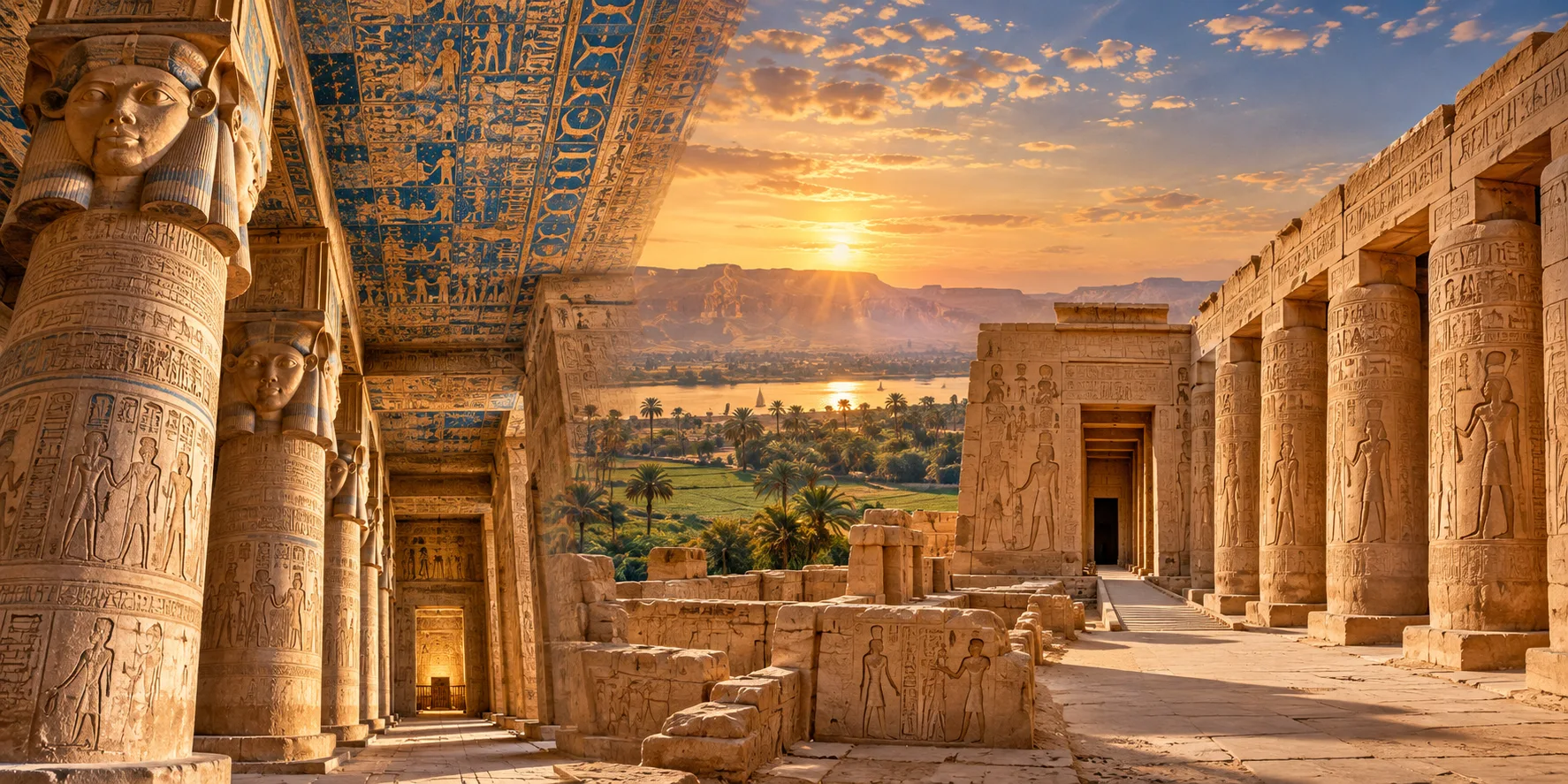
Step through the doorway of the Temple of Hathor at Dendera and look up. Where most ancient temples have surrendered their ceilings to time, this one still holds a painted night sky of stars, goddesses and celestial boats above your head.
The Temple of Hathor at Dendera is one of Egypt’s most remarkably preserved ancient temples. Standing near Qena, north of Luxor, this extraordinary monument is celebrated for its Hathor-headed columns, vivid astronomical ceilings, intricate religious carvings, underground crypts, and rooftop chapels.
Dedicated to Hathor, the ancient Egyptian goddess associated with music, joy, love, motherhood, and the sky, the temple offers a fascinating perspective on Egyptian religious life during the Ptolemaic and Roman periods.
What makes Dendera particularly special is how much of its architecture has survived. Unlike archaeological sites where temples have been reduced to foundations or scattered columns, the Temple of Hathor still contains enclosed halls, stairways, chambers, and decorated ceilings. It is also associated with the famous Dendera Zodiac, an ancient astronomical relief now displayed in the Louvre Museum in Paris.
For travelers planning a visit from Luxor, this guide explains the temple’s history, architecture, religious significance, most important artistic features, and practical visiting information. If you would rather skip the logistics, our private Dendera Temple half-day tour from Luxor handles everything for you.
Temple of Hathor at a Glance
Location
Dendera Temple Complex, near Qena in Upper Egypt
Dedicated To
Hathor, goddess of music, joy, love, motherhood and the sky
Main Period
Late Ptolemaic, with Roman-era decoration
From Luxor
Private half-day excursion of about 5 hours
Getting your bearings
Where Is the Temple of Hathor Located?
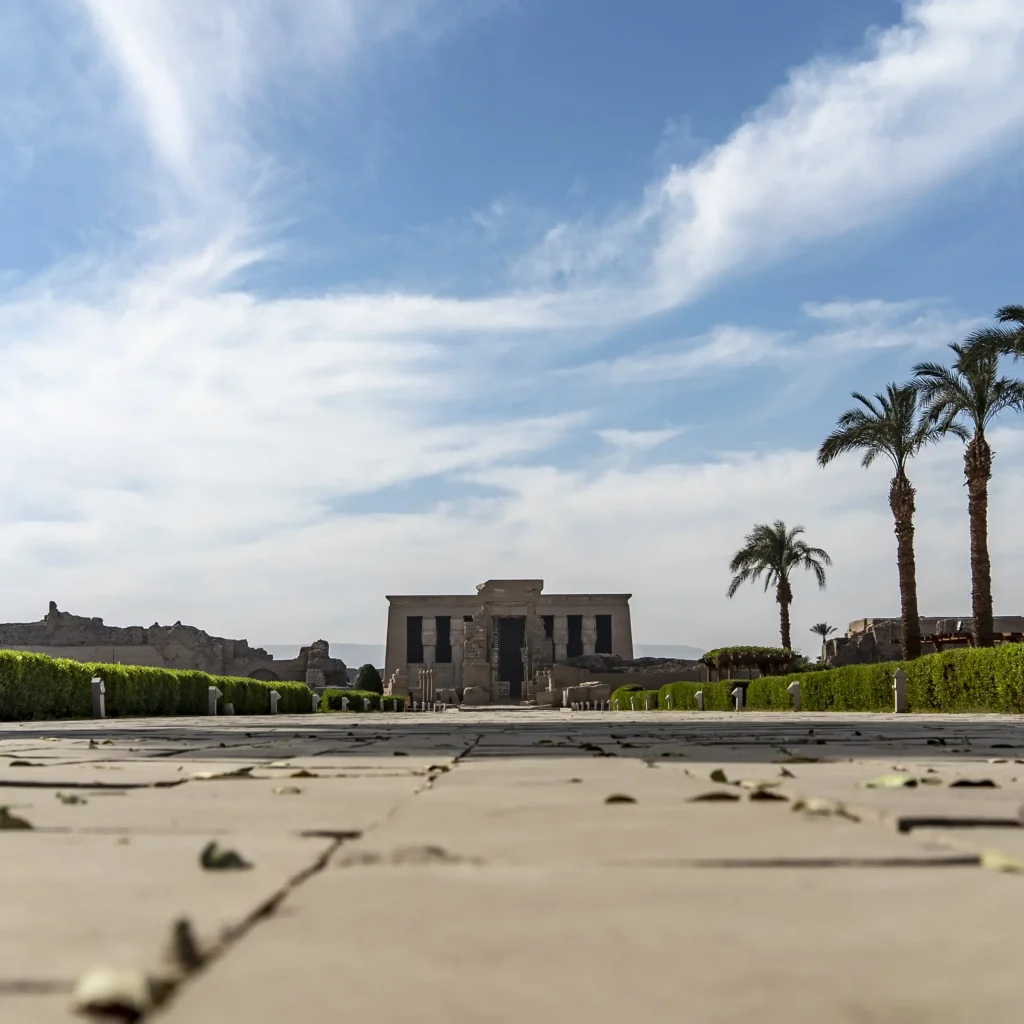
The Temple of Hathor is located within the Dendera Temple Complex, near the modern city of Qena in Upper Egypt.
Dendera stands north of Luxor, on the western side of the Nile Valley. Although travelers sometimes refer to it as the Temple of Hathor in Luxor, the archaeological site lies outside Luxor itself.
It is roughly 60 to 75 kilometres from Luxor, depending on the route, which makes it ideal for a dedicated half-day trip.
The journey is part of the experience. Agricultural land, villages, and the Nile Valley countryside replace the busy streets and hotel districts of central Luxor. For visitors staying in Luxor, Dendera offers a major ancient Egyptian religious site without changing hotels or arranging a multi-day itinerary. Pair it with our other Luxor tours for a complete Upper Egypt stay.
The goddess
Who Was Hathor in Ancient Egyptian Religion?
Hathor was one of ancient Egypt’s most important goddesses. Her worship had deep roots in Egyptian religious tradition, and her identity embraced several aspects of both everyday and divine life.
Music and Joy
Patron of dancing, celebration and the sistrum, the rattle-like instrument shaken in temple ceremonies.
Love and Motherhood
A nurturing figure, often shown as a cow or a woman with cow-like ears.
Sky and Sun
Frequently depicted wearing a sun disk between cow horns, linking her to the heavens.
Hathor was also closely connected with Horus, the falcon-headed god associated with kingship. In the religious traditions of Dendera and Edfu, the two deities were linked through sacred celebrations and ritual encounters.
Good to know: The Egyptian Ministry of Tourism and Antiquities identifies Dendera as Hathor’s principal cult centre and highlights the temple’s unusual state of preservation.
The story
Temple of Hathor History: Who Built the Temple?
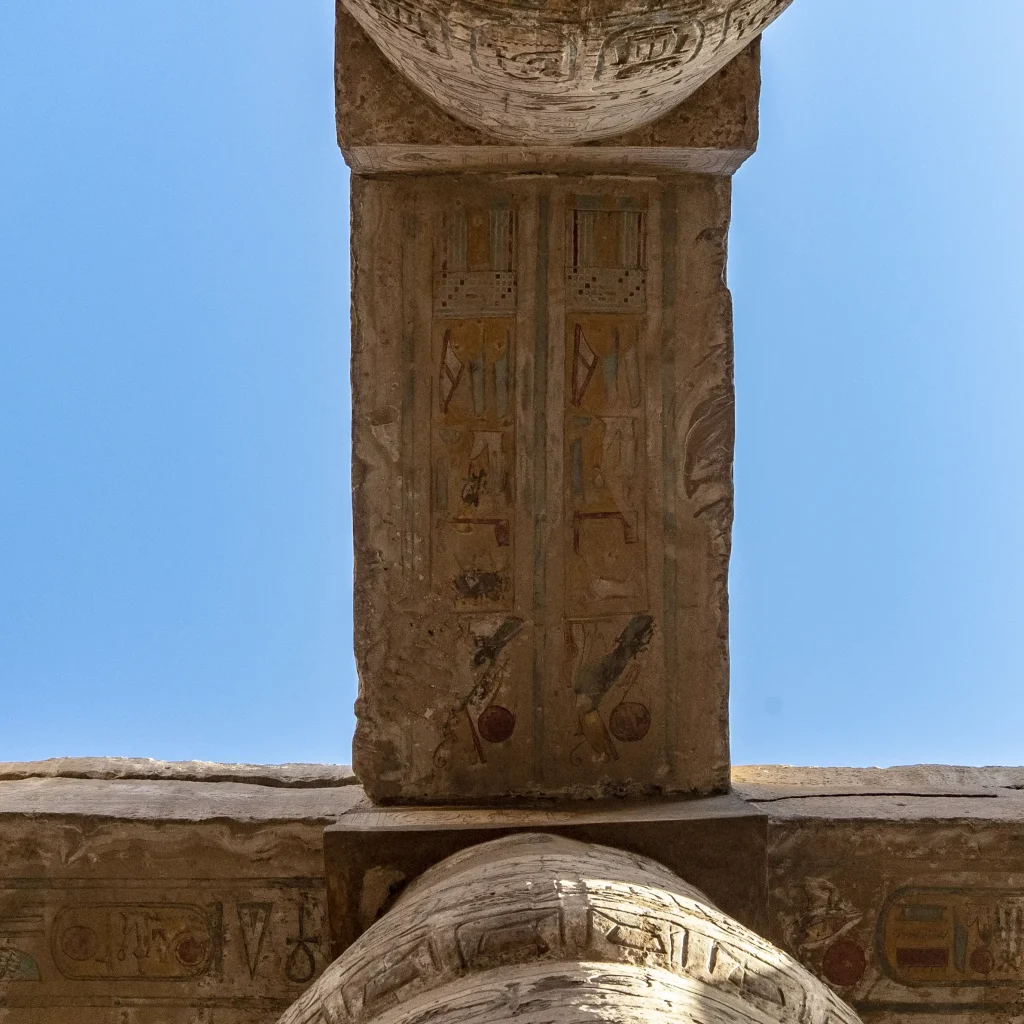
Religious activity at Dendera is considerably older than the temple visitors see today. According to Egypt’s Ministry of Tourism and Antiquities, evidence of earlier structures extends back to the Old Kingdom, including the reign of King Pepy I of the Sixth Dynasty. The surviving main temple, however, belongs primarily to the Ptolemaic period, with further construction and decoration under Roman rule.
Old Kingdom
Earlier structures at the site, linked to King Pepy I of the Sixth Dynasty.
Late Ptolemaic Period
The surviving temple was developed, with main construction associated with the first century BCE.
Roman Period
After 30 BCE, construction and decoration continued under Roman emperors.
The Ptolemaic Period
Following Alexander the Great’s conquest of Egypt, the country came under the rule of the Ptolemaic dynasty. Although the dynasty originated from a Macedonian Greek background, its rulers adopted established Egyptian religious traditions and commissioned monuments using traditional Egyptian architectural and artistic forms.
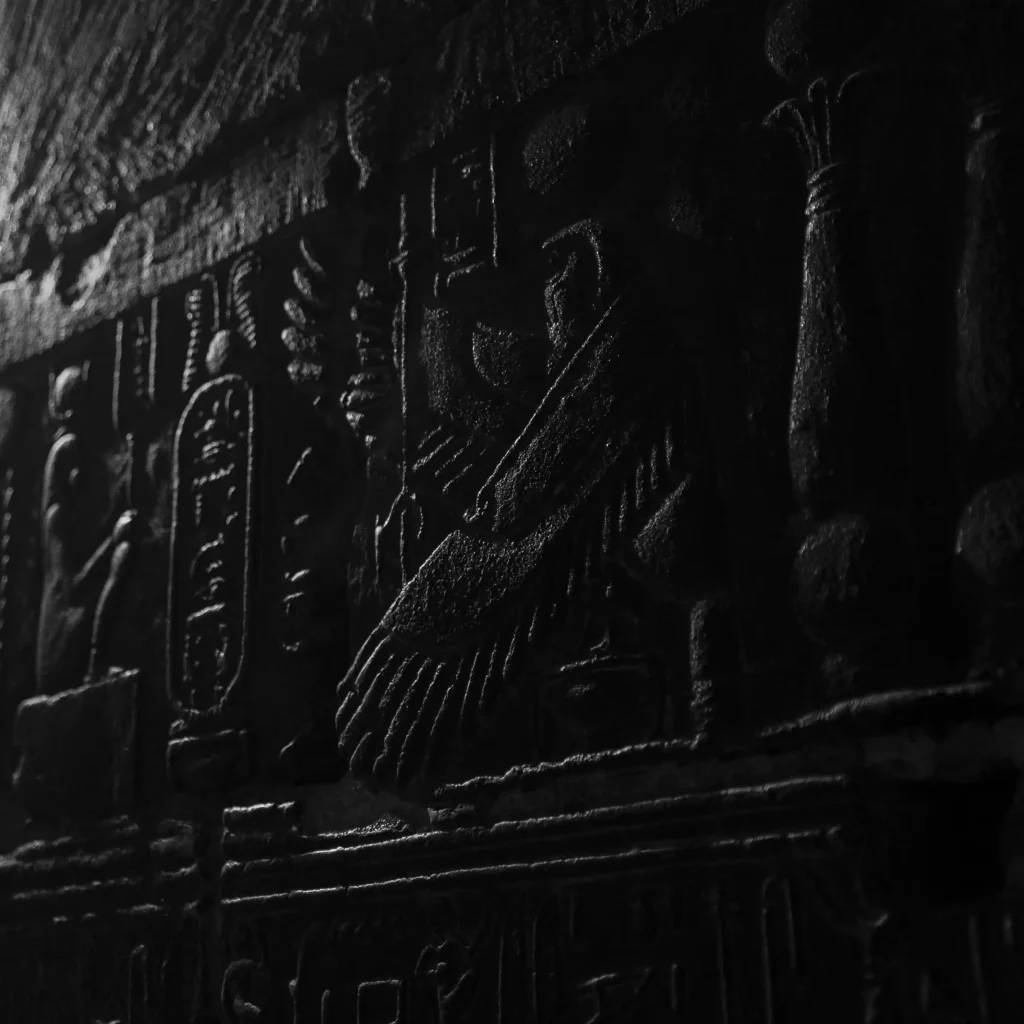
Scenes carved on the temple walls show rulers performing ritual offerings before Egyptian deities, expressing the religious responsibilities traditionally associated with kingship.
The Roman Period
After Egypt became a Roman province in 30 BCE, temple construction and decoration continued. Roman emperors were represented on Egyptian temple walls in the clothing and ceremonial roles traditionally associated with pharaohs. Dendera therefore illustrates the remarkable continuity of Egyptian religious architecture through major political change, with artistic traditions that originated centuries earlier remaining influential under both Greek-speaking Ptolemaic rulers and Roman emperors.
Inside the temple
Architecture of the Temple of Hathor
The temple is particularly impressive because of the relationship between its monumental architecture and its elaborate decoration. As visitors move through the building, they pass from spacious columned halls into smaller chambers associated with increasingly restricted religious functions, a progression that reflects the importance of sacred space in ancient Egyptian temple design.
The Great Hypostyle Hall
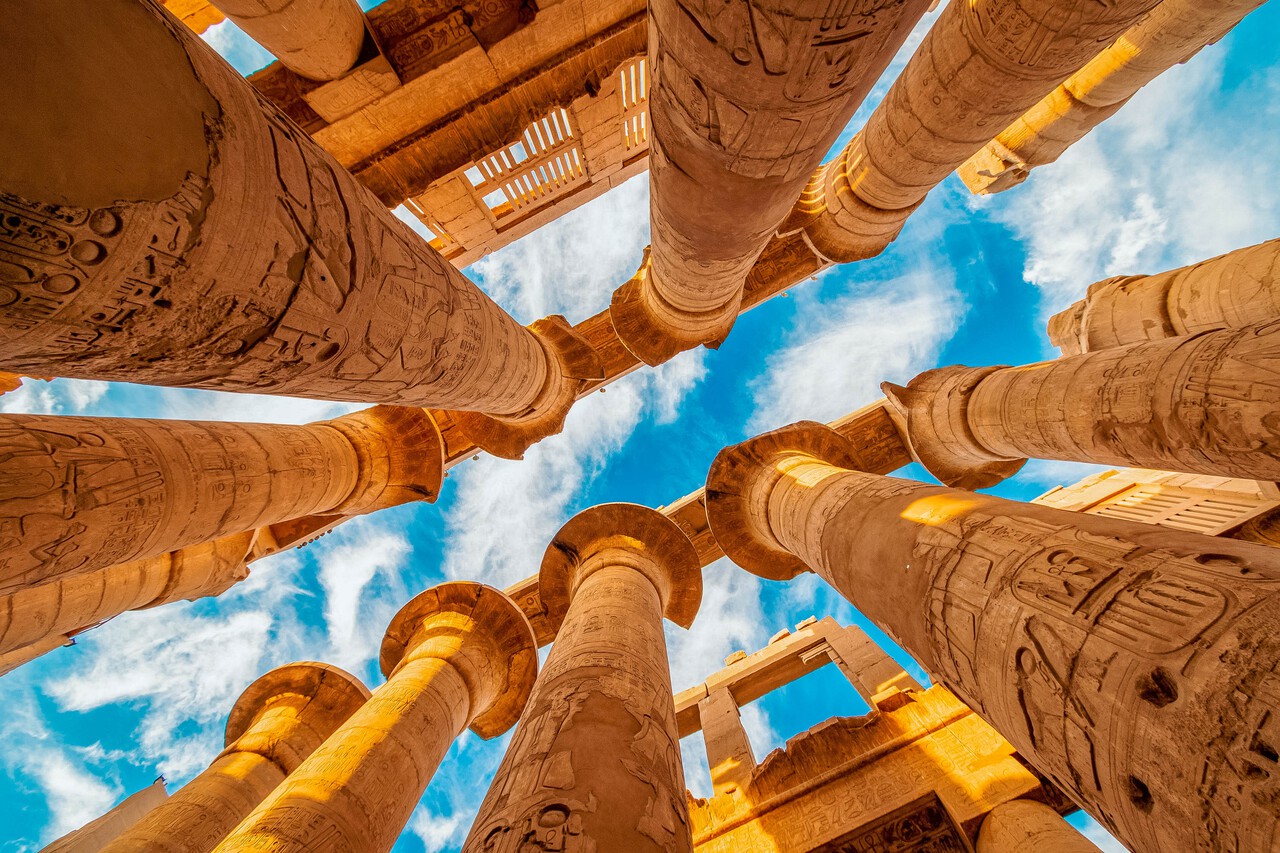
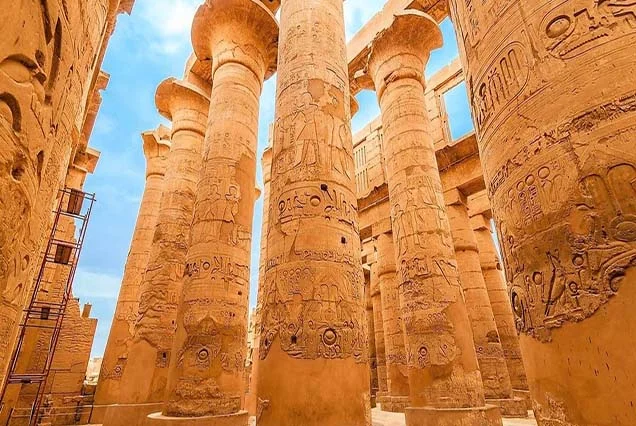
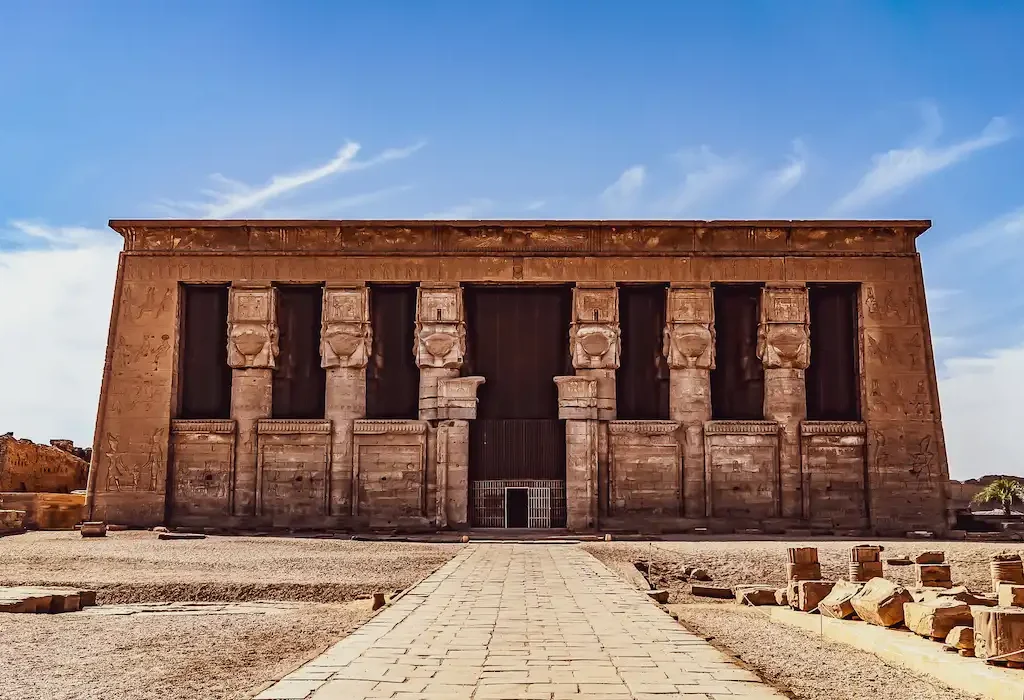
The hypostyle hall is among the temple’s most recognisable architectural features. Its substantial columns are crowned by capitals decorated with Hathor’s face, making the goddess an integral part of the building’s visual identity. The entrance itself features six massive columns with Hathor-headed capitals, framed by decorative elements associated with the sistrum.
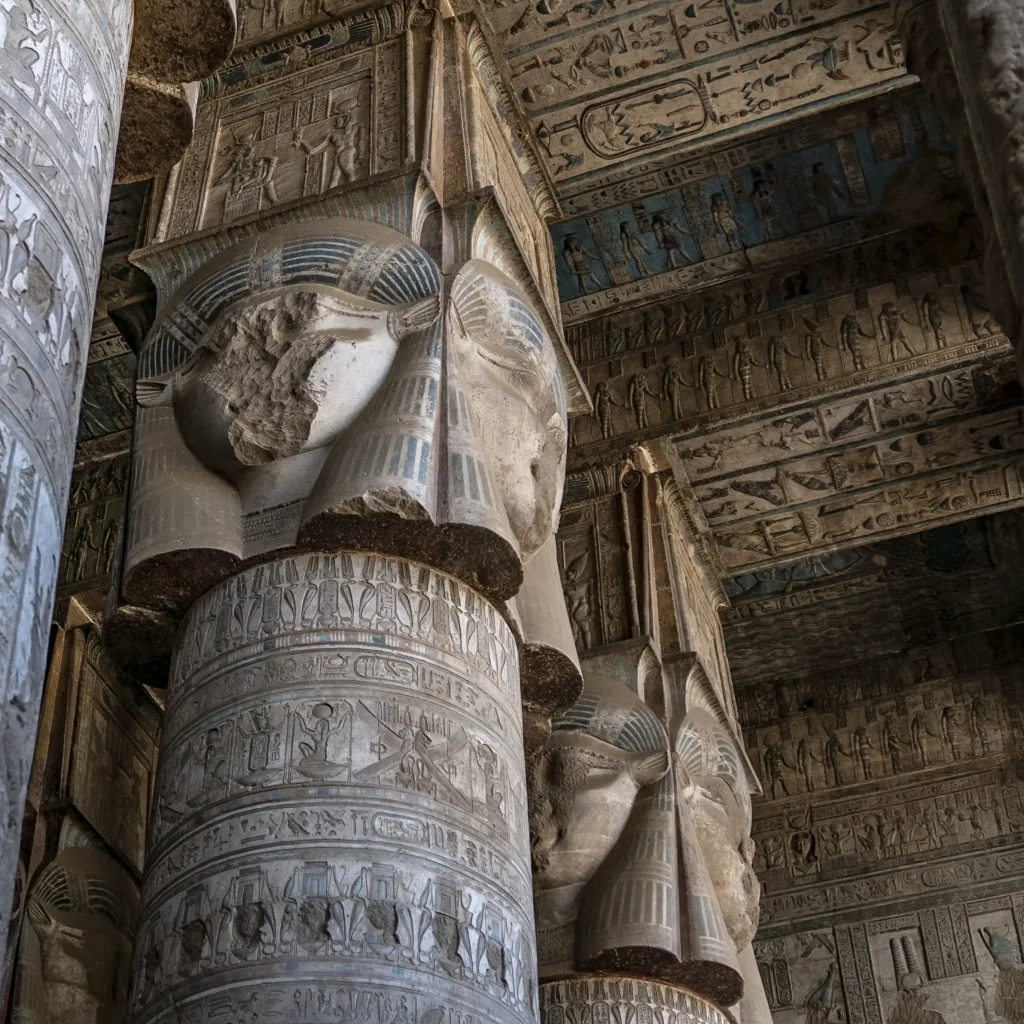
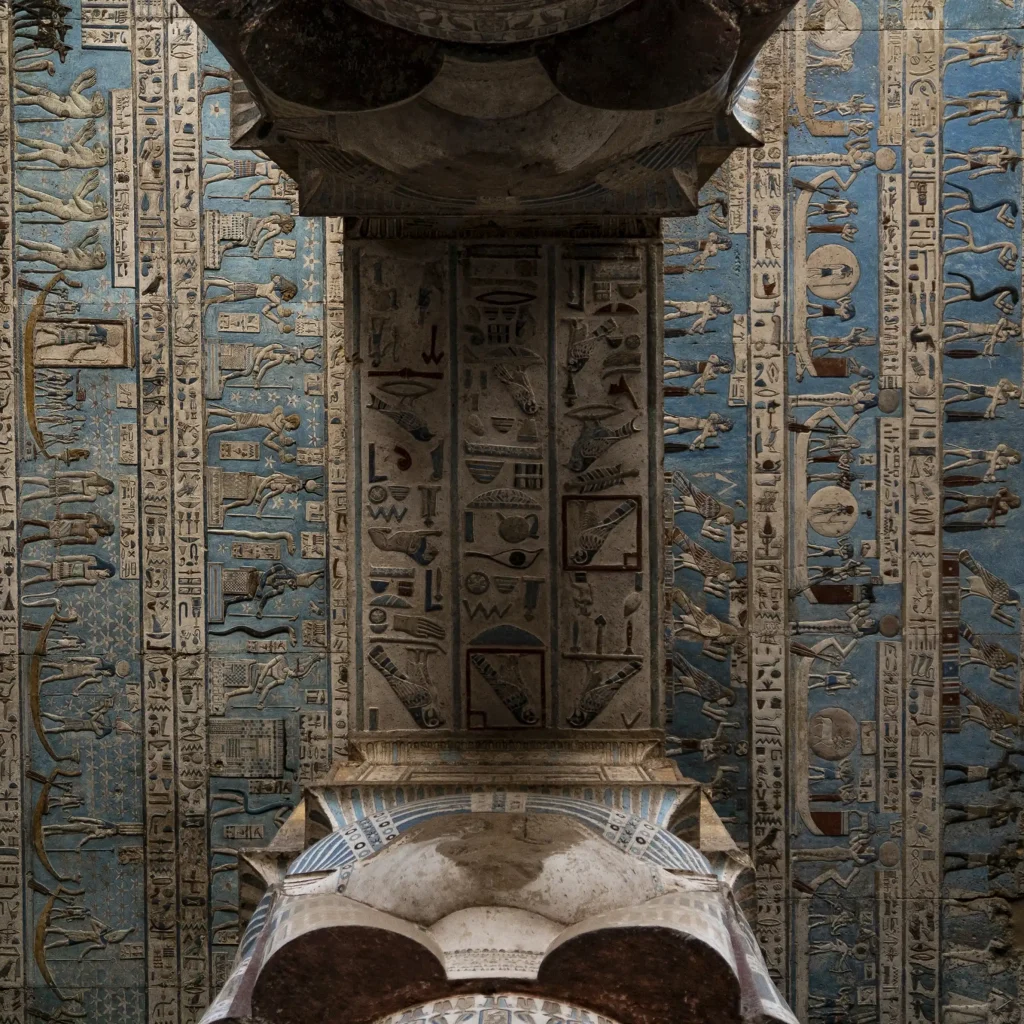
Inside the hall, the columns support an elaborately decorated ceiling covered with religious and celestial imagery. The atmosphere is very different from that of an open courtyard: the enclosed space lets you appreciate the relationship between monumental stone architecture and detailed surface decoration.
The Astronomical Ceiling
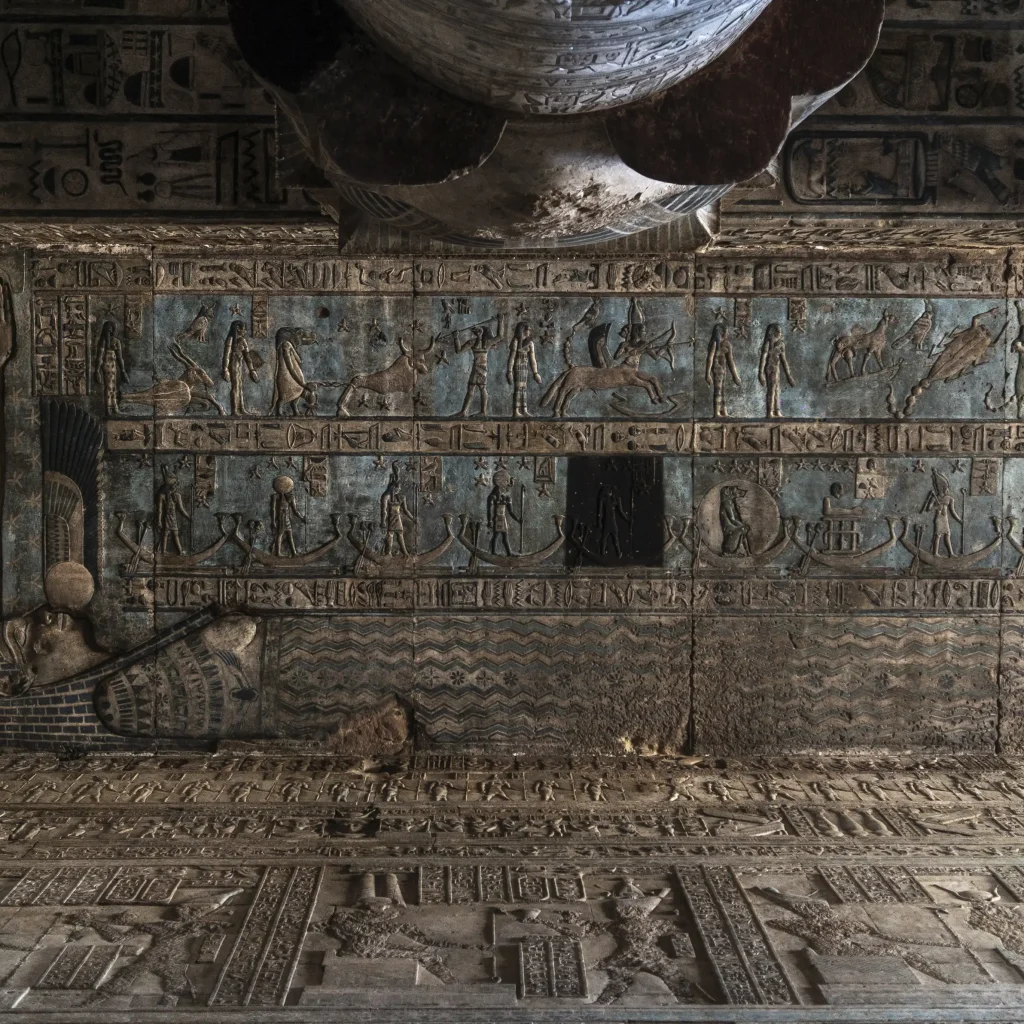
Look up. These ceilings were designed to be read like a map of the heavens.
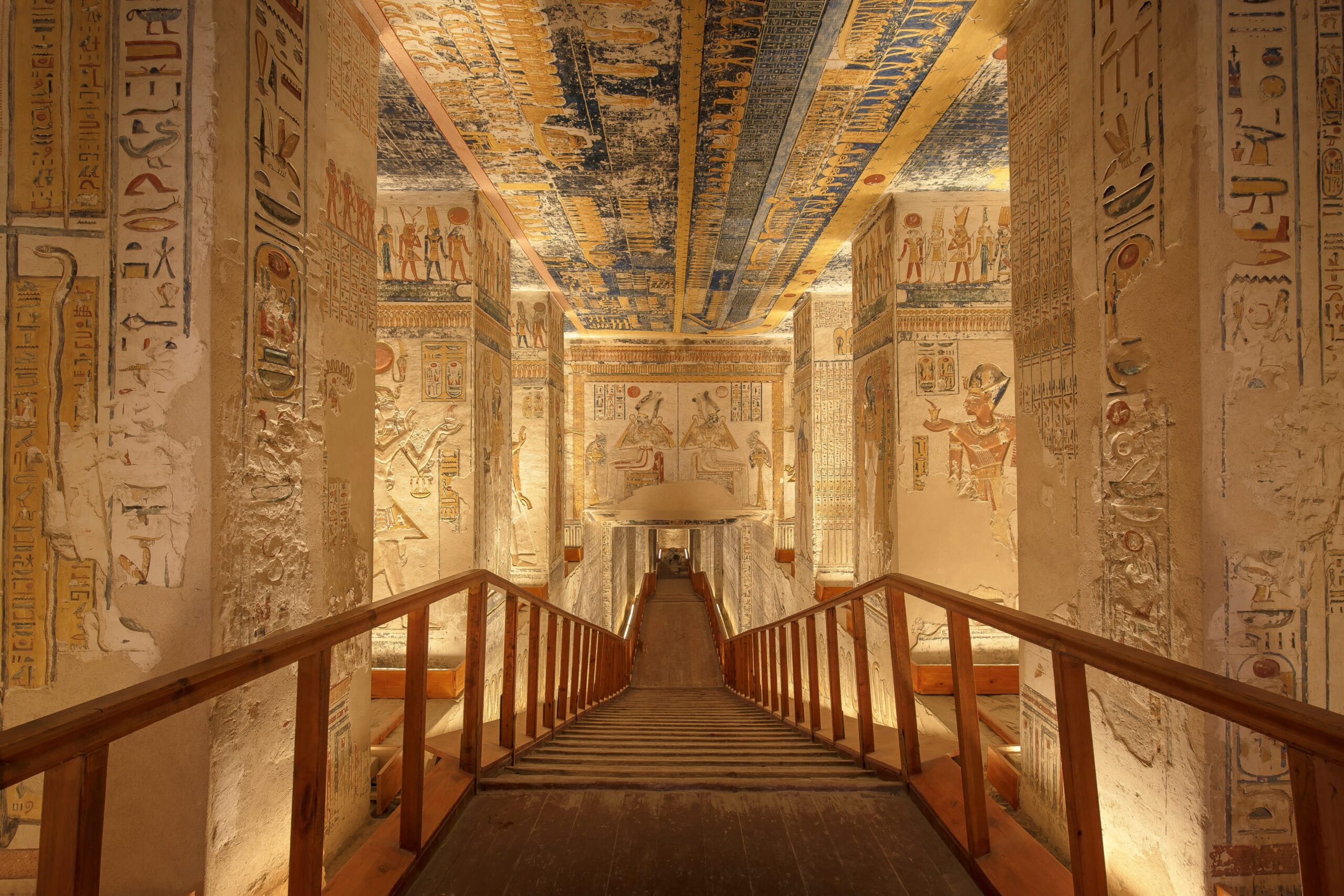
One of the most remarkable features of the Temple of Hathor is its painted astronomical ceiling. The decorations include representations of heavenly bodies, celestial figures, and religious scenes associated with the Egyptian understanding of the cosmos, a worldview in which the sky, the movement of celestial bodies, and divine activity were closely connected.
The ceiling also reveals the complexity of temple decoration. It was not simply intended to make the building beautiful; its imagery communicated religious ideas through symbols that priests and educated members of Egyptian society would have understood. Restoration work has helped reveal the colours and details of some decorated surfaces.
The Sanctuary and Offering Chambers
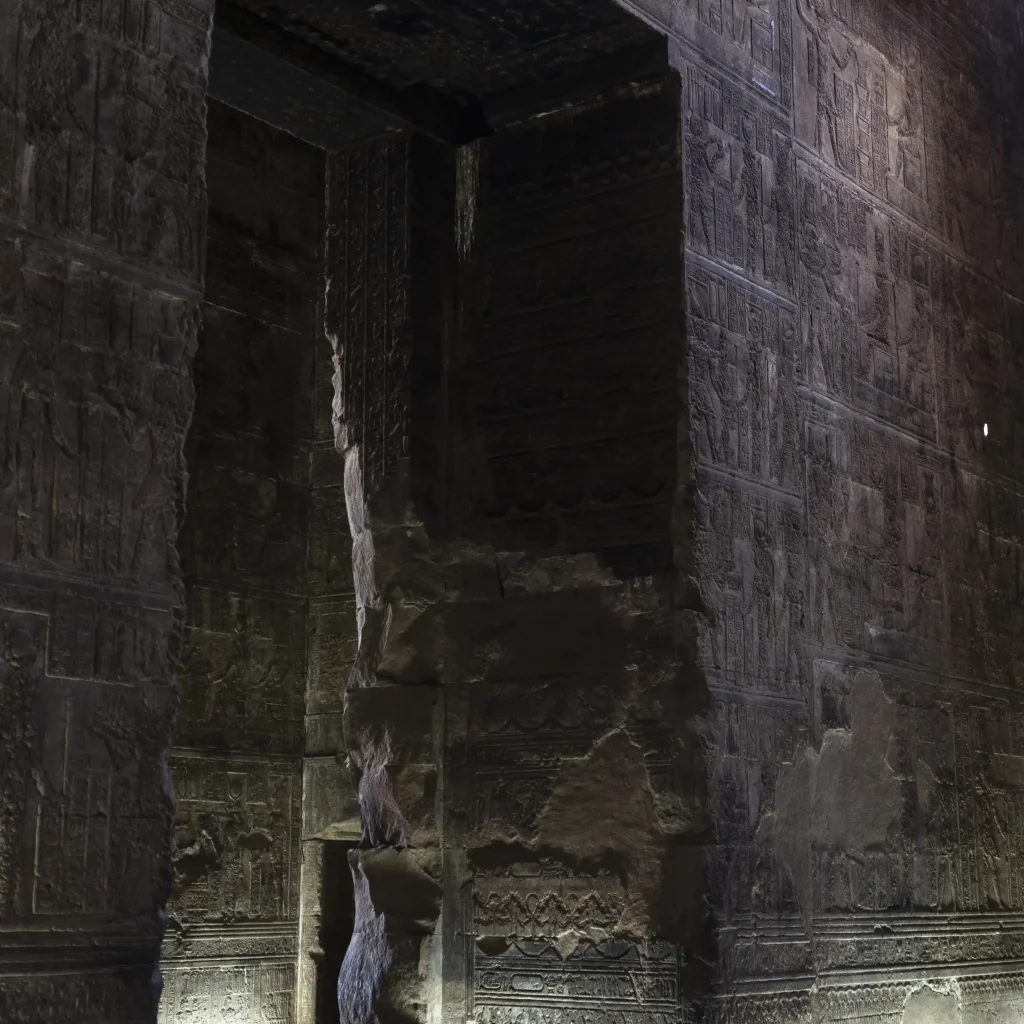
Beyond the principal halls are smaller rooms associated with ritual activities. The sanctuary formed the religious centre of the temple, while surrounding chambers supported different ceremonial functions.
Reliefs depict rulers presenting offerings to gods and goddesses, symbolising the relationship between kingship, divine authority, and the maintenance of cosmic order. Even where the original ceremonial objects have disappeared, the architecture and decoration show how the temple was designed to function.
Egypt in the sky
The Dendera Zodiac: Ancient Egyptian Astronomy
The Dendera Zodiac is one of the most famous astronomical representations associated with ancient Egypt. Originally located on the ceiling of an Osiris chapel on the temple’s roof, the circular relief depicts constellations, zodiacal signs, and other celestial figures.
Its circular composition distinguishes it from many earlier Egyptian astronomical representations, and it reflects a period when Egyptian religious traditions interacted with astronomical ideas circulating throughout the Mediterranean world.
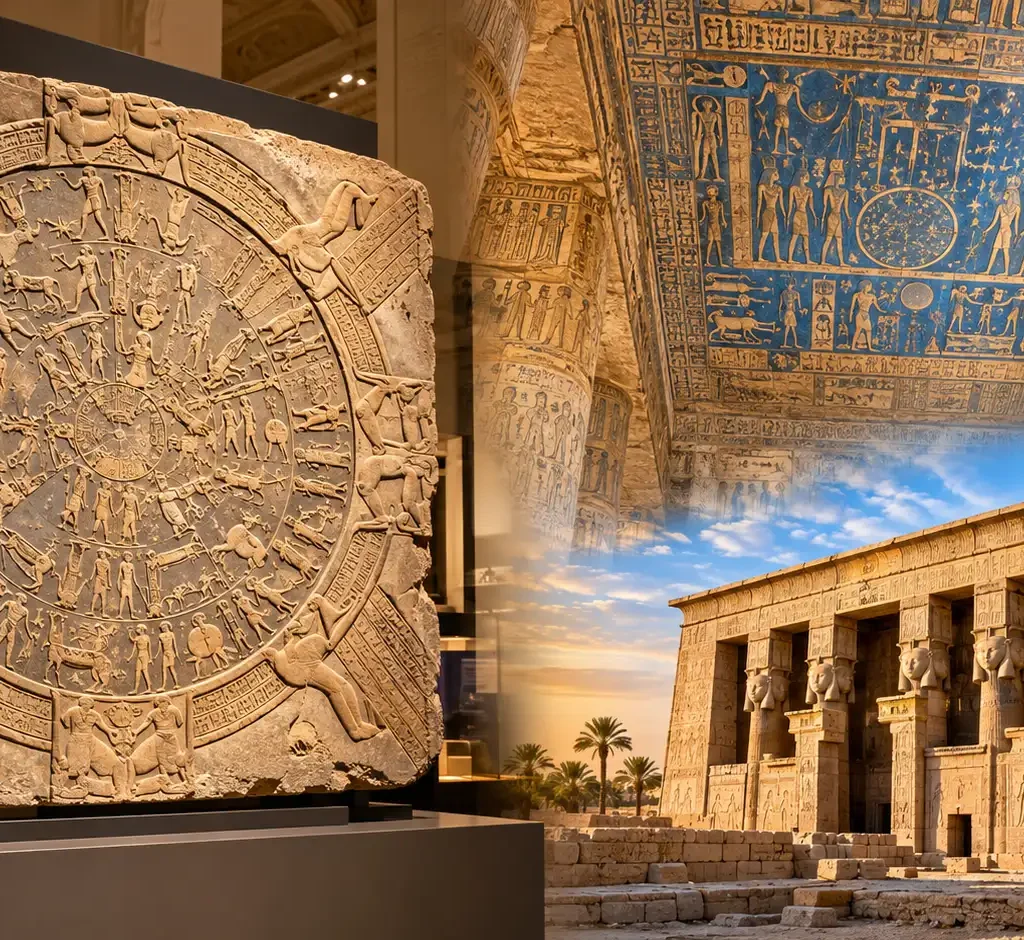
Where Is the Original Dendera Zodiac Today?
The original Dendera Zodiac is held by the Louvre Museum. According to the Louvre’s official collection record, the zodiac dates to approximately 50 BCE and originally decorated an Osiris chapel on the roof of the Temple of Hathor. The relief was removed from the temple in 1821 and transported to France, where it entered the French royal collections.
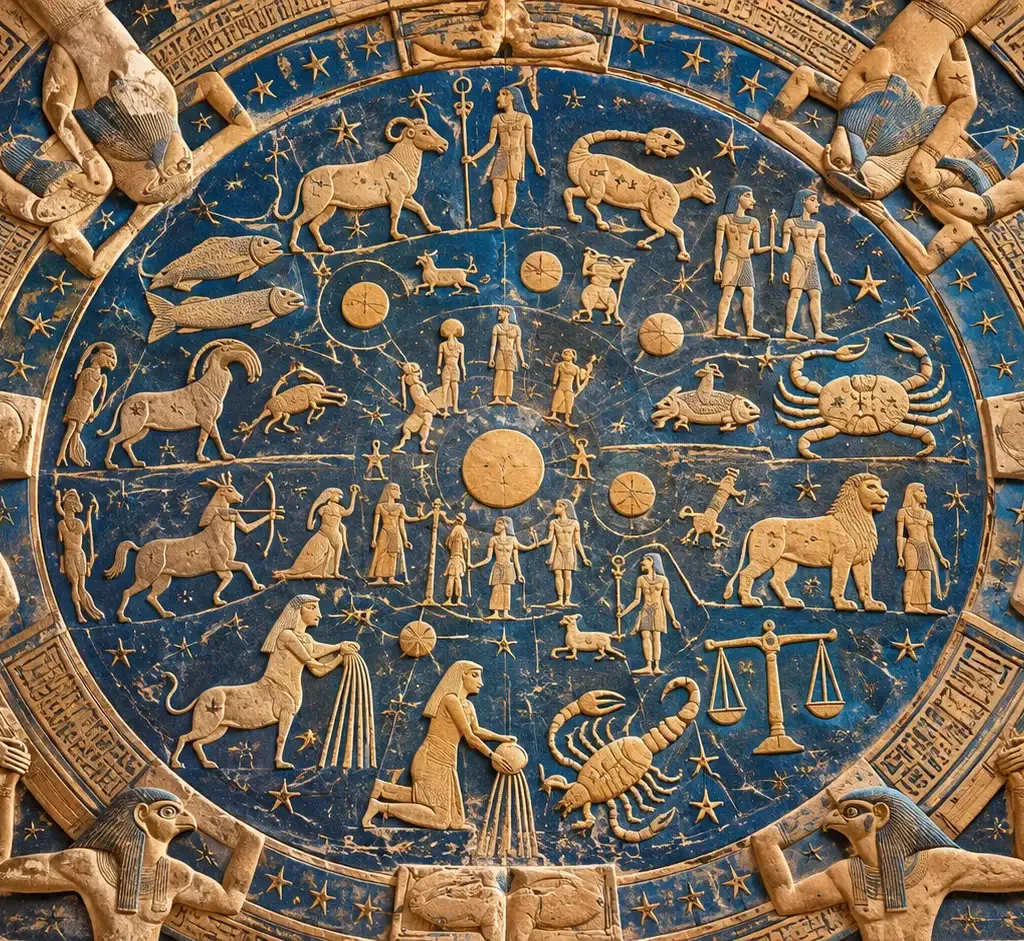
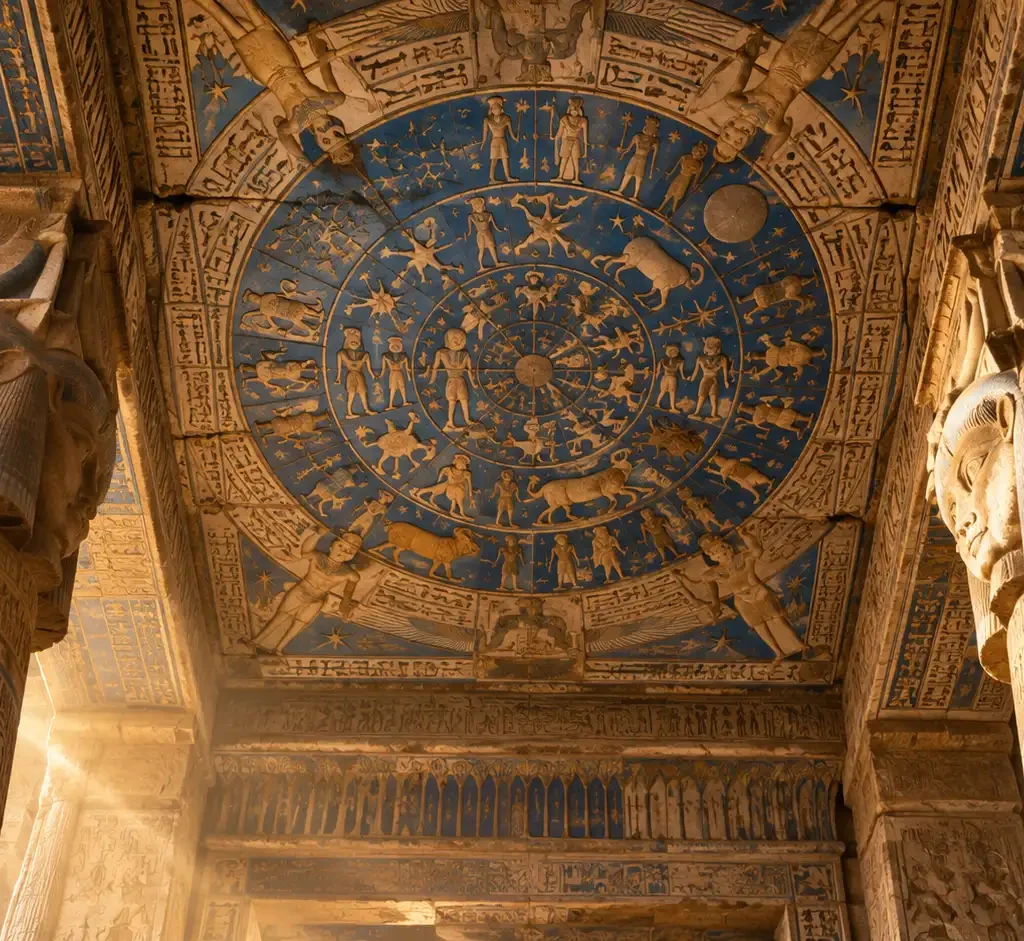
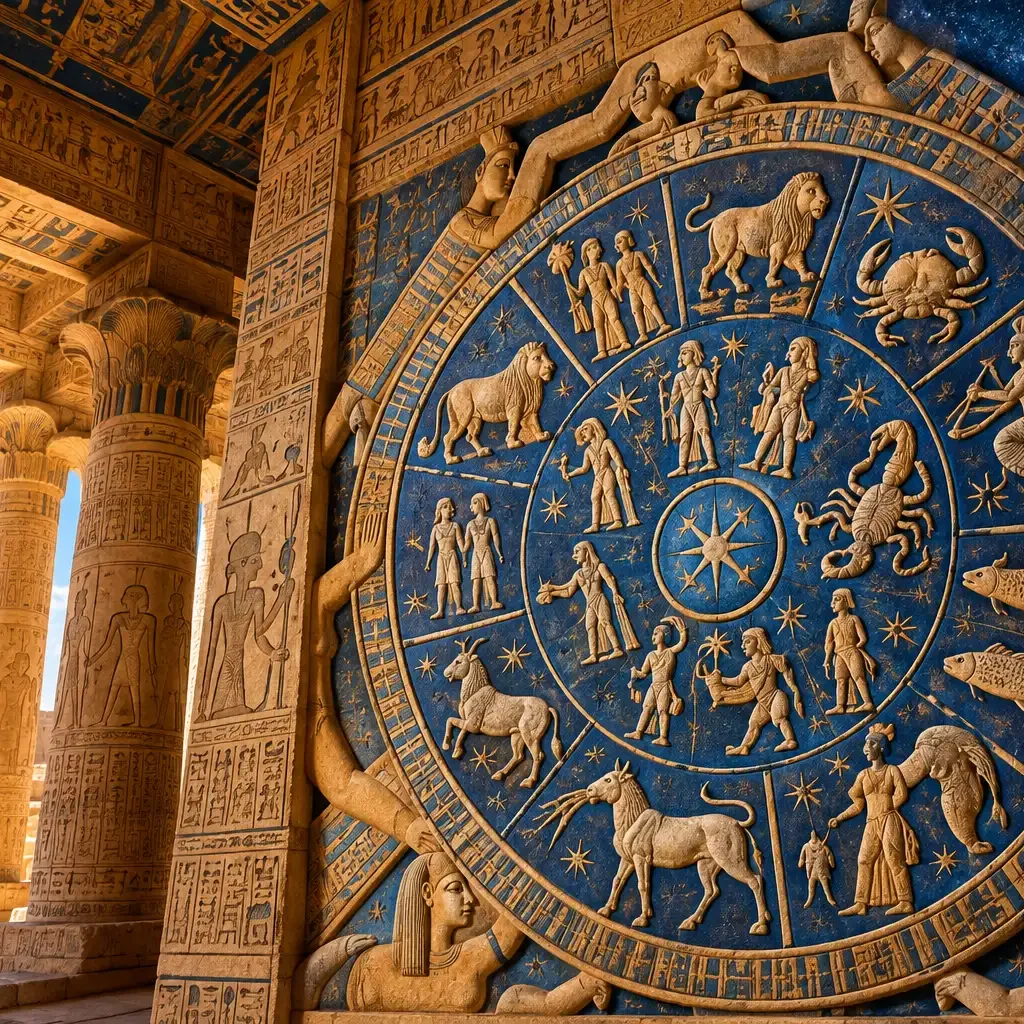
Visitors to Dendera can still explore the temple’s astronomical decorations and see the architectural location associated with the famous relief, subject to the site’s access arrangements.
Not a horoscope: It is important to distinguish the historical Dendera Zodiac from modern horoscope practices. Although the artwork includes zodiacal imagery, its original meaning was connected with ancient religious and astronomical traditions.
Myth vs. Egyptology
The Dendera Light: What Does the Famous Relief Represent?
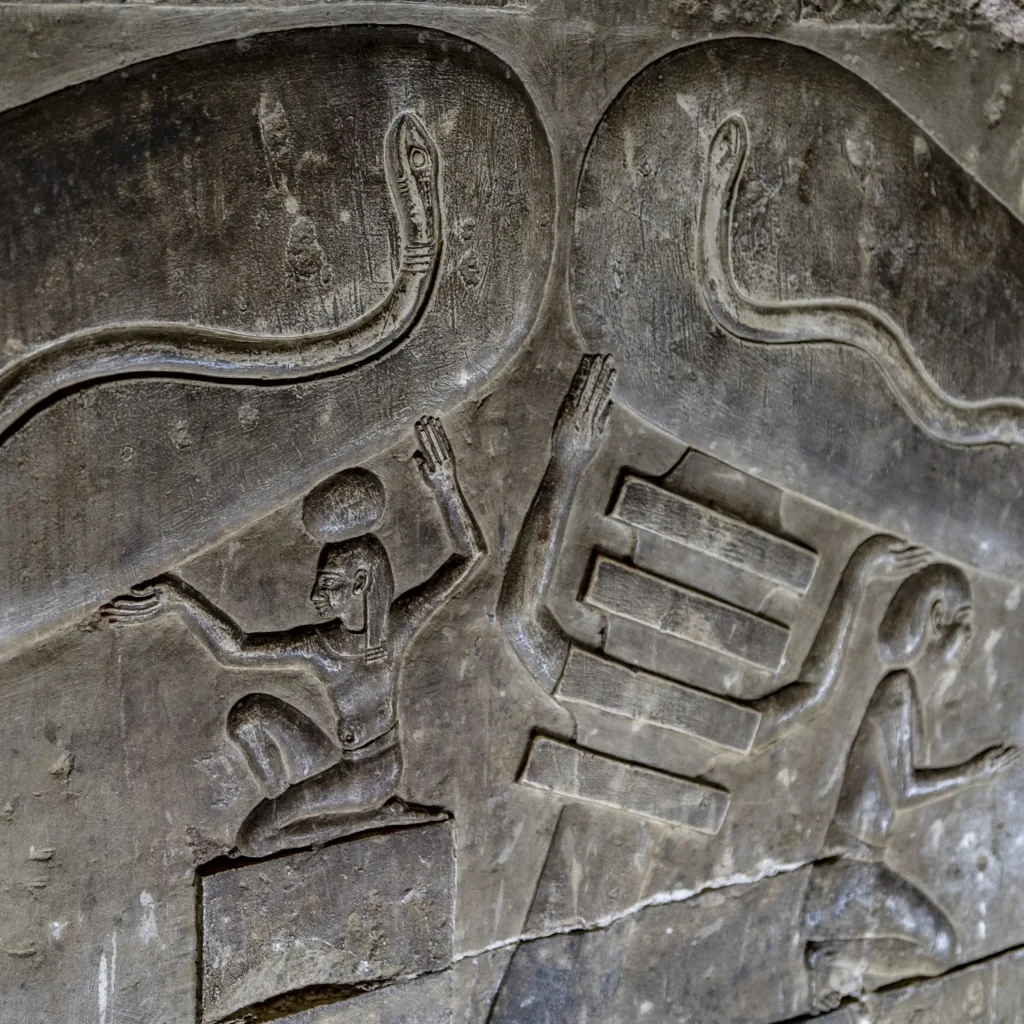
Among the temple’s most discussed decorations is a relief popularly called the Dendera Light. The image contains an elongated form, a serpent, and symbolic elements associated with Egyptian mythology.
The Popular Claim
Some modern alternative interpretations claim that the scene depicts an ancient electric lamp. No reliable archaeological evidence shows that the ancient Egyptians used electrical lighting based on this relief.
The Egyptological View
The conventional interpretation reads the imagery through religious symbolism linked to the deity Harsomtus, creation, and rebirth.
The scene is best approached as part of the temple’s complex religious decoration rather than as evidence of an otherwise undocumented ancient technology.
Hidden chambers
The Underground Crypts of Dendera Temple
The Temple of Hathor contains underground and concealed chambers commonly called crypts. These spaces were associated with the protection and storage of sacred objects, including items connected with temple ceremonies, and their architecture differs considerably from the large halls above ground.
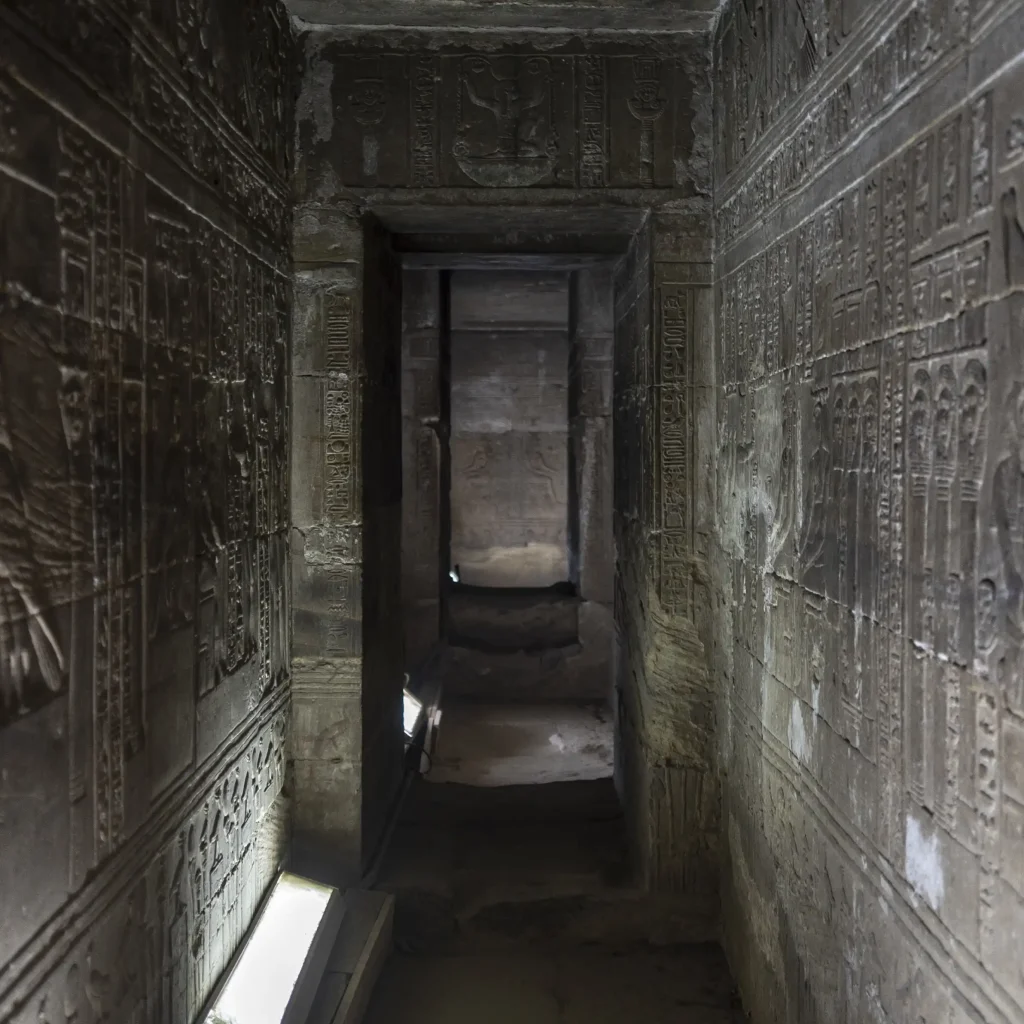
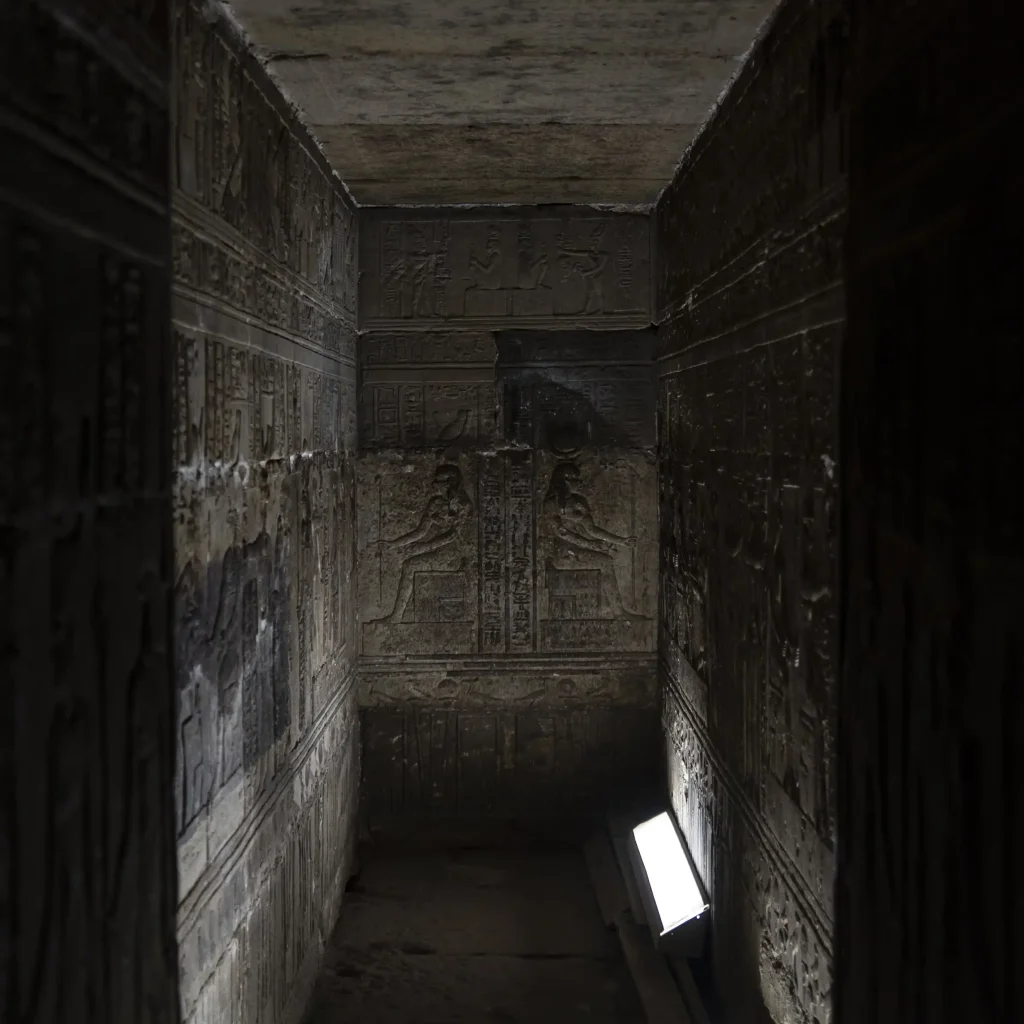
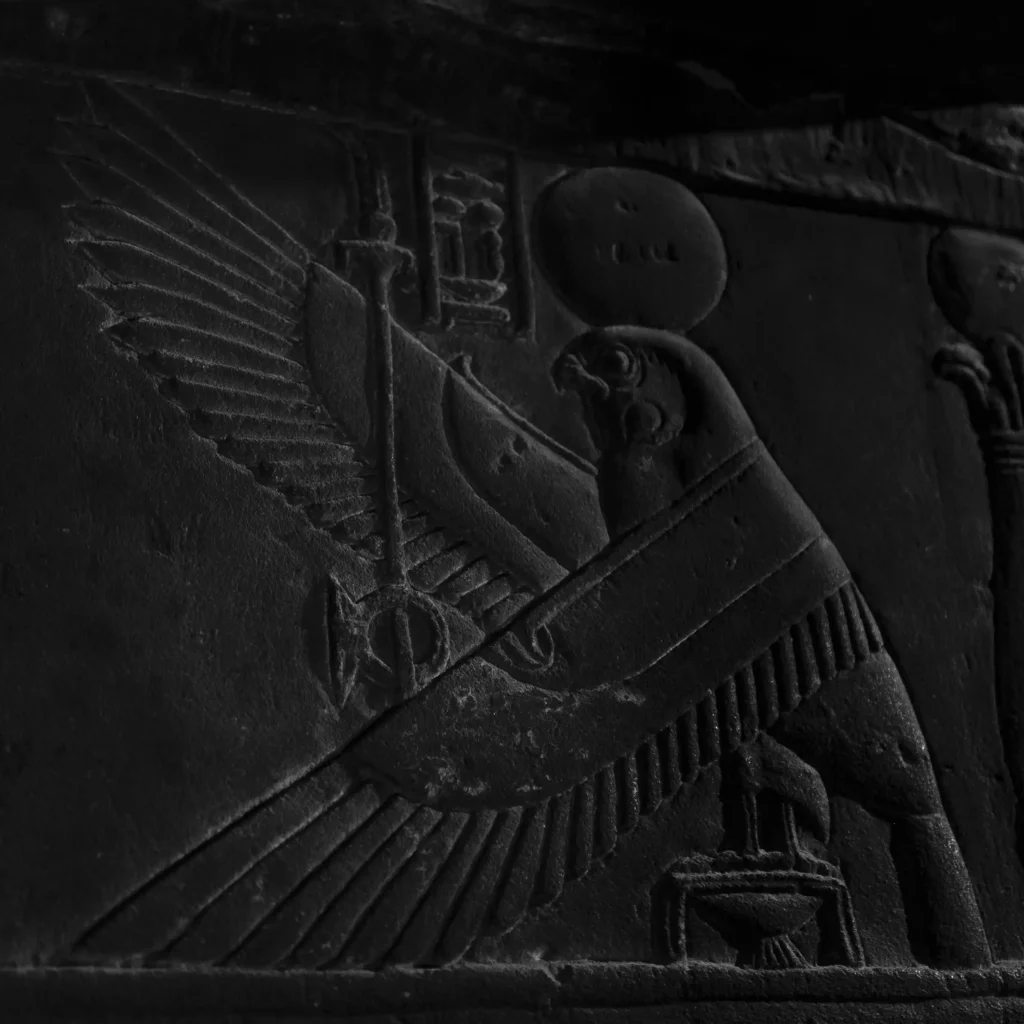
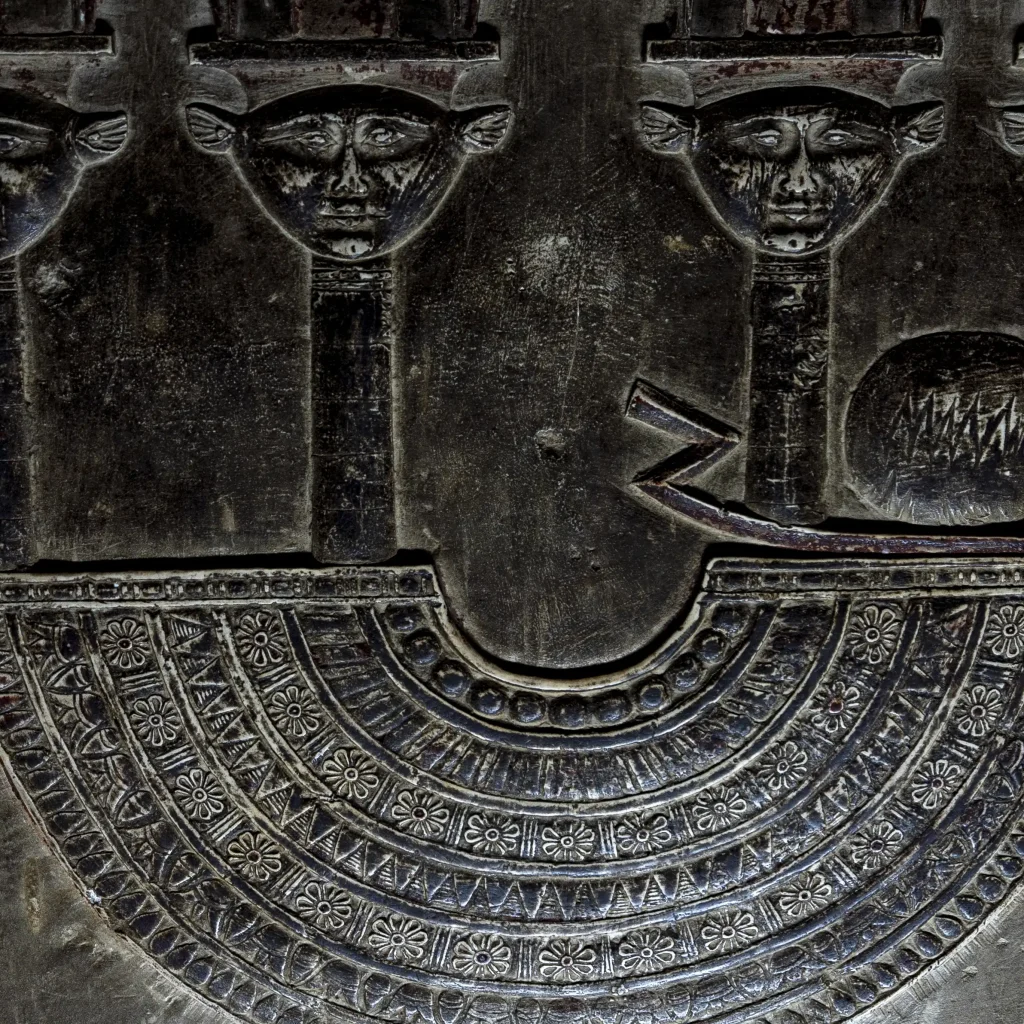
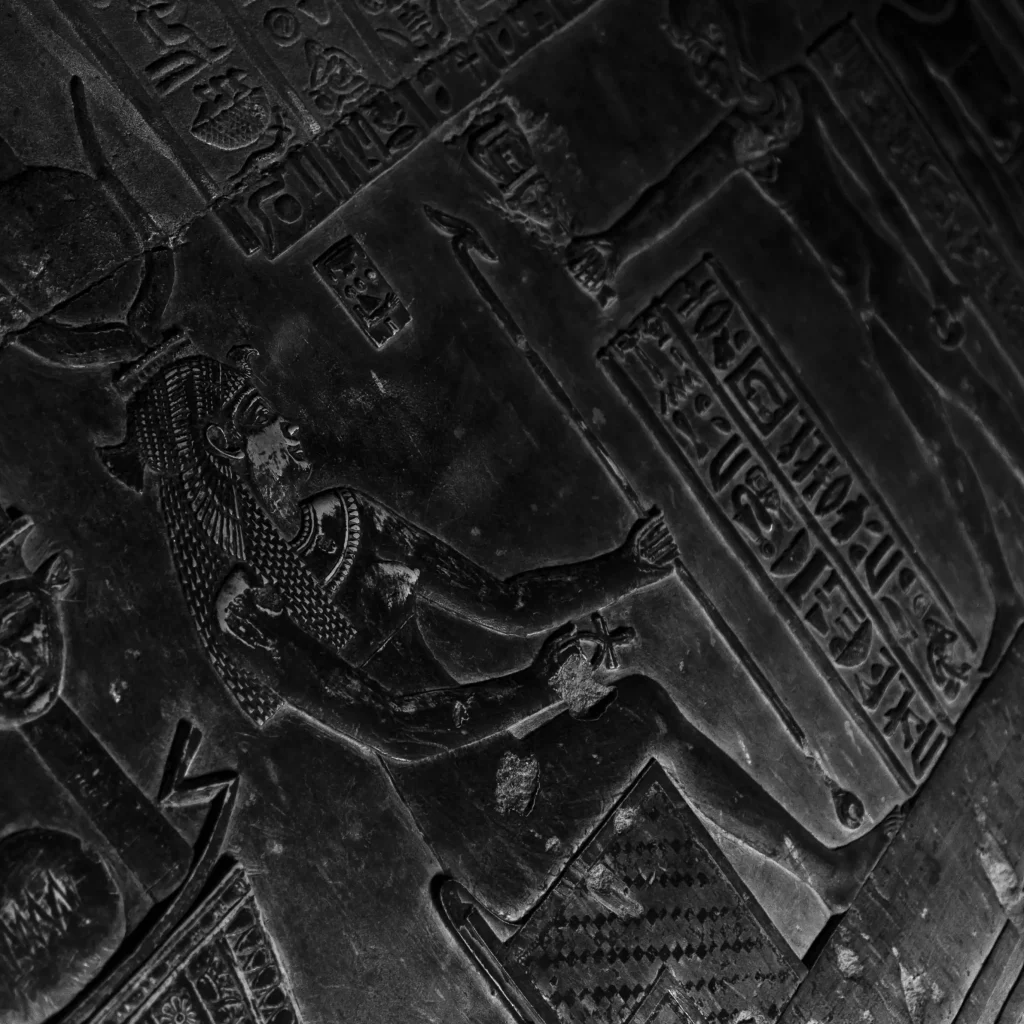
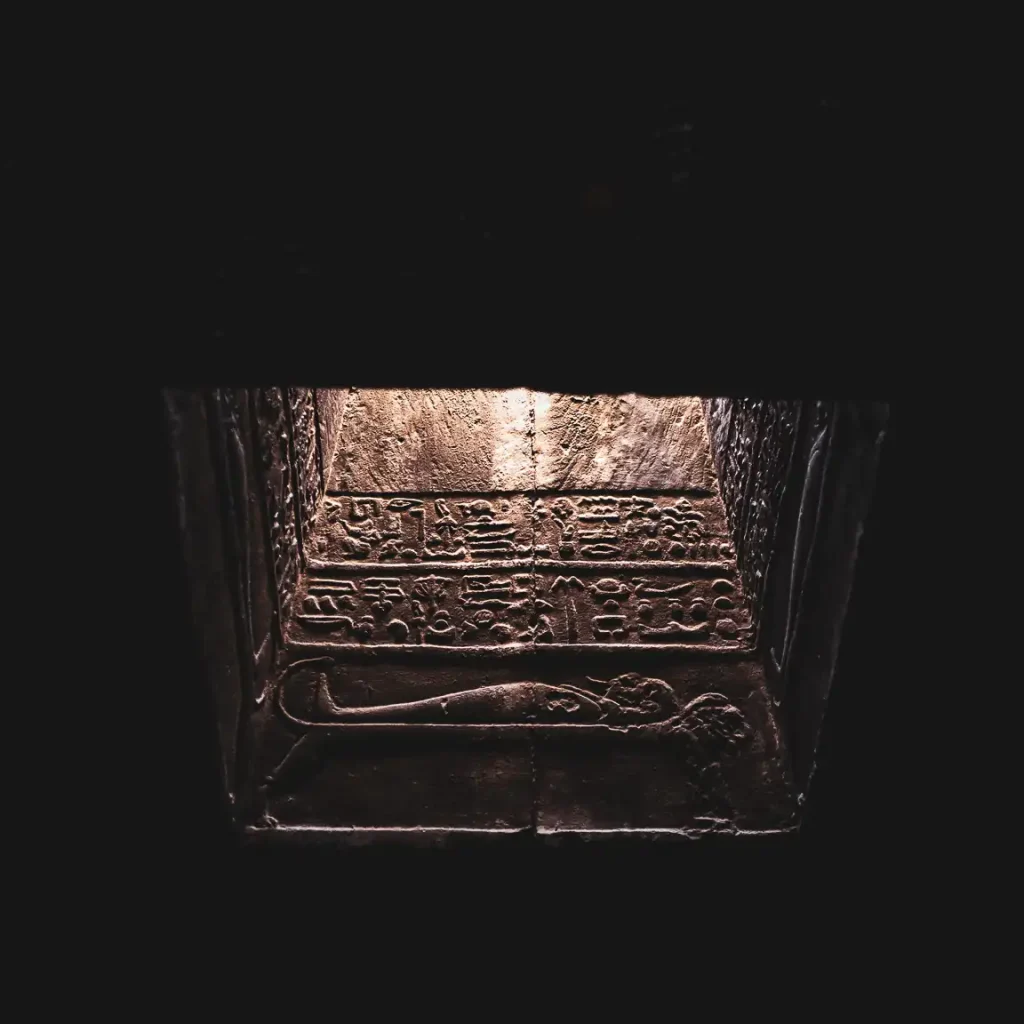
Some passages are narrow, and their decorated walls contain detailed religious scenes that reward close examination. The crypts are especially interesting because they reveal aspects of temple organisation that are not visible from the monumental entrance. Access may depend on current archaeological regulations and additional ticket arrangements.
Above it all
The Rooftop Chapels and Sacred Stairways
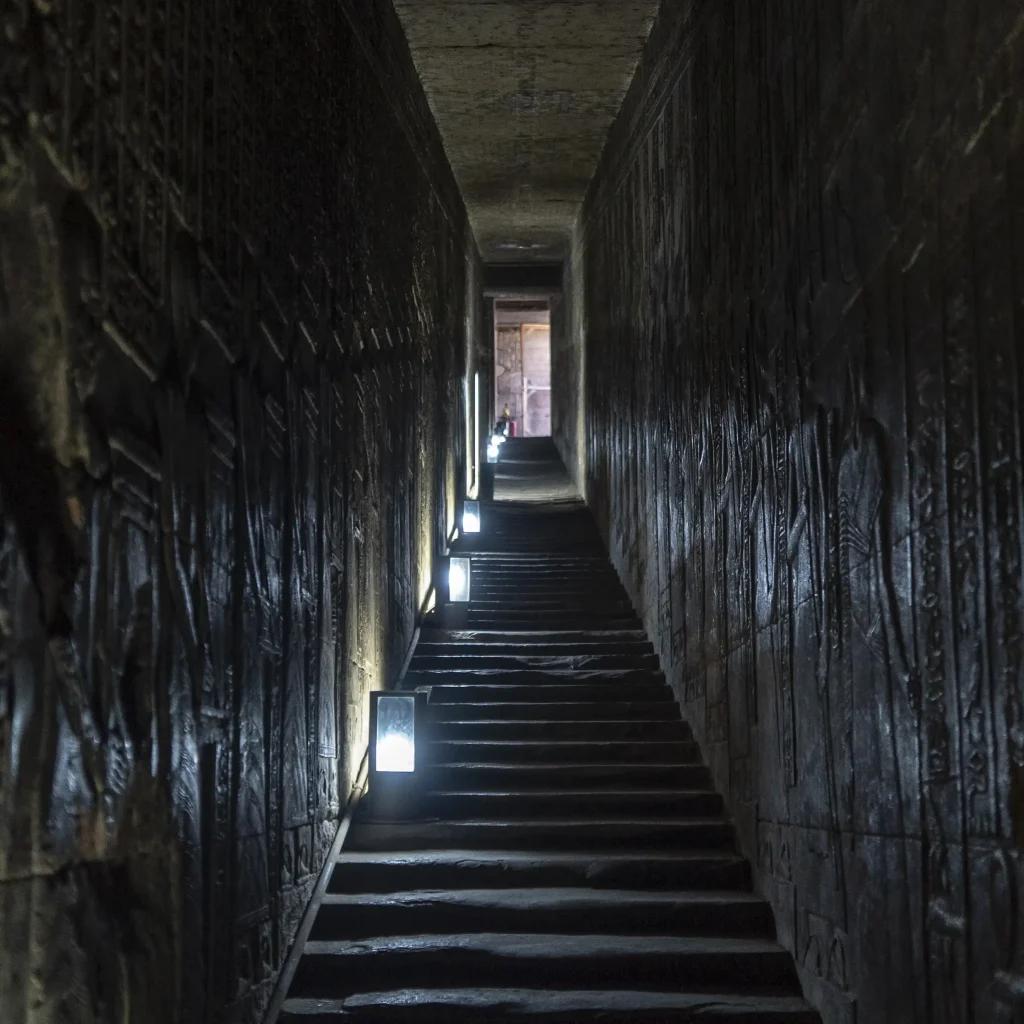
The roof of the Temple of Hathor contains chapels associated with Osiris and religious ceremonies. Ancient stairways connect the main temple with these elevated spaces, and their walls are decorated with processions of priests carrying sacred images and ritual objects.
The artwork shows how temple ceremonies could involve movement between different architectural areas. The rooftop chapels also help explain the original setting of the Dendera Zodiac, a link between architecture, decoration, and ceremonial activity.
Beyond the main temple
What Else Can You See at the Dendera Temple Complex?
Dendera is more than a single temple building. The wider archaeological complex includes structures from different stages of its religious history, among them birth houses, commonly called mammisi, and a sacred lake. Birth houses were associated with the celebration of divine birth and the renewal of kingship, while the lake formed part of the temple’s ritual environment and was associated with purification practices.
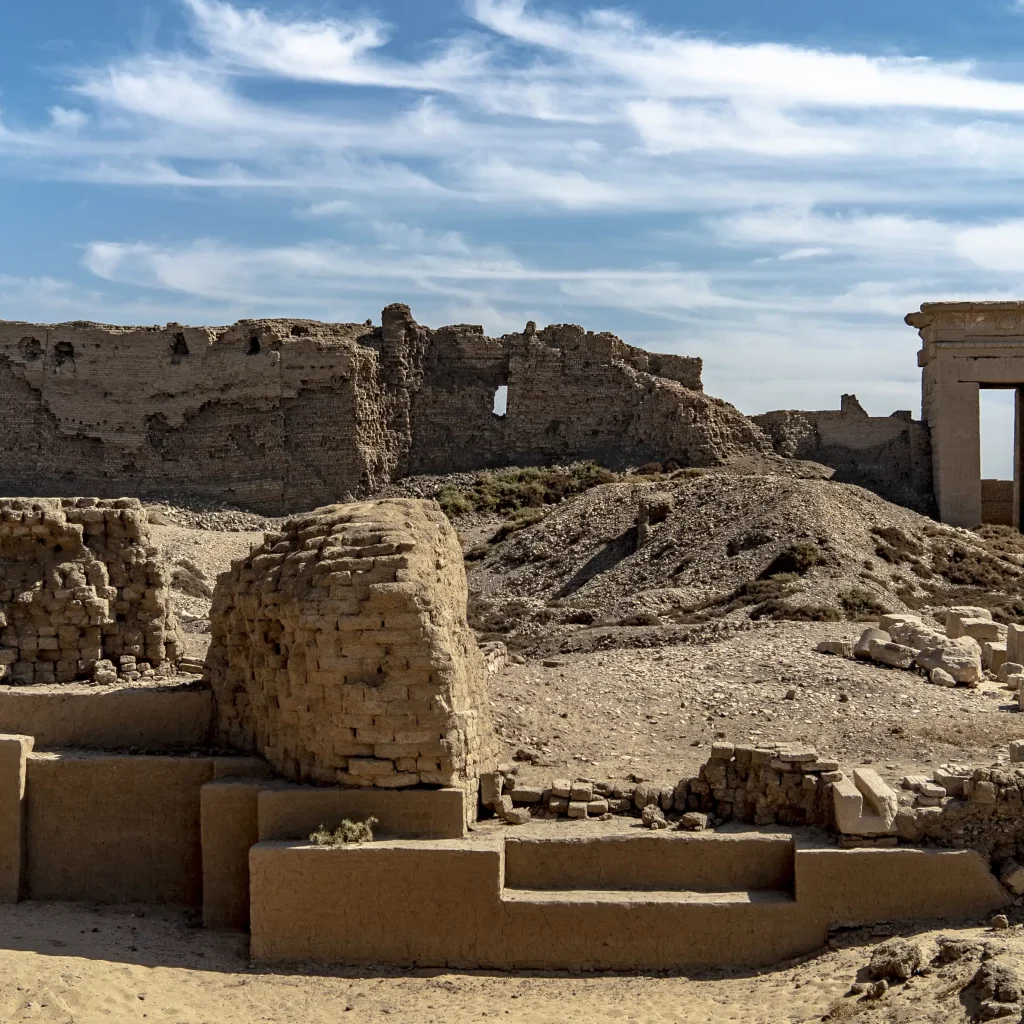
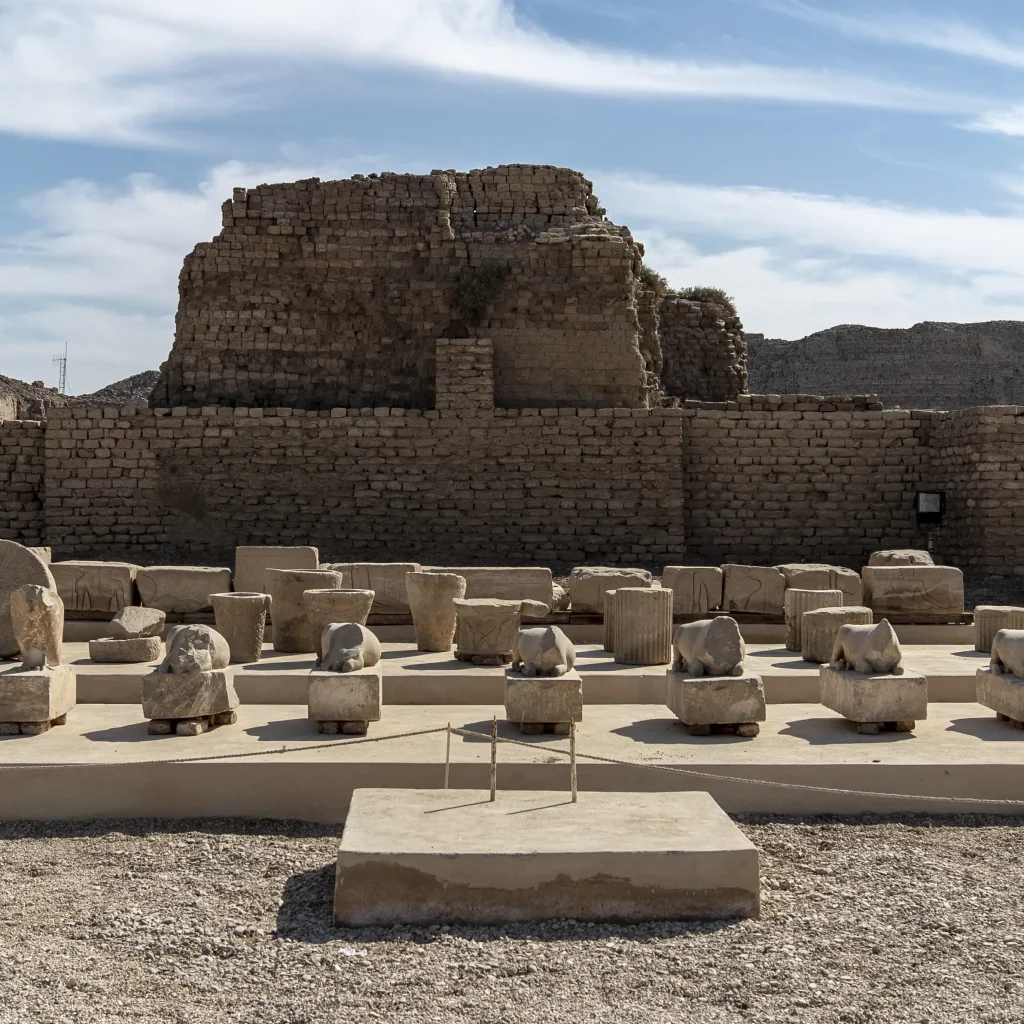
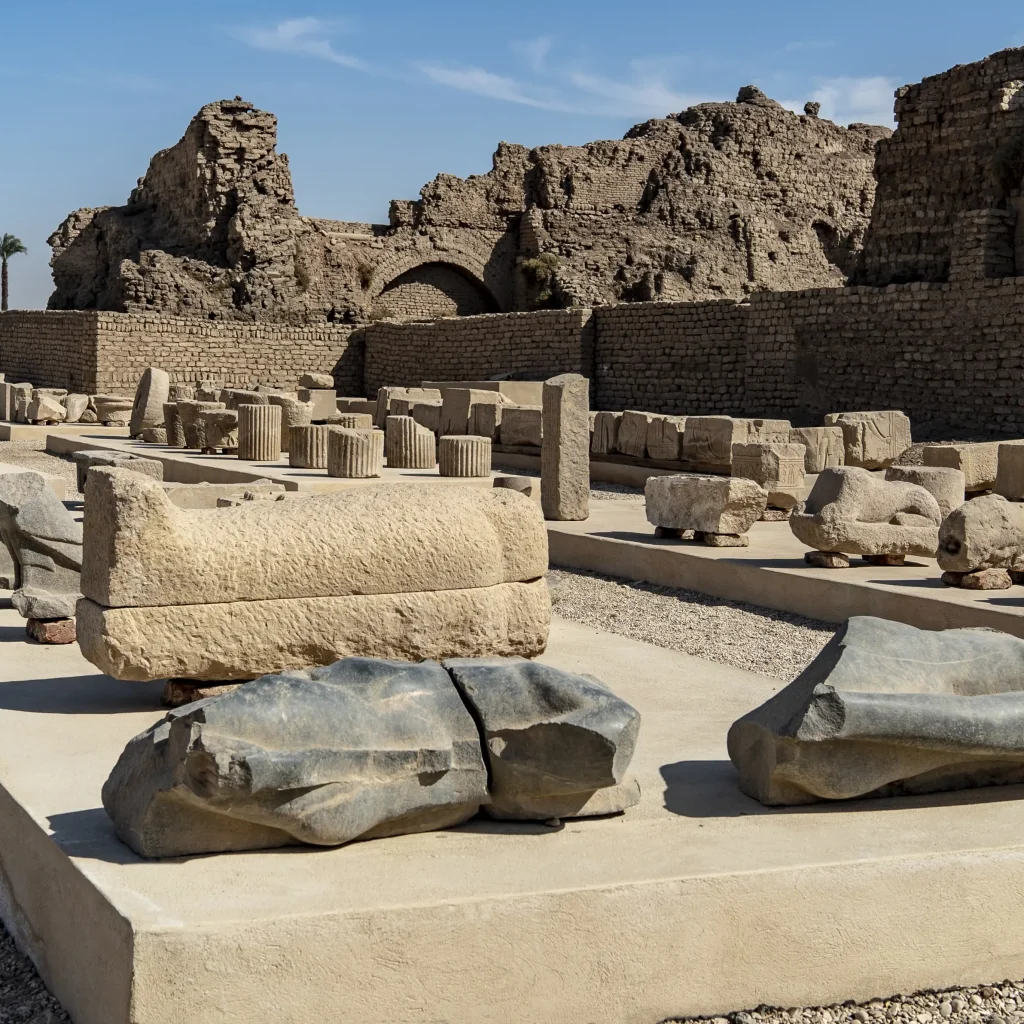
The presence of buildings constructed during different historical periods shows that Dendera remained a significant sacred site over an extended period.
Plan your day
How to Visit the Temple of Hathor from Luxor
Most international travelers visit Dendera while staying in Luxor. A private guided tour lets you focus on the temple without organising separate transportation and admission arrangements. Egypt Luxury Trips currently offers two ways to experience it.
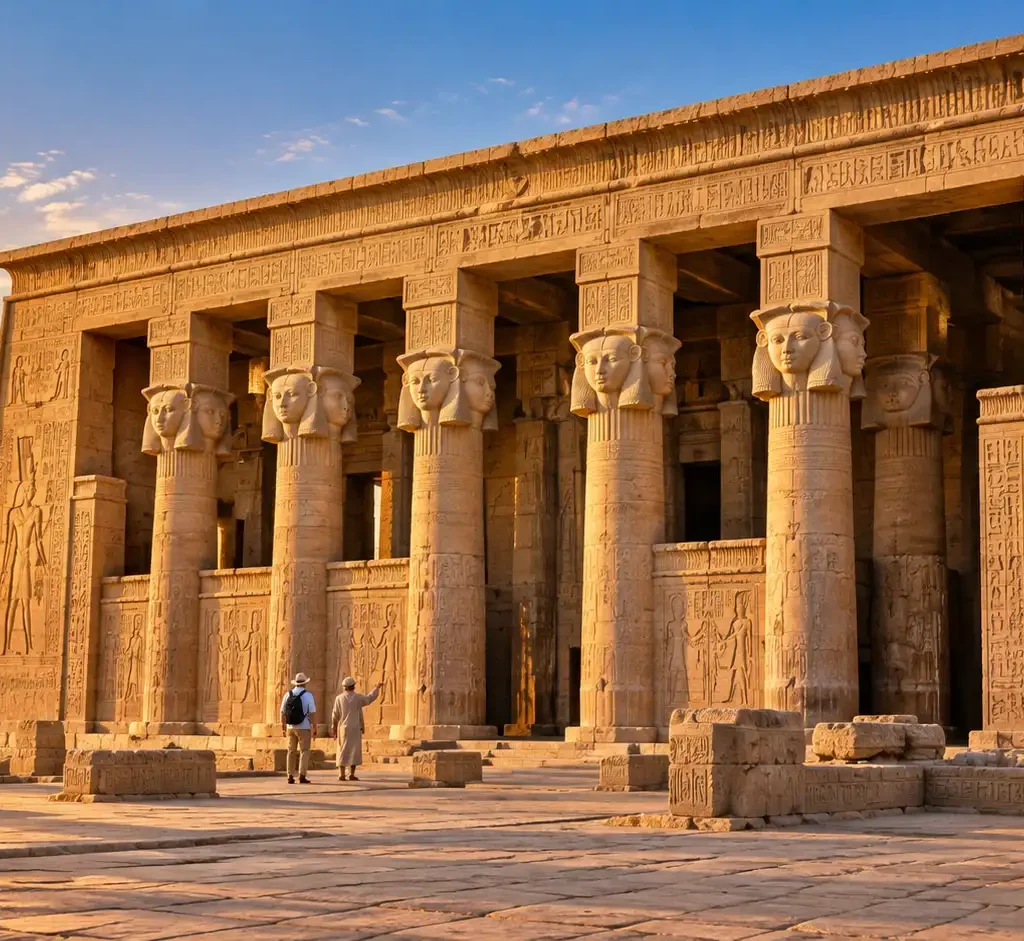
Dendera Temple Half-Day Tour from Luxor
Designed for travelers who want to concentrate on the Temple of Hathor. The itinerary covers the great columned hall, restored astronomical ceiling, sanctuary and other principal features, with crypts and rooftop areas visited when regulations permit.
About 5 hours · Private air-conditioned transport · Egyptologist guide · Bottled water
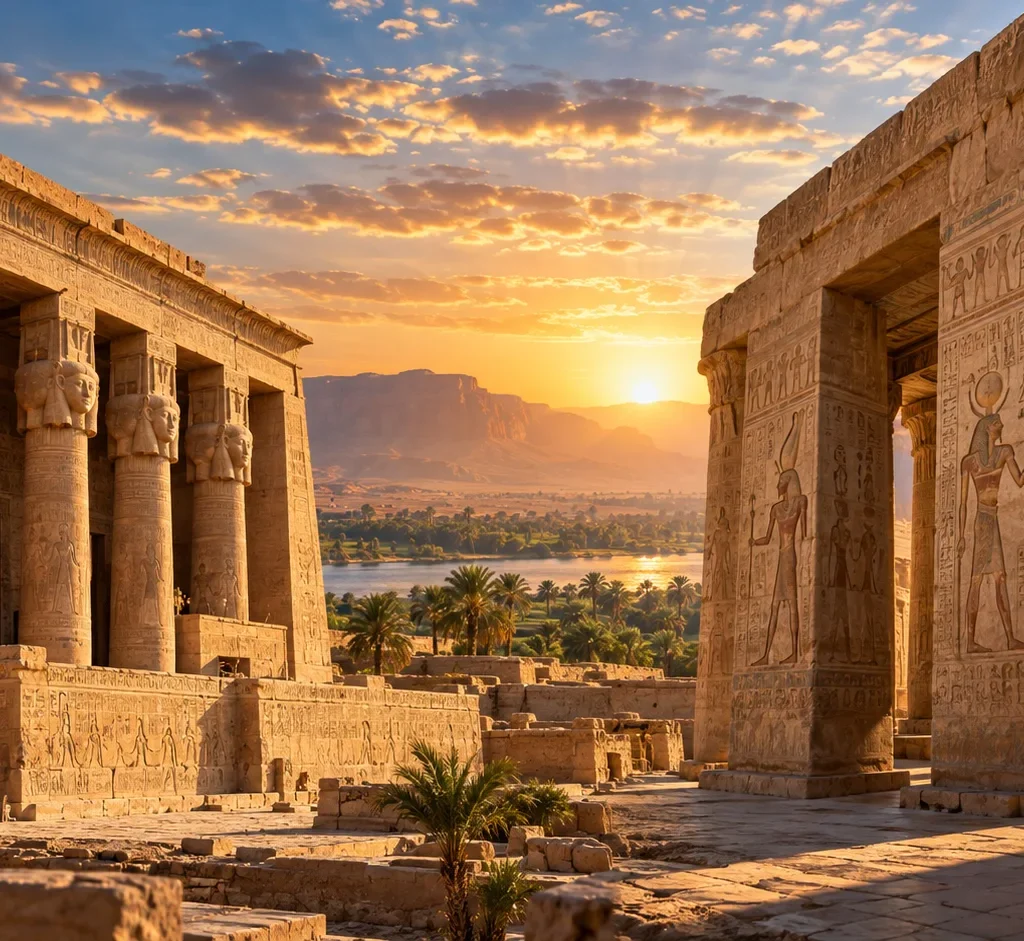
Dendera and Abydos Day Tour from Luxor
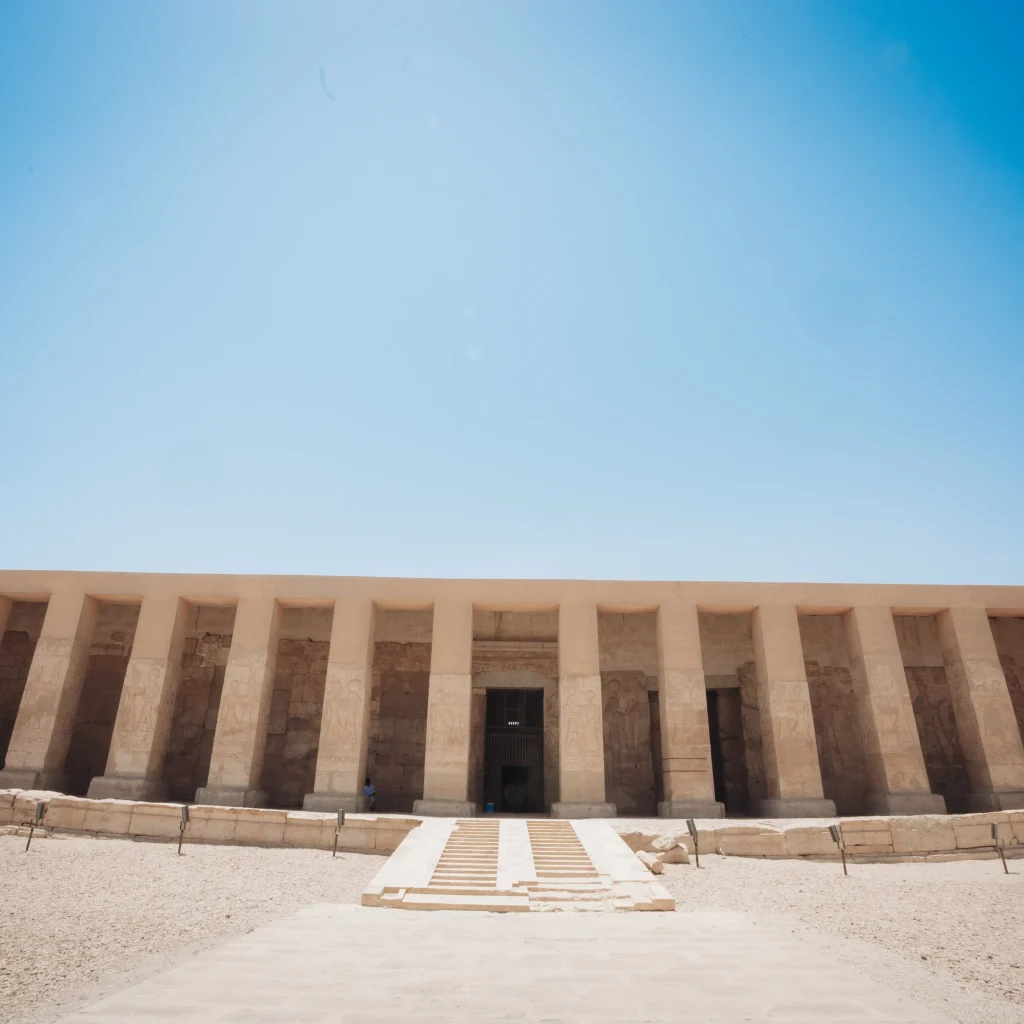
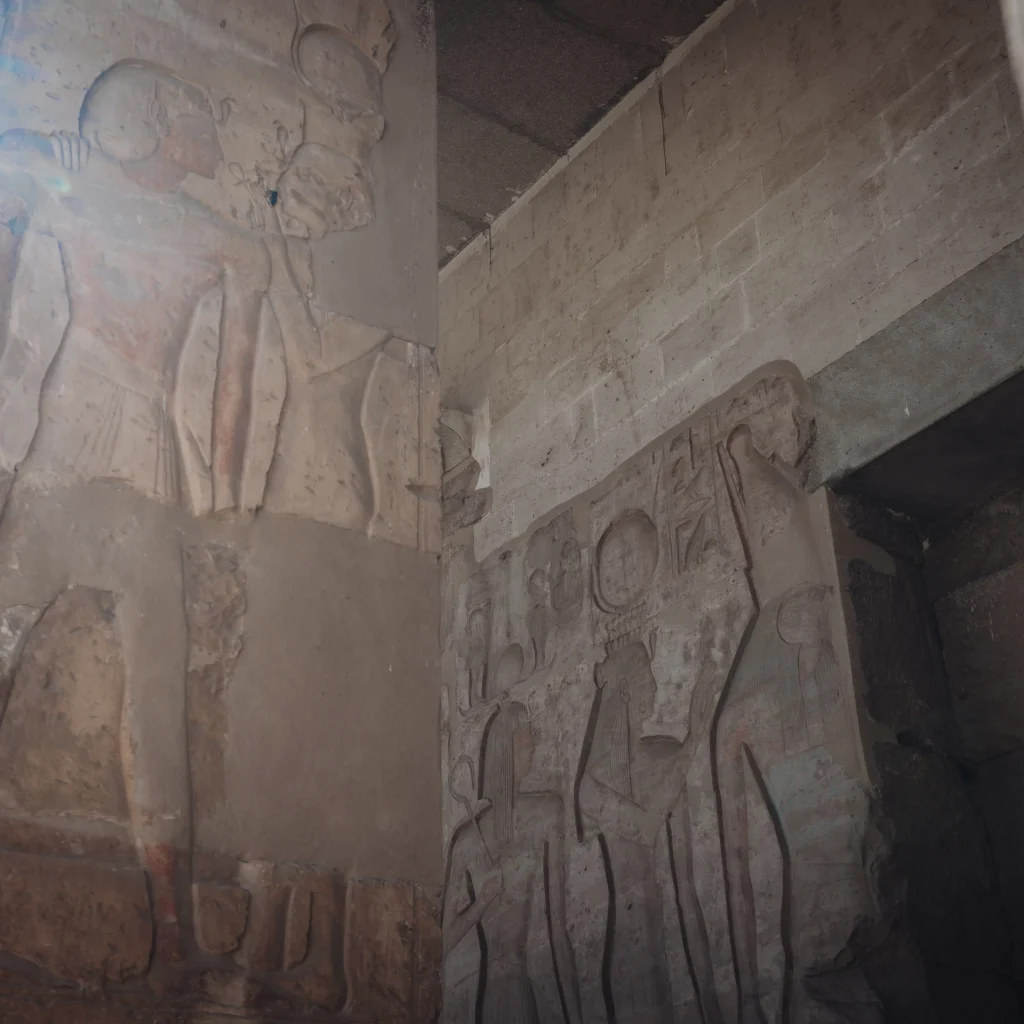
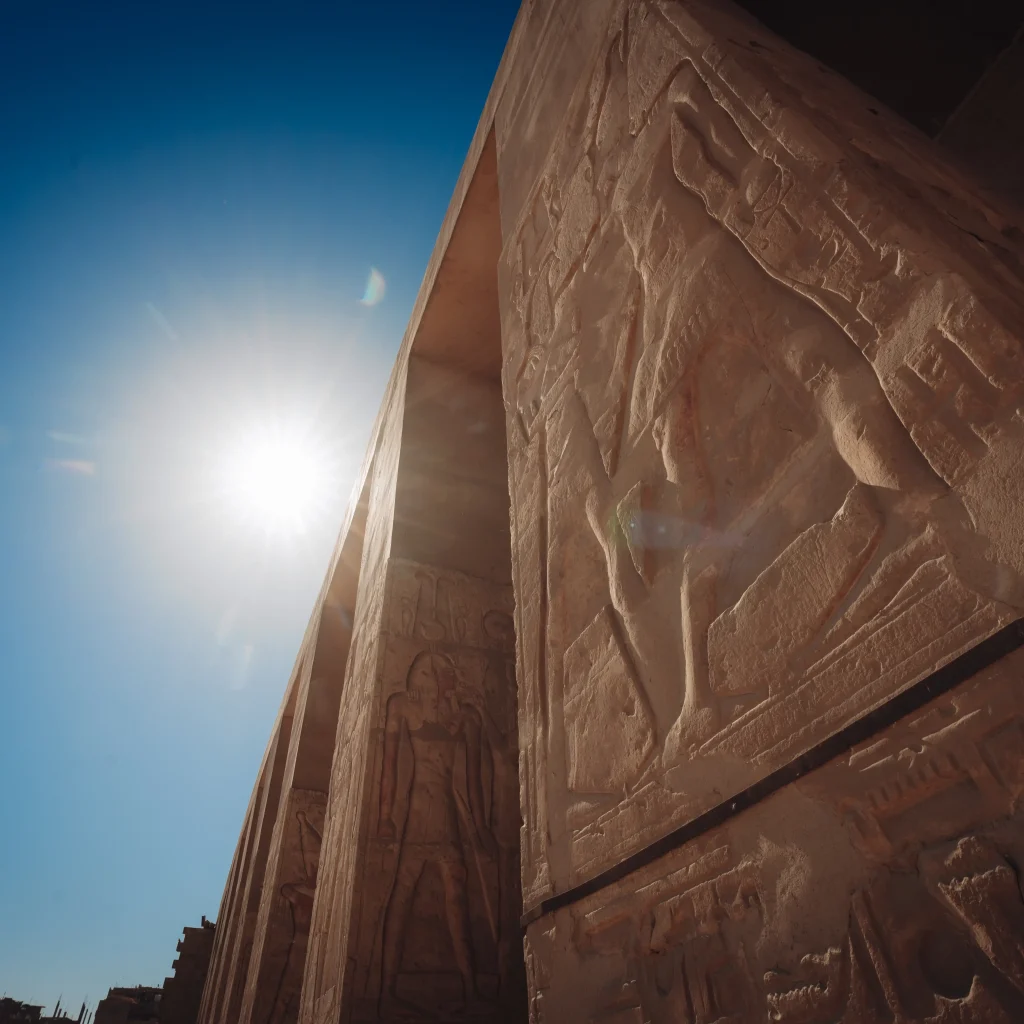
A broader archaeological day that combines the Temple of Hathor with the Temple of Seti I at Abydos, celebrated for its religious reliefs, parallel sanctuaries and the famous Abydos King List.
About 10 hours · Private transport · English-speaking Egyptologist · Both entrance fees
Curious about the second stop? Read our guide to Dendera and Abydos temples from Luxor to see how the two sites fit together in one private day.
Comparing the Two Tours
| Feature | Dendera Half-Day Tour | Dendera & Abydos Tour |
|---|---|---|
| Approximate duration | 5 hours | 10 hours |
| Departure | Luxor | Luxor |
| Temple of Hathor | Yes | Yes |
| Temple of Seti I | No | Yes |
| Private transport | Yes | Yes |
| Egyptologist guide | Yes | Yes |
| Entrance fees | Included | Included |
| Meals | Excluded | Excluded |
The right option depends on how much time you have and whether you want to focus on a single temple or visit two major religious sites in one day.
Know before you go
Temple of Hathor Opening Hours and Ticket Prices
The Egyptian Ministry of Tourism and Antiquities publishes admission information for the Dendera Temple Complex. Opening hours are 7:00 AM to 5:00 PM. Foreign visitor ticket prices are listed below.
Adult ticket
EGP 300
Student ticket
EGP 150
Temple panorama
EGP 100
Crypt (serdab)
EGP 100
Published official prices checked in October 2026. Please confirm updated rates and access rules before visiting. These figures relate to site admission rather than the total cost of a privately guided excursion.
Timing
Best Time to Visit the Temple of Hathor
The cooler months, particularly from October to April, are generally more comfortable for sightseeing in Upper Egypt. Summer temperatures can be very high, so an early start is especially helpful during warmer periods.
Although the temple contains covered areas, you will also spend time in exposed courtyards, so pack for the sun:
- Comfortable walking footwear
- Drinking water and sun protection
- A camera or smartphone for photographs
- A light layer for cool, shaded crypts
Anyone with limited mobility should ask about accessibility before booking, particularly if interested in narrow crypt passages or rooftop stairways.
Two great temples
Temple of Hathor vs Temple of Horus at Edfu
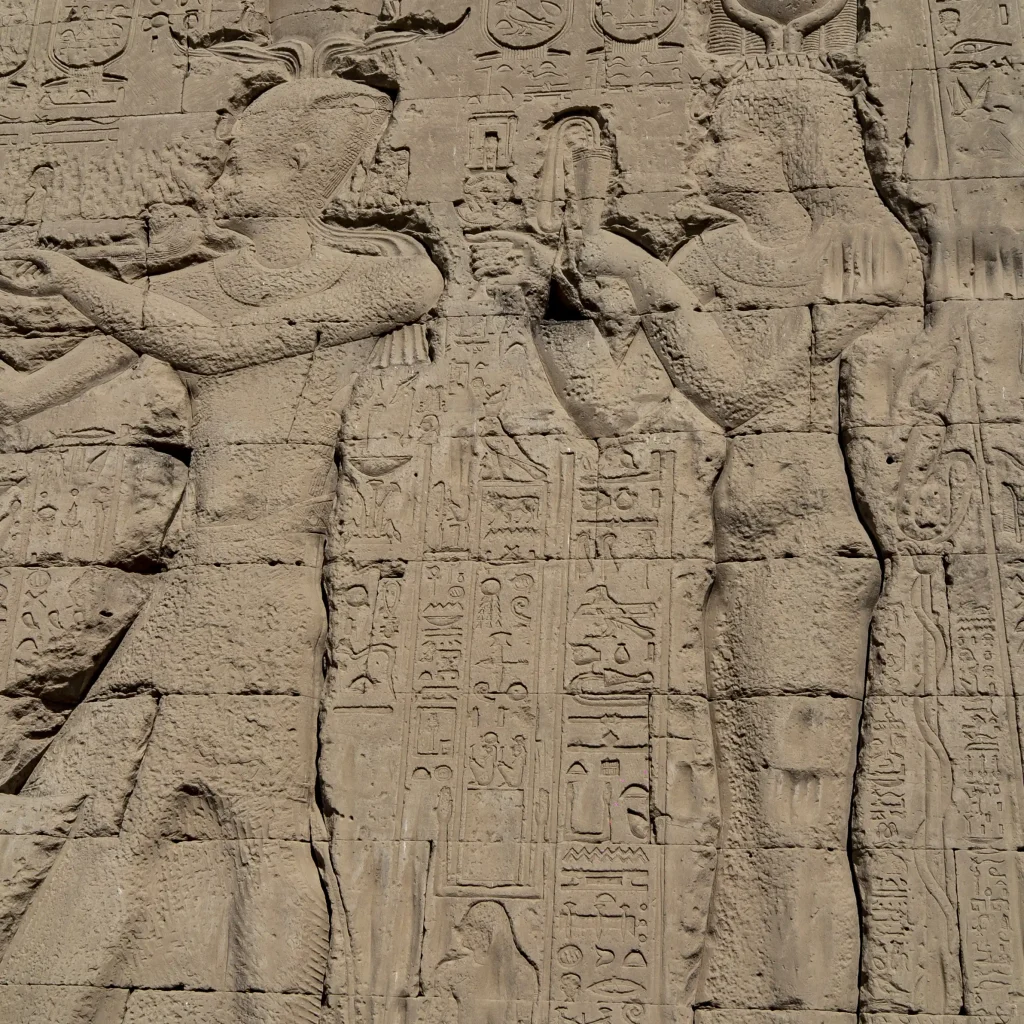
Dendera and Edfu are among Upper Egypt’s most significant surviving temple sites. Both belong to the late phases of ancient Egyptian temple building, but they have distinct religious identities.
| Temple of Hathor at Dendera | Temple of Horus at Edfu |
|---|---|
| Dedicated to Hathor | Dedicated to Horus |
| Located near Qena | Located at Edfu |
| Famous for astronomical ceilings | Famous for its monumental entrance pylon |
| Contains decorated crypts and rooftop chapels | Known for extensive ritual inscriptions and reliefs |
| Common excursion from Luxor | Commonly visited during Luxor–Aswan travel |
The religious traditions of both temples were connected through the ceremonial relationship between Hathor and Horus. Visiting both shows how ancient Egyptian religious ideas could be shared between temples while keeping distinctive local traditions. Travelling south? Our Edfu and Kom Ombo temples tour from Luxor or a Nile cruise from Luxor to Aswan brings Edfu into your journey.
Build the perfect stay
Combine Dendera with More of Luxor
Karnak and Luxor Temples
The East Bank giants, led by a private Egyptologist. Explore →
Valley of the Kings
Royal tombs and Hatshepsut’s terraced temple on the West Bank. Explore →
Full-Day Luxor Tour
East and West Banks in one unhurried private day. Explore →
Luxor Temple Tours
Browse every temple experience we run from Luxor. Explore →
Loved by travelers
What Travelers Say About Egypt Luxury Trips
Our private tours are reviewed by the guests who take them. Here is what recent travelers have shared on Tripadvisor.


Quick answers
Frequently Asked Questions About the Temple of Hathor
What is the Temple of Hathor?
The Temple of Hathor is the principal surviving temple at Dendera in Upper Egypt. It was dedicated to the goddess Hathor and is particularly famous for its monumental columns, astronomical decorations, and richly carved chambers.
Where is the Temple of Hathor located?
It is located near Qena, north of Luxor, within the Dendera Temple Complex on the western side of the Nile Valley.
Who built the Temple of Hathor?
The standing temple was developed primarily during the Ptolemaic period, with subsequent decoration and additions under Roman rule. Evidence of earlier structures at the site extends back to the Old Kingdom.
What is special about the Temple of Hathor?
Its excellent state of preservation, Hathor-headed columns, astronomical ceiling, underground crypts, and association with the Dendera Zodiac make it particularly important.
Where is the original Dendera Zodiac?
The original circular relief is preserved in the Louvre Museum in Paris. It was removed from the temple in 1821.
What is the Dendera Light?
It is a famous relief in the temple showing an elongated form and a serpent. Egyptologists read it as religious symbolism linked to Harsomtus, creation, and rebirth rather than as an ancient electric lamp.
Can you visit the underground crypts?
Some crypts can be visited when access is permitted. Additional fees or restrictions may apply, so it is best to confirm on the day with your guide.
Can you visit Dendera Temple from Luxor?
Yes. Dendera is a common excursion from Luxor, and private half-day tours are available, such as our Dendera Temple half-day tour from Luxor.
How much does it cost to visit the Temple of Hathor?
The official published standard admission rate for foreign adults is EGP 300, with separate listed charges for certain additional areas such as the panorama and the crypt. Guided tour prices depend on the operator and included services.
How long should you spend at the Temple of Hathor?
The visit length depends on your interests and access arrangements. Our complete private half-day excursion from Luxor is listed as approximately five hours, including travel.
What is the best time to visit the Temple of Hathor?
The cooler months from October to April are generally the most comfortable, and an early start helps during warmer periods.
Is the Temple of Hathor worth visiting?
Dendera is especially worthwhile for travelers interested in Egyptian mythology, astronomical art, architectural preservation, and religious history. Its surviving enclosed spaces offer an experience distinct from many other Egyptian temples.
In conclusion
Conclusion: Why the Temple of Hathor Is Worth Discovering
The Temple of Hathor at Dendera is an exceptional place to understand the relationship between ancient Egyptian architecture, religion, and astronomy. Its enormous Hathor-headed columns, intricate astronomical ceilings, underground chambers, and rooftop chapels reveal a religious world shaped by ritual, symbolism, and centuries of tradition, and its survival shows how Egyptian practice continued through the Ptolemaic and Roman periods.
Whether you visit independently or with a guide, Dendera rewards those who take the time to look beyond its impressive façade and understand the ideas preserved within its walls.
Let’s design your Egypt
Walk through the Temple of Hathor with a knowledgeable private Egyptologist. Your custom itinerary is one conversation away.
Private consultation
Plan Your Dendera Visit with Egypt Luxury Trips
Tell us your dates, group size and interests, and we will reply with a tailored private itinerary.